[Asia Economy Reporter Seomideum] The Jogye Order of Korean Buddhism announced on the 21st that a Taegeukgi, presumed to have been painted during the Japanese colonial period, was discovered in a Buddhist painting stored at Seonwonsa Temple in Namwon-si, Jeonbuk. This is the first time a Taegeukgi has been found in a Buddhist painting, and experts interpret it as part of the anti-Japanese movement.
The Taegeukgi in the Buddhist painting was found in the ‘Jijangsiwangdo’ located in the Myeongbujeon Hall of Seonwonsa Temple. It was drawn in a trapezoidal shape on the headgear of one of the characters in the painting. It was discovered in October during a prayer by Ven. Unmun, the head monk of Seonunsa Temple, but due to its small size?8.3 cm wide and 4 cm tall?it had gone unnoticed until now.
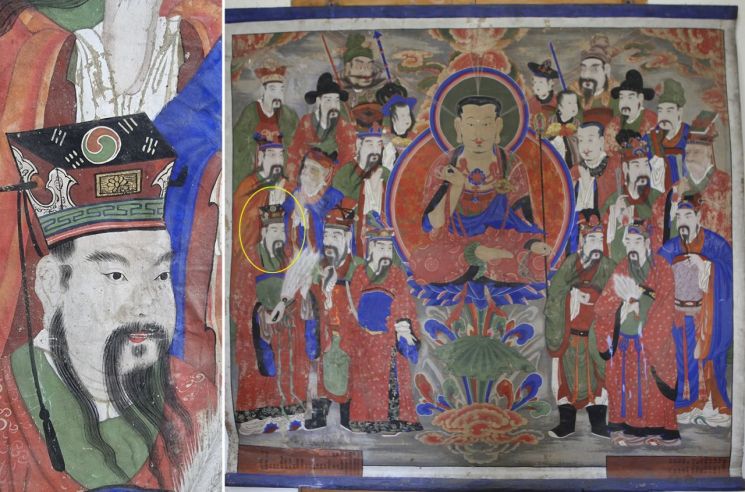 The character (marked with a yellow circle) in the Buddhist painting "Jijangsiwangdo" located in the Myeongbujeon of Seonwonsa Temple in Namwon-si, Jeollabuk-do, has a Taegukgi (Korean national flag) painted on its official hat. The left photo is a close-up of the character with the Taegukgi on its hat.
 [Photo by the Jogye Order of Korean Buddhism] [Image source=Yonhap News]
The creation period is estimated to be during the Japanese colonial era. Kim Chang-gyun, a member of the Jogye Order’s Cultural Heritage Preservation Committee, stated that based on the inscription under the painting reading ‘Taisho 6’ (1917), the painting was started on November 5, 1917, and completed on the 17th of the same month. Additionally, it was said that the then head monk, Ven. Giseon, produced the painting with certification from Ven. Jin-eung, who is known to have interacted with independence activist Han Yong-un and held anti-Japanese views.
Song Myung-ho, a former expert member of the Cultural Heritage Administration’s Modern Cultural Heritage Division who has extensively studied the Taegeukgi, said, “This is the first time a Taegeukgi has been found in a Buddhist painting,” and estimated that it was created as part of the anti-Japanese movement. It is believed that the Taegeukgi was drawn despite the risks, expressing a wish for independence. In fact, Japan had banned the display of the Taegeukgi since 1912.
The character on which the Taegeukgi is painted is presumed to be King Byeonseong. King Byeonseong presides over the hell of Dosanjigok, where those who harm others with a sword suffer the same pain. Regarding this, former expert Song speculated that Ven. Jin-eung’s consciousness, that ‘the Japanese imperialists deserve to be judged and suffer in Dosanjigok,’ was reflected in the painting.
Seonwonsa Temple plans to pursue registration of this Buddhist painting as a modern cultural heritage asset.
© The Asia Business Daily(www.asiae.co.kr). All rights reserved.
![Clutching a Stolen Dior Bag, Saying "I Hate Being Poor but Real"... The Grotesque Con of a "Human Knockoff" [Slate]](https://cwcontent.asiae.co.kr/asiaresize/183/2026021902243444107_1771435474.jpg)
















