Domestic Research Results "Minimal Increase in Tritium Concentration"
Impact on Marine Ecosystem Not Included in Study
[Asia Economy Reporter Yoon Seul-gi] As the Japanese government plans to discharge contaminated water from Fukushima starting in March, raising safety concerns, a study has found that the tritium (hydrogen-3) concentration in domestic waters 10 years after the discharge will increase by about one hundred-thousandth compared to the current level. This means there will be no sudden increase in tritium concentration due to the contaminated water discharge, but it is difficult to conclude from this study alone that there will be no negative impact on the marine ecosystem in the future.
On the 16th, researchers from the Korea Institute of Ocean Science and Technology (KIOST) and the Korea Atomic Energy Research Institute (KAERI) presented the "Simulation Results of Fukushima Contaminated Water Marine Dispersion" at the Korean Society of Disaster Prevention conference held at the Ramada Hotel in Jeju. This simulation was conducted under the assumption that Japan will discharge contaminated water containing up to 22 T㏃ (tera becquerels; becquerel is a unit of radioactivity) of tritium annually for 10 years.
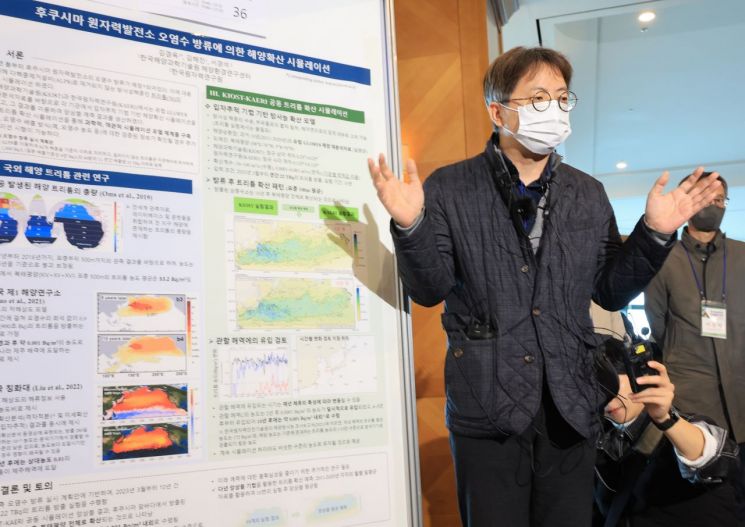 On the morning of the 16th, at the Ramada Plaza Jeju Hotel in Jeju City, Kim Kyung-ok, a senior researcher at the Marine Environment Research Center of the Korea Institute of Ocean Science and Technology, presented the research results on "Simulation of Marine Dispersion Due to the Discharge of Contaminated Water from the Fukushima Nuclear Power Plant" at the academic conference of the Korean Society of Disaster Prevention. Photo by Yonhap News
Tritium is the radioactive substance that has become the biggest issue in the contaminated water discharge. The Japanese government claims the contaminated water is "treated water" diluted to 1/40th and safe, but it is known that tritium, a radioactive substance, is not removed even after treatment with the Advanced Liquid Processing System (ALPS).
The study results showed that 10 years after the contaminated water discharge, the tritium concentration in Korean waters will increase by about one hundred-thousandth compared to the current level. According to the joint research team's simulation, tritium at 0.0001 Bq (becquerels)/㎥ will temporarily flow into Korean waters starting two years later, and full-scale inflow will begin around 4 to 5 years later.
After 10 years, tritium inflow will be around 0.001 Bq/㎥. This is about one hundred-thousandth of the average tritium concentration of 172 Bq/㎥ in domestic waters as of 2021, a concentration too low to be detected with current analytical instruments.
However, it cannot be definitively stated that there will be no impact on the overall marine ecosystem. The joint research team explained that this study analyzed tritium concentration, and the actual impact on the marine ecosystem should be clarified through future research.
There is also concern that the study was conducted based on data disclosed by the Japanese government. Previously, experts have expressed doubts about the reliability of data shared by Tokyo Electric Power Company (TEPCO) of Japan.
At a symposium held last month by the Democratic Party of Korea's Fukushima Contaminated Water Marine Discharge Response Team, Professor Dalnoki Veress Pereng from the Middlebury Institute of International Studies in the United States pointed out that Japan tested only 9 out of 64 radioactive nuclides in the contaminated water and did not collect data samples during an excessively long gap period.
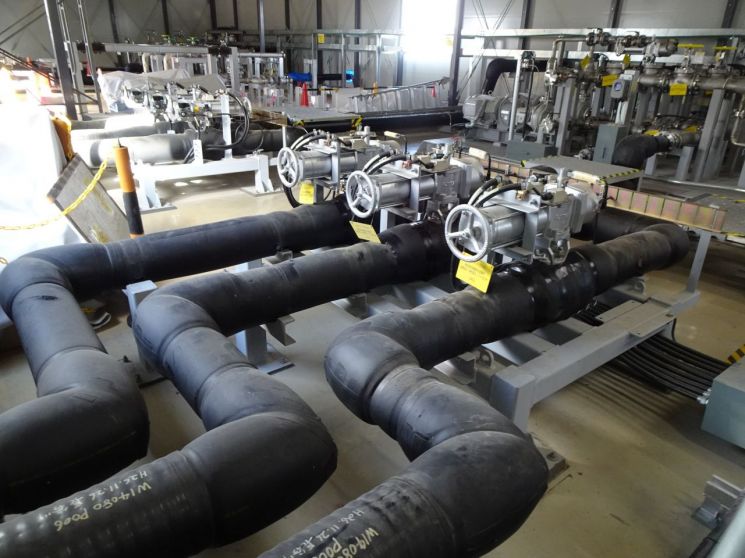
Meanwhile, the Japanese government plans to discharge contaminated water for the next 30 years starting as early as March, as there is no more storage space for the contaminated water. Currently, TEPCO is storing 1.3 million tons of contaminated water purified by ALPS in 1,066 contaminated water tanks located within the nuclear power plant site.
© The Asia Business Daily(www.asiae.co.kr). All rights reserved.
![Clutching a Stolen Dior Bag, Saying "I Hate Being Poor but Real"... The Grotesque Con of a "Human Knockoff" [Slate]](https://cwcontent.asiae.co.kr/asiaresize/183/2026021902243444107_1771435474.jpg)
















