Gangnam Severance Hospital Professor Kang Jeong-hyun's Team
Develops 'Albumin-Muscle Fat Index'
Lower Values Associated with Reduced 5-Year Survival Rate
[Asia Economy Reporter Lee Gwan-joo] A new biomarker capable of predicting the prognosis of colorectal cancer patients has been proposed by a domestic research team. The lower the levels of albumin and myosteatosis index, which are protein components in the blood, the higher the mortality rate of colorectal cancer patients.

Professor Kang Jeong-hyun's team from the Department of Colorectal Surgery at Yonsei University Gangnam Severance Hospital announced on the 16th that they published a paper presenting a new prognostic factor for colorectal cancer called the 'Albumin-Myosteatosis Index (AMG)'.
During the progression of colorectal cancer, inflammatory responses caused by the cancer secrete cytokines, which are immune regulatory factors. These cytokines induce myosteatosis, the accumulation of fat in muscles, or affect albumin production in the liver. Therefore, myosteatosis and albumin levels have been discussed as prognostic factors for colorectal cancer. However, there was no arithmetic index that reflected both factors simultaneously to assess prognosis.
The research team devised a new index, AMG, which simultaneously reflects serum albumin (g/dL) and skeletal muscle radiation density (SMD). To prove the effectiveness of this index, a study was conducted on 906 patients who underwent surgery for stage 1 to 3 colorectal cancer at Gangnam Severance Hospital from July 2006 to February 2014 and for whom evaluations of myosteatosis and albumin were available.
The team calculated the AMG for each patient and divided males and females into four groups based on the values. Males were divided using thresholds of 158.6, 189.9, and 218.5, while females were divided using 138.4, 174.0, and 200.5. Then, the groups were combined into four groups, G1 to G4, and the prognosis of patients in each group was analyzed.
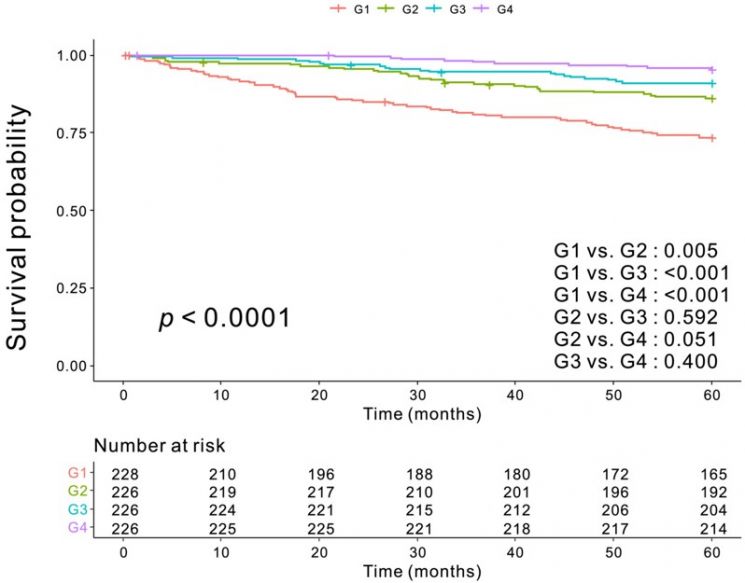 Graph of survival rate analysis according to AMG group classification devised by Professor Kang Jeong-hyun's team. The 5-year survival rate of the low AMG 'G1' group was statistically significantly lower than that of other groups. [Data provided by Gangnam Severance Hospital]
As a result, the 5-year survival rate of the group with the lowest AMG value, G1, was 73.4%, which was statistically significantly lower than that of the other groups. The survival rates for G2 and G3 were 86.2% and 91.1%, respectively, and the group with the highest AMG value, G4, had the highest 5-year survival rate at 95.5% (P<0.0001).
Professor Kang Jeong-hyun said, "This study confirmed the usefulness of AMG as a new index to predict the prognosis of colorectal cancer patients," adding, "AMG can be used as a new prognostic biomarker reflecting the risk of cachexia and nutritional status in colorectal cancer patients." He further stated, "Measuring AMG before surgery to predict patient prognosis will help decide whether to administer chemotherapy after surgery and allow flexible adjustment of follow-up timing."
This study was published in the internationally renowned gerontology journal 'J Cachexia Sarcopenia Muscle (IF=12.063)'.
© The Asia Business Daily(www.asiae.co.kr). All rights reserved.
![Clutching a Stolen Dior Bag, Saying "I Hate Being Poor but Real"... The Grotesque Con of a "Human Knockoff" [Slate]](https://cwcontent.asiae.co.kr/asiaresize/183/2026021902243444107_1771435474.jpg)
















