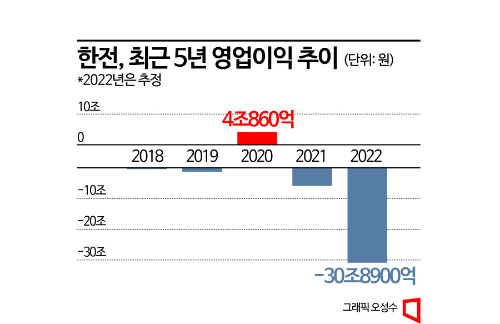
[Asia Economy Sejong=Reporter Dongwoo Lee] As the number of 'high-income earners' with annual salaries exceeding 100 million won rapidly increases at Korea Electric Power Corporation (KEPCO) and Korea Gas Corporation (KOGAS), two key domestic energy public enterprises, criticism over the chronic issue of inefficient management in public institutions has become unavoidable. This is because the proportion of employees earning over 100 million won has significantly increased despite the combined operating losses of KEPCO and KOGAS approaching 40 trillion won (including unpaid receivables) last year. In particular, while ordinary citizens are tightening their belts to cope with the increased household burden caused by the 'heating bill bomb' this winter, there are concerns that a 'high-income salary feast' is creating social deprivation and discord.
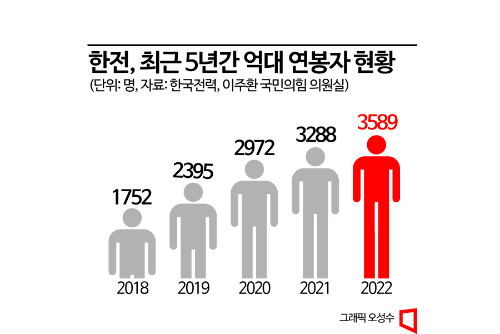
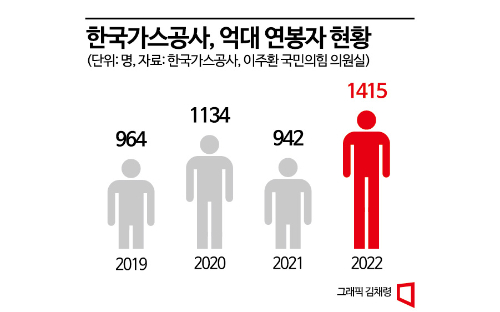
On the 15th, Asia Economy analyzed the 'Annual Profitability and Welfare Status of KEPCO and KOGAS' obtained through the office of Lee Joo-hwan, a member of the People Power Party. The analysis showed that last year, a total of 5,004 employees from the two companies earned annual salaries exceeding 100 million won. The combined total number of employees at the two companies was 27,689 as of last year, meaning that on average, one out of every 5.5 employees earns more than 100 million won annually. This accounts for 18.0% of all employees at the two companies, an increase of 2.6 percentage points from 15.4% in 2021.
Profits Are 'Ours', Losses Are 'The People's'
The steady increase in high-income earners at these two representative energy public enterprises is attributed to a wage system centered on seniority-based pay scales, where salaries rise according to years of service regardless of job performance. Employees with longer tenure naturally have a higher chance of earning over 100 million won, regardless of the difficulty, value, or capability related to their duties. It is known that KOGAS saw a significant increase in senior employees who were included among high-income earners last year by receiving performance bonuses amounting to 106% of their base salary. This indicates that a considerable number of employees are already close to earning over 100 million won based on their base salary alone.
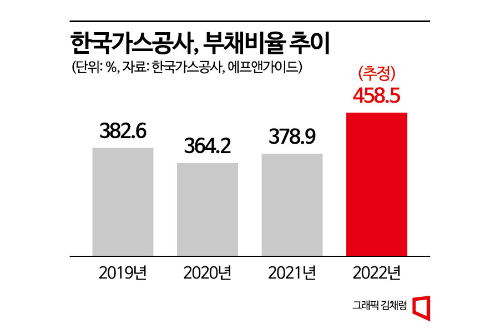
The problem became evident last year when the two companies recorded record losses due to the surge in international energy prices. While KOGAS's unpaid receivables (losses) increased from 200 billion won in 2020 to 9 trillion won by the end of 2022, the average annual salary per employee rose by 5.9%, from 88.33 million won to 93.57 million won. An industry insider said, "Because the base salary is relatively high, even if the proportion of performance bonuses is not large, the actual amount received by senior employees is substantial, which increases the burden of labor costs."
While the benefits go to internal employees, the losses are entirely borne by the public. Last year, the government raised electricity rates by 29.5% and city gas rates by 36.2% compared to the previous year. In KEPCO's case, to cover the estimated operating deficit of 30.8 trillion won last year, the Ministry of Trade, Industry and Energy is reviewing a plan to increase electricity rates by an additional 51.6 won per kWh this year. This is 2.7 times the increase of 19.3 won per kWh implemented last year. KOGAS is also discussing with relevant authorities a plan to raise rates by at least 8.4 won per MJ starting from the second quarter of this year, believing it can recover all unpaid receivables by 2027. Ultimately, this means shifting the burden of massive losses onto the public.
Moral Hazard Caused by Lack of Competition
Experts attribute the fundamental reason for the increase in high-income earners at public institutions despite tens of trillions in deficits to the absence of competition. In particular, the de facto monopoly structure of energy public enterprises is said to cause 'moral hazard.' Professor Cho Dong-geun of Myongji University's Department of Economics criticized, "In general private companies, high salaries are paid as compensation for exposure to uncertainty, reflecting market principles. The increase in high-income earners at public institutions lacking competition means they are seeking monopoly rents to monopolize the benefits."
The government's recent attempt to introduce a job-based pay system instead of the seniority-based pay system in public institutions also means shifting the existing seniority-heavy wage system to a job-centered one by differentiating pay according to job difficulty. This provides grounds to adjust the wages of high-salary workers under the seniority system based on performance. The Ministry of Economy and Finance has encouraged the adoption of job-based pay systems in public institutions, but as of 2021, only 35 out of 350 public institutions (10%) have participated. The majority still prefer the high-wage system based on seniority.
The success of the government's plan to reduce the workforce in public institutions is also uncertain. The Ministry of Trade, Industry and Energy plans to gradually reduce about 4,100 employees across 41 affiliated public institutions, but in reality, it relies on natural attrition as artificial restructuring is difficult. In KEPCO's case, despite a target to reduce 2.1% (496 employees) of the total workforce, the number of employees actually increased by 275 last year due to new hires. An energy industry insider expressed concern, saying, "As long as the justification remains that the public can bear the responsibility for massive deficits because these are public institutions, the cycle of inefficient management will only become more entrenched."
© The Asia Business Daily(www.asiae.co.kr). All rights reserved.
![Clutching a Stolen Dior Bag, Saying "I Hate Being Poor but Real"... The Grotesque Con of a "Human Knockoff" [Slate]](https://cwcontent.asiae.co.kr/asiaresize/183/2026021902243444107_1771435474.jpg)

















