Pet Registration System Inadequate... Registration Rate Below 50%
Ongoing Issues with Standardization of Veterinary Care
"Mandatory Issuance of Medical Records and Standardization of Treatment Fees Urgently Needed"

[Asia Economy Reporter Minwoo Lee] Although pet adoptions are increasing, the pet insurance subscription rate remains low at less than 1%. It is pointed out that information asymmetry among insurance companies, pet owners, and veterinary hospitals is hindering market activation. In particular, it is analyzed that the difficulty in standardizing medical fees makes it hard for insurers to manage loss ratios, leading to growing consumer dissatisfaction.
On the 12th, the Korea Insurance Research Institute pointed this out in its report titled "Current Status and Challenges of the Pet Insurance Market."
Insurance Penetration Rate at 0.8%... Far Below Advanced Countries
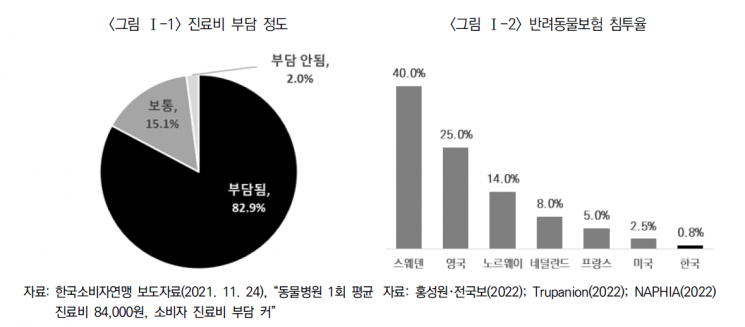
First, the domestic pet insurance market is still in its early stages. According to the 2020 population census, the number of households raising pets in Korea is estimated at 3.13 million, about 15% of total households. As pets age and the level of medical services improves, the medical expenses burden on pet-owning households is increasing. However, as of October last year, the number of pet insurance subscribers in Korea was about 55,000, only 0.8% of the 7.2 million pet owners. The number of insurance contracts was 61,000, resulting in a penetration rate of 0.8% compared to the total number of pets. This is significantly lower than Sweden (40.0%), the United Kingdom (25.0%), and the United States (2.5%).
The government is also making efforts to grow the market considering this. "Pet insurance activation" has even been included as a national policy task. Since the "one company, one license" policy was relaxed in November last year, not only non-life insurers but also life insurers have been able to launch pet insurance. As a result, the number of companies offering pet insurance increased from 3 in 2017 to 11 as of this year.
Nevertheless, market growth remains sluggish. Risk management is difficult for insurers, and products are not differentiated by company, with limited coverage. The cost burden is also high. Premiums typically range from 40,000 to 50,000 KRW per month, and can be as high as 80,000 to 90,000 KRW.
Registration Rate and Medical Fee Standardization Still 'Opaque'
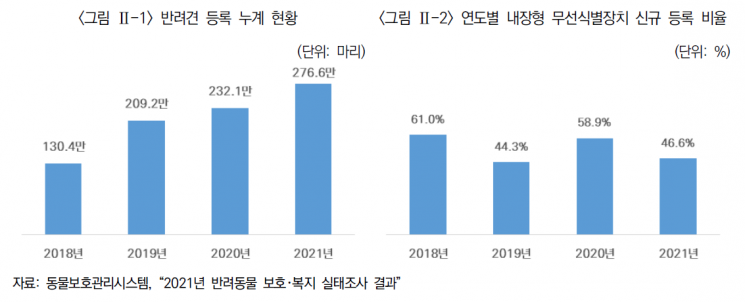
The biggest problem is "standardization." Standardization at the pet owner level is inadequate. The registration rate of embedded RFID chips, which can be used to identify the pet and determine its age at the time of subscription, remains stagnant at around 50%. The proportion of newly registered dogs with embedded chips, which cannot be artificially manipulated, dropped by more than 10 percentage points from 58.9% in 2020 to 46.6% in 2021. Moreover, cats are not subject to mandatory registration. Only 0.7% of the total 2.25 million pet cats are registered.
There are also institutional loopholes. Kyungseon Kim, a research fellow at the Korea Insurance Research Institute, pointed out, "Management of reports on lost or deceased registered pets is insufficient, and changes to animal breed, date of birth, etc., are allowed solely at the request of pet owners."
Standardization of veterinary medical fees is also a problem. Disease names and procedure codes are not standardized, resulting in large variations in medical fees between hospitals. Veterinarians are not obligated to issue medical records, making medical fee information highly asymmetric. Researcher Kim criticized, "Even for the same disease, different veterinary hospitals use different disease names and procedure codes, making it difficult to prepare quality statistics. The medical fee system is non-standardized and opaque, making fee prediction difficult and causing large fee differences between hospitals. This limits insurers' ability to calculate premiums, set compensation limits, and develop new products."
The current Veterinary Service Act does not include related provisions. There are no clauses regarding the viewing or issuance of medical records containing detailed medical information, resulting in low accessibility for pet owners to veterinary medical records and entrenching information asymmetry regarding medical fees.
Urgent Need for Veterinary Hospital Participation... Institutional Improvements Required
The physical infrastructure is already in place. In May 2019, the Korea Insurance Development Institute established the "Pet Animal Medical Claim System (POS)." It is possible for insurers to request transmission of veterinary medical records linked with electronic medical records (EMR) from veterinary hospitals. However, the system is still operated by having subscribers directly send paper receipts issued by veterinary hospitals. Paper receipts mostly lack detailed treatment information and only show card payment amounts, making accurate loss assessment difficult. There is also a possibility of excessive treatment and insurance leakage at veterinary hospitals.
Therefore, participation from veterinary hospitals is necessary but remains distant. Researcher Kim explained, "For claim computerization, participation of veterinary hospitals is essential, including the use of electronic charts and external provision of medical records. However, veterinarians resist claim computerization due to concerns about external judgment of treatment procedures and medical fee appropriateness."
Ultimately, institutional improvements at the government level are urgently needed. It is necessary to improve the pet registration system to increase registration rates and standardize the treatment system. Researcher Kim emphasized, "By amending the Veterinary Service Act and establishing standardized treatment terminology and procedures, veterinary hospitals should prepare and announce standardized classification systems, enabling consumers to compare and choose medical fees. Furthermore, after accumulating quality treatment statistics, it is necessary to consider introducing a standardized fee system."
© The Asia Business Daily(www.asiae.co.kr). All rights reserved.
![Clutching a Stolen Dior Bag, Saying "I Hate Being Poor but Real"... The Grotesque Con of a "Human Knockoff" [Slate]](https://cwcontent.asiae.co.kr/asiaresize/183/2026021902243444107_1771435474.jpg)

















