Lowest Ever Use of Renewal Rights Amid Reverse Jeonse Crisis
3 Out of 10 Cases Are Reduced Contracts
[Asia Economy Reporter Minyoung Kim] Mr. A, who is currently living in a jeonse (long-term deposit lease) worth 530 million KRW, has decided to ask the landlord to lower the jeonse deposit upon renewal as the contract is set to expire in March. This is because the recent jeonse market price for the same area in the same complex is around 340 million to 350 million KRW. Mr. A said, "The soaring interest on jeonse loans is also burdensome, so I want to sign a reduced contract, but if the landlord does not accept it, I am considering moving within the complex."
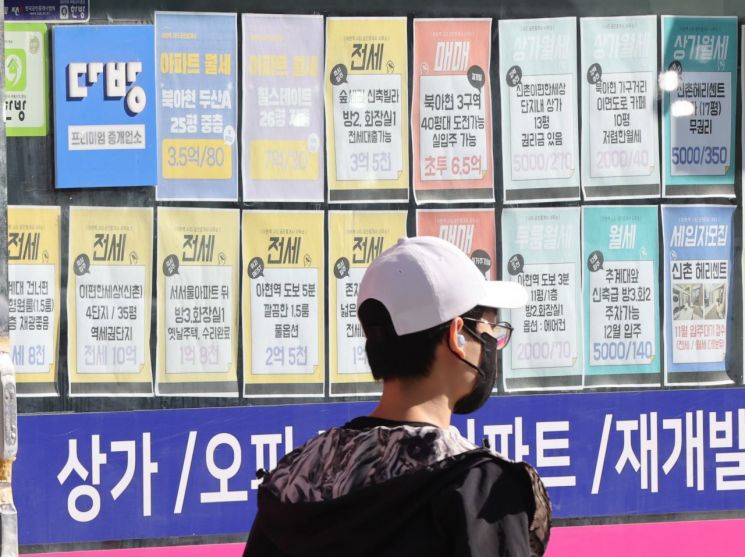
Recently, as jeonse prices have sharply declined, the number of renewal contracts with reduced previous jeonse or monthly rent amounts significantly increased at the end of last year. Cases using the renewal right, which limits the rent increase rate to a maximum of 5% upon renewal, also sharply decreased to about half compared to a year ago. This is believed to be because the continued decline in jeonse prices and tenants' preference for monthly rent have made it harder to attract tenants, resulting in fewer cases where landlords raise deposits by more than 5%.
According to an analysis of actual transaction data from the Ministry of Land, Infrastructure and Transport by real estate brokerage firm Jiptos on the 8th, in December last year, there were 1,481 contracts in the metropolitan area apartments where the renewal right was used and the rent was reduced compared to the previous contract. This is more than 19 times the 76 cases in the same month of the previous year. In other words, 3 out of 10 contracts (32%) using the renewal right were reduced contracts.
The renewal right was introduced after the amendment of the three lease laws in July 2020. It allows tenants to extend the contract once under the same terms even if the landlord does not want to renew. The lease period for contracts renewed using the renewal right is two years.
The number of tenants using the renewal right has also decreased. In December last year, the number of renewal contracts using the renewal right in the metropolitan area was 6,574, marking the lowest ever. This accounts for about 36% of all renewal contracts, a 47% decrease compared to the same month last year.
This is believed to be because it has become difficult to attract tenants amid the worsening reverse jeonse crisis and falling jeonse prices, leading to fewer tenants using the renewal right. According to the Korea Real Estate Board, the apartment jeonse price index, which was 104.4 in December 2021 (based on 100 in June 2021), fell to 95.3 in December last year, one year later. It can also be seen that renewals are being made through agreements between landlords and tenants considering recent jeonse market prices without necessarily using the renewal right.
The jeonse supply-demand index in the metropolitan area was 68.6 as of November last year, below the baseline of 100. A lower jeonse supply-demand index means that supply exceeds demand, indicating a tenant-favorable market.
Jin Tae-in, head of the apartment brokerage team at Jiptos, said, "With rising interest rates increasing loan burdens, tenants are looking for relatively cheaper properties," adding, "Landlords sometimes reduce jeonse prices or support tenants' loan interest."
© The Asia Business Daily(www.asiae.co.kr). All rights reserved.
![Clutching a Stolen Dior Bag, Saying "I Hate Being Poor but Real"... The Grotesque Con of a "Human Knockoff" [Slate]](https://cwcontent.asiae.co.kr/asiaresize/183/2026021902243444107_1771435474.jpg)















