2022 CSAT Gap Narrowed More Than 10.16 Points
Differences Vary Greatly Depending on CSAT Difficulty and Elective Subjects
[Asia Economy Reporter Yoo Byung-don] The dominance of repeat test-takers continued in the 2023 College Scholastic Ability Test (CSAT).
On the 8th, JinHakSa analyzed data from test-takers who entered their CSAT scores for the 2022 and 2023 academic years and confirmed that the average percentile score of graduates was about 10 points higher than that of current students. Considering that nearly half of the users of JinHakSa's regular admission service are graduates, the actual score gap is expected to be much larger.
Among the 447,669 candidates who took last year's CSAT, 308,284 were current students, accounting for 68.9%, falling short of 70%. The remaining 139,385 (31.1%) were graduates and those who passed the qualification exam, with the proportion of graduates alone estimated to be about 28%, similar to the CSAT registration status. This represents an increase compared to the 26.4% of graduates among CSAT registrants in the 2022 academic year, which was 26.2%.
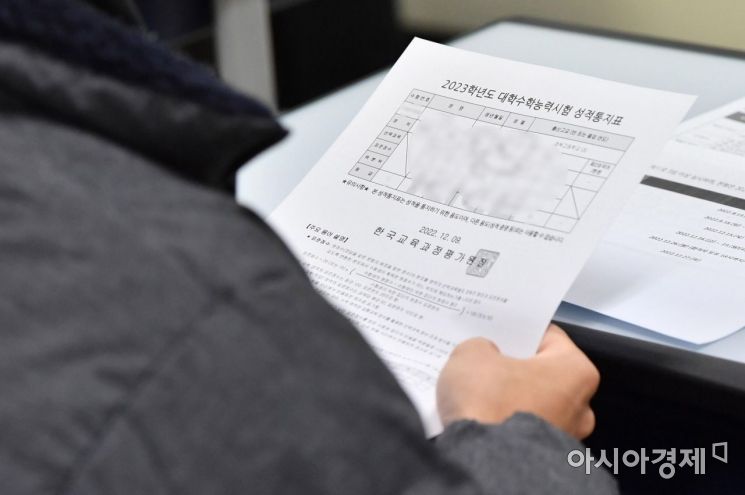 On the 9th, the day of distribution for the 2023 College Scholastic Ability Test (CSAT) score reports, a high school senior is looking at their CSAT score report at Gyeongbok High School in Jongno-gu, Seoul. Photo by Hyunmin Kim kimhyun81@
In the 2023 academic year, the difference slightly decreased compared to the previous year. The average percentile score for Korean, Math, and Inquiry subjects among 2023 graduates was 72.17 points, which was 9.68 points higher than the current students' average of 62.49 points, showing a slight decrease from the 10.16-point gap in the previous year. Both current students and graduates saw a decline in average percentile scores in 2023 compared to 2022, but the smaller decline among current students led to a reduced gap between the two groups.
In particular, the score gap between current students and graduates narrowed in the Korean and Math subjects. In 2022, the percentile difference in Korean between current students and graduates was 9.87 points, but it decreased to 8.16 points in 2023. This was due to an increase in the average percentile for current students (+32) and a decrease for graduates (-1.39), reducing the gap between the two groups. Similarly, in Math, the score gap narrowed from 10.03 points to 9.63 points. Both groups experienced score declines in 2023, but the decline was smaller for current students (-0.29) compared to graduates (-0.69), slightly reducing the gap.
The subject area where the gap widened in 2023 was Inquiry. While graduates' percentile dropped by 0.26 points, current students' percentile fell by 0.86 points, widening the gap from 9.87 points in 2022 to 10.47 points in 2023.
However, the reduced score gap between current students and graduates does not necessarily indicate a decline in graduates' academic ability. For example, the Korean subject was very difficult in 2022 but was relatively easier in 2023, weakening its discriminative power. In Math, score distribution varies depending on the chosen elective subjects, and more current students aiming for humanities fields are selecting Calculus. Therefore, the gap may narrow further this year.
Regarding the Inquiry subject, the increased score gap between current students and graduates is likely due to its high difficulty level. Particularly, the challenging social studies inquiry seemed to favor graduates somewhat.
Ultimately, factors such as CSAT difficulty and elective subject choices affect scores beyond academic ability. Nevertheless, the fact that the score gap between current students and graduates narrowed in last year's CSAT, which saw many top-tier students retaking the exam, is significant.
Woo Yeon-cheol, head of JinHakSa's Admission Strategy Research Institute, stated, "It is true that graduates who have studied longer tend to have higher CSAT scores, but current students should not be intimidated by the exam. The narrowing gap between current students and graduates in last year's CSAT, where the proportion of graduates increased significantly, carries important implications for students. Since major universities in Seoul now select about 40% of their students through regular admissions, I recommend that students prepare not only through school grades and activities but also by thoroughly preparing for the CSAT."
© The Asia Business Daily(www.asiae.co.kr). All rights reserved.
![Clutching a Stolen Dior Bag, Saying "I Hate Being Poor but Real"... The Grotesque Con of a "Human Knockoff" [Slate]](https://cwcontent.asiae.co.kr/asiaresize/183/2026021902243444107_1771435474.jpg)















