Reduction measures for unfair transport companies including Jiip specialized firms
New vehicle increase allowed for directly managed transport companies
Abolishment of Safe Freight System and introduction of Standard Freight System
[Asia Economy Reporter Minyoung Kim] The government’s “Transport Industry Normalization Plan” announced on the 6th includes not only the introduction of a standard freight rate system to replace the existing safe freight rate system but also improvements to the consignment system to resolve structural problems in Korea’s transport market and measures to improve the poor income of truck owners. Last year, when the Cargo Solidarity’s collective transport refusal incident caused damage amounting to 4.1 trillion won, the government decided to overhaul the truck transport market to prevent such incidents at their root.
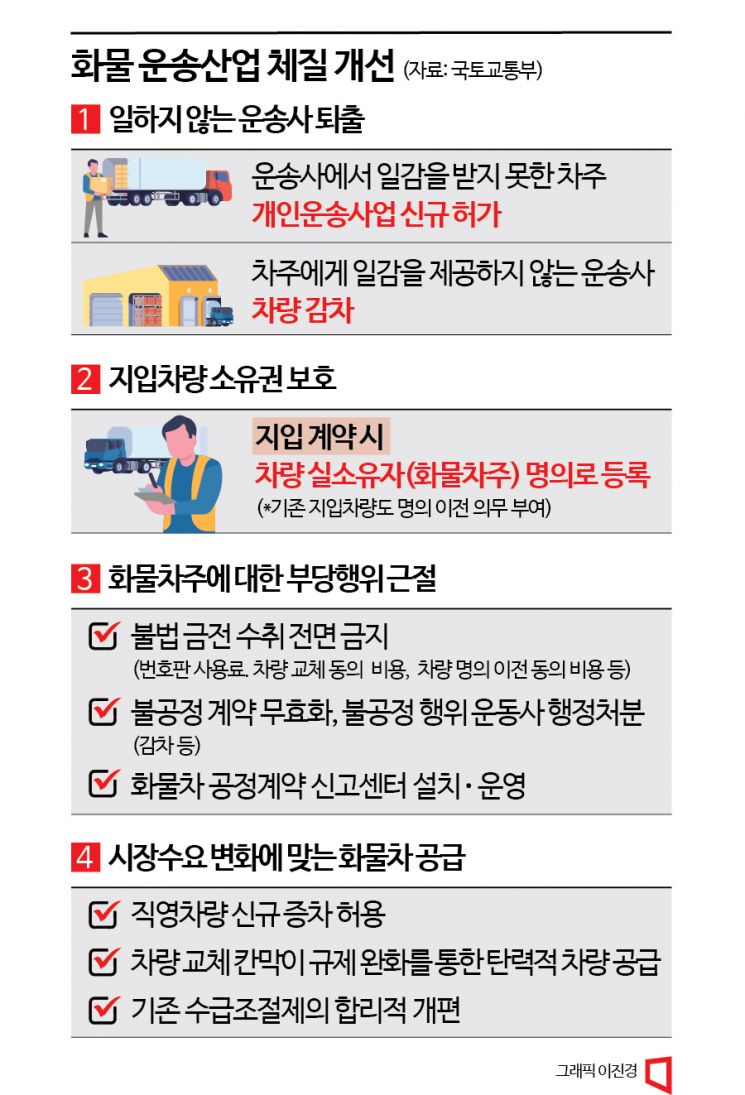
◆ Removal of transport companies that collect consignment fees without transporting = The government focused on reforming the safe freight rate system, which plays a dual role in the cargo transport market, and innovating the consignment system. It is estimated that there are up to 7,000 consignment-specialized companies that own dozens of commercial truck license plates and rent them to truck owners while charging fees for the entrustment contracts (license plate usage fees) and monthly consignment fees. Truck owners must purchase vehicles at their own expense and sign contracts with these companies in exchange for using the license plates. Accordingly, the government decided to remove transport companies and consignment-specialized companies that do not perform transport functions but only collect consignment fees.
In addition, management will be strengthened so that all transport companies without exception provide work and report transport performance, and truck owners will also be required to report their performance. In particular, the level of punishment for transport companies with no performance will be strengthened from business suspension to vehicle reduction. Currently, consignment contracts register vehicles under the name of the transport company, but this will be changed to register under the name of the actual owner, the consigned truck owner, and transport companies violating this will be subject to vehicle reduction penalties. This is to eliminate the license plate usage fees imposed on truck owners by registering vehicles under the transport company’s name. Until now, transport companies have typically demanded license plate usage fees close to 30 million won, vehicle replacement consent fees of about 8 million won, and name transfer consent fees of about 4 million won upon contract termination from truck owners.
Unfair monetary demands such as collecting license plate usage fees will be completely banned, and if detected, unfair contract cases will be specified, leading to contract invalidation and administrative sanctions such as vehicle reduction. Furthermore, new vehicle additions will be allowed regardless of vehicle type for directly managed vehicles where the transport company manages vehicles and drivers directly, and transport companies with a high proportion of direct management will be offered various benefits (incentives) such as priority entry into logistics complexes. Restrictions on replacement ranges by vehicle type and tonnage during large-scale vehicle replacement will be relaxed to induce flexible vehicle supply according to market demand changes. The supply-demand adjustment system, which has been in place for 20 years, will be reviewed for improvement.
◆ Removal of penalties for cargo owners... Freight rates linked to fuel prices = The safe freight rate system will be abolished and replaced by a standard freight rate system. The government plans to implement the standard freight rate system on a trial basis for three years until 2025, limited to containers and cement, and then decide on its continuation. Under the standard freight rate system, transport companies will be required to pay truck drivers a standard freight rate as before. However, if the driver’s income reaches an appropriate level, they will be excluded from the mandatory target.
The freight rates paid by cargo owners to transport operators will be given as “guidelines” but decided autonomously through negotiation. Although the obligation for cargo owners to pay transport companies is abolished, transport companies must pay truck owners at least the standard freight rate. The key point of the standard freight rate system is the removal of penalty provisions for cargo owners. For transport companies, instead of immediately imposing fines, corrective orders will be issued first, followed by gradually increasing fines of 1 million won and 2 million won. The amount of fines will also be reduced from 5 million won. The decision-making structure, which favored transport companies and truck owners, will be reorganized by increasing the number of public interest committee members from 4 to 6 and reducing the number of transport company and truck owner members from 3 to 2 each.
To improve the income uncertainty of truck owners vulnerable to fuel price fluctuations, a standard contract including a “freight rate-fuel price linkage system” will also be introduced. In addition, the obligation to submit regular Driving Time Recorder (DTG) data will be expanded to large trucks. To prevent truck traffic accidents, the current obligation to submit regular DTG data, which applies to hazardous material transport vehicles and route buses, will be extended to large tractors and trucks over 25 tons to actively monitor whether truck owners comply with rest times and driving habits. Based on monitoring results, a fine of 500,000 won will be imposed on truck owners who fail to comply with rest times. Furthermore, the responsibility of cargo owners and transport companies for overloading will be strengthened. The sanctions for overloading, which previously focused on truck owners, will be shifted to strengthen the responsibility of cargo owners and transport companies who requested overloading, and the responsibility of truck owners will be reduced when the responsibility of cargo owners and transport companies is clear.
The Ministry of Land, Infrastructure and Transport plans to revise the “Freight Motor Vehicle Transport Business Act” reflecting improvements to the consignment system and the standard freight rate system, and will also proceed with subsequent subordinate law revisions. Minister Won Hee-ryong of the Ministry of Land, Infrastructure and Transport said, “The practical improvement of truck owners’ treatment is the most important,” adding, “Along with improvements to the consignment system maintained since the 1960s, the introduction of a freight rate-fuel price linked standard contract that can secure stable income despite high oil prices will improve the poor wage levels.”
© The Asia Business Daily(www.asiae.co.kr). All rights reserved.
![Clutching a Stolen Dior Bag, Saying "I Hate Being Poor but Real"... The Grotesque Con of a "Human Knockoff" [Slate]](https://cwcontent.asiae.co.kr/asiaresize/183/2026021902243444107_1771435474.jpg)















