Cabinet Nominates Amamiya as Deputy Governor
Final Coordination of Personnel Including Deputy Governor
Key Architect of Current Monetary Policy Framework
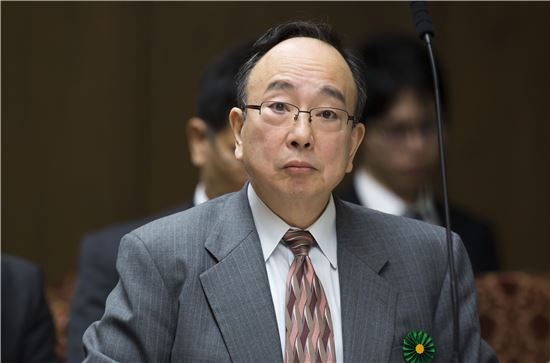
[Asia Economy Reporter Lee Ji-eun] The Japanese government has nominated Masayoshi Amamiya, the current Deputy Governor of the Bank of Japan (BOJ), as the next Governor of the BOJ, Nihon Keizai Shimbun reported on the 6th.
The outlet confirmed with multiple Japanese government and ruling party officials that the Kishida Fumio Cabinet has begun finalizing personnel arrangements to nominate Deputy Governor Amamiya as the BOJ Governor. The BOJ Governor’s term is five years, and the appointment requires the consent of both the House of Representatives and the House of Councillors.
Deputy Governor Amamiya was the key figure behind the Yield Curve Control (YCC) policy introduced shortly after Governor Kuroda Haruhiko took office. He has also been involved in Japan’s overall quantitative easing policies. As Deputy Governor, he assists the Governor as a member of the executive team and participates in monetary policy decisions as a member of the Policy Board.
Regarding monetary policy, many analysts view him as somewhat more dovish compared to former Deputy Governor Nakaso Hiroshi, who was also mentioned as a candidate. Accordingly, the market expects that if he is appointed as the next Governor, the current easing policy stance will be maintained while gradually lowering the intensity of the policy at a moderate pace.
Nihon Keizai stated, "If Deputy Governor Amamiya becomes Governor, it is expected that the YCC policy and negative interest rate policy will be reviewed for discontinuation in the near future," but added, "However, it is predicted that the radical easing policies will be scaled back to a normal level while maintaining an accommodative stance to support the economy."
The challenges facing the next Governor include responding to rapid inflation and resolving market distortions caused by prolonged accommodative monetary policies. Japan’s consumer price index in December last year rose 4.0% year-on-year, marking the largest increase since 1981. The policy of unlimited government bond purchases to maintain long-term interest rates at a certain level has exacerbated market distortions, with yields on 8- and 9-year government bonds surpassing those of 10-year bonds.
Nihon Keizai explained, "The next Governor will need persistence to implement easing policies on a different level from before, carefully reviewing their effects and side effects, and gradually adjusting policies. Rushing policy adjustments could significantly increase the risk of renewed deflationary pressures."
© The Asia Business Daily(www.asiae.co.kr). All rights reserved.
![Clutching a Stolen Dior Bag, Saying "I Hate Being Poor but Real"... The Grotesque Con of a "Human Knockoff" [Slate]](https://cwcontent.asiae.co.kr/asiaresize/183/2026021902243444107_1771435474.jpg)














