900 Billion KRW Export Support Budget Invested in First Half
Close Support for Top 10 Manufacturing Industries with 100 Trillion KRW Investment
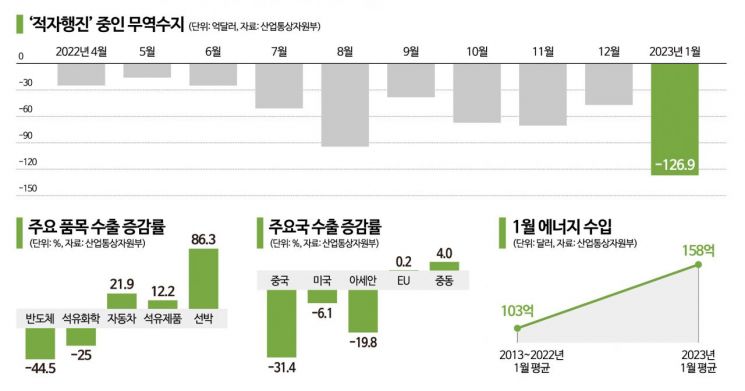
[Asia Economy Reporter Park Sun-mi] The government will inject 900 billion KRW in export support budgets in the first half of the year and closely support the top 10 manufacturing industries, including semiconductors, which are undertaking investments worth 100 trillion KRW this year. Amid the worst-ever trade deficit caused by a global economic slowdown, semiconductor industry downturn, and deteriorating export conditions to China, measures to consolidate export capabilities across all industries and support private investment were discussed.
On the 3rd, the Ministry of Trade, Industry and Energy announced export and investment support plans by manufacturing sector at the Emergency Economic Ministers' Meeting and Export Investment Countermeasures Meeting. To achieve the goal of realizing an 'export plus' with 680 billion USD in exports, two-thirds of the export marketing, certification, and logistics budget (about 900 billion KRW) will be concentrated in the first half of the year. A record-high 360 trillion KRW in trade finance will be supplied this year, and support will be provided to facilitate easy acquisition of overseas certifications, the first gateway for exports. Support for exhibitions, which can serve as a stepping stone for exports, will also be expanded from 624 companies in the first half of last year to 1,000 companies in the first half of this year, and new export vouchers will be provided to early-stage export companies.
Investment in three major areas?facilities, research and development (R&D), and foreign investment?will also be revitalized. In particular, a specialized complex for advanced strategic industries will be designated in June, and a win-win incentive system and permit timeout system will be introduced to expedite approvals. A total of 81 trillion KRW in policy finance will be supplied to support manufacturing facility and R&D investments.
Additionally, 5.6 trillion KRW will be invested in strategic R&D projects focused on securing super-gap technologies and carbon reduction technologies, and more than 30 billion USD in foreign investment will be attracted targeting 100 core companies in future industries.
Despite difficult investment conditions, as the top 10 manufacturing industries including semiconductors plan investments worth 100 trillion KRW this year, tailored support will be provided to maximize investment efficiency. The scale of domestic companies' investment plans this year includes 47 trillion KRW for semiconductors, 16 trillion KRW for automobiles, 14 trillion KRW for displays, 8 trillion KRW for batteries, 4.8 trillion KRW for steel, 4 trillion KRW for petrochemicals, and 2 trillion KRW for shipbuilding.
For semiconductors, the government will strengthen support for fabless (semiconductor design) and SoBuJang (materials, parts, and equipment). To this end, a preliminary feasibility study worth 1.5 trillion KRW will be promoted to secure three major system semiconductor technologies including power and automotive semiconductors and advanced packaging. One billion KRW in national funds will be provided for infrastructure in semiconductor specialized complexes, and fabless investments will be supported through a 300 billion KRW semiconductor fund and 530 billion KRW in policy finance.
The display sector, expected to see a slight increase in exports due to the expansion of the OLED market this year, will create three next-generation new markets including transparent, automotive, and ultra-small displays, and a 1 trillion KRW preliminary feasibility study will be promoted to secure inorganic light-emitting display technology. Related SoBuJang technologies will be designated as national strategic technologies under the Restriction of Special Taxation Act to expand investment tax credits, and 900 billion KRW in policy finance will be supported.
The battery sector will actively support companies' investment realization through policy funds amounting to 5.3 trillion KRW, which accounts for two-thirds of private investment, designation of advanced industry specialized complexes, and establishment of a battery academy. In the automotive sector, 1.4 trillion KRW will be supported for R&D including Level 4 autonomous driving commercialization technology until 2027. To resolve the shortage of ships for automobile exports, support will be provided for the use of container ships, and priority allocation of spare shipping capacity will be arranged through cooperation between shipowners and cargo owners.
Furthermore, to ensure shipbuilding companies do not face disruptions in production and exports, support for securing manpower will be provided, including a hiring subsidy of 600,000 KRW per month for six months when recruiting shipbuilding personnel. In addition, domestic visa issuance procedures will be shortened to one month, and support for foreign workforce introduction will be expanded by increasing the foreign workforce ratio from 20% to 30%.
For the steel industry, policy finance worth 3.6 trillion KRW will be supported focusing on eco-friendly facility investments while minimizing corporate burdens from new trade norms. Minister Lee Chang-yang said at the meeting, "We plan to support the consolidation of capabilities for export recovery while ensuring that facility and R&D investments continue in preparation for the economic recovery period." He added, "We will promptly prepare a comprehensive export plus plan that consolidates cross-ministerial export support capabilities and closely cooperate with the National Assembly to ensure the swift legislation of the temporary investment tax credit system and the increase of tax credits for national strategic technologies."
© The Asia Business Daily(www.asiae.co.kr). All rights reserved.
![Clutching a Stolen Dior Bag, Saying "I Hate Being Poor but Real"... The Grotesque Con of a "Human Knockoff" [Slate]](https://cwcontent.asiae.co.kr/asiaresize/183/2026021902243444107_1771435474.jpg)















