The Academy of Korean Studies: "Limiting to In-Person Ancestor Worship is Reasonable"
Sungkyunkwan Also Continues to Recommend "Simplifying Ancestral Rites Table"
A claim has been raised that holding ancestral rites for great-great-grandparents, whom one has never even met, was a custom that did not exist even during the Joseon Dynasty.
On the 2nd, the Korea Institute of Korean Studies stated, "In today's society where early marriage customs have disappeared, continuing the four-generation ancestral rites that include great-great-grandparents is anachronistic."
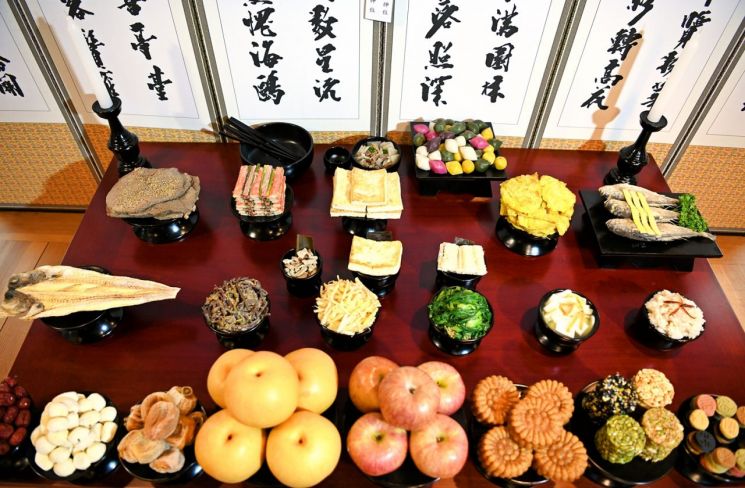
During the Joseon era, it was common for people to marry at a young age around 15 and for four generations, including great-great-grandparents, to live together.
Because of this, it was natural to hold ancestral rites for great-great-grandparents as part of the four-generation rites. However, it is explained that continuing rites or memorial services when one has rarely or never met or remembered the great-great-grandparents or great-grandparents is inappropriate.
Kim Mi-young, Research Planning Team Leader at the Humanities and Spiritual Training Institute of the Korea Institute of Korean Studies, said, "The more memories one has of ancestors, the different the emotional engagement with ancestral rites," adding, "Even in Gyeongbuk, a region with strong Confucian tendencies, cases of changing ancestral rites to include only up to great-grandparents or grandparents are gradually increasing."
She further emphasized, "Ancestral rites are a kind of memorial ceremony to confirm individual identity," and "Since emotional memories exchanged during the ancestors' lifetime deepen the memorial sentiment, it is a reasonable approach to limit the subjects of ancestral rites to 'ancestors one has met.'"
The four-generation rites were propagated by Confucian scholars who followed the Zhuzi Jia Li (a book recording daily etiquette by Zhu Xi, a Neo-Confucian scholar of the Song Dynasty in China).
Even in the Joseon Dynasty's caste society, the legal code Gyeongguk Daejeon stipulated that ancestral rites be held according to official rank, requiring those of the sixth rank or higher to hold rites up to great-grandparents.
The Korea Institute of Korean Studies added that nowhere in the Joseon era was the four-generation rites including great-great-grandparents explicitly established as a system.
Kim Mi-young has served as a cultural heritage commissioner in Gyeongbuk, Gyeongnam, and Daegu, researching family estates and ancestral rites culture.
Her major works include "Acceptance of Family Rites and Household Management of Joseon Sadaebu" and "Tradition and Symbolism of Confucian Rites."
Sungkyunkwan Also Recommends "Keep Memorial Rites Simple"
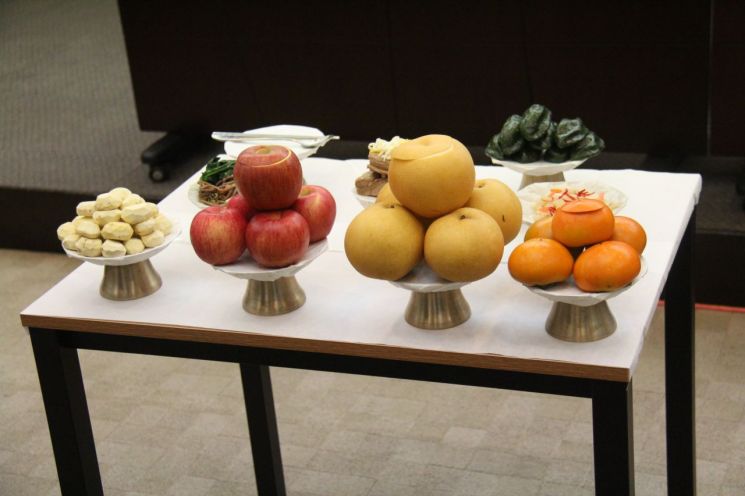 The Sungkyunkwan Ritual Establishment Committee announced the 'Simplification of Ancestral Rites' plan on September 5 last year at the Korea Press Center in Jung-gu, Seoul. The photo shows the ancestral rite table set with nine dishes according to the simplification plan.
 [Photo by Sungkyunkwan Ritual Establishment Committee]
Sungkyunkwan, which advocates for "Confucianism suited to the times," also recommended keeping memorial rites simple ahead of this year's Lunar New Year.
Sungkyunkwan presented a memorial table with nine types of food including rice cake soup (tteokguk), seasoned vegetables, grilled dishes, kimchi, alcohol (cups), and four kinds of fruit. The difference from the Chuseok memorial table is the preparation of rice cake soup instead of songpyeon.
Sungkyunkwan emphasized again the principle proposed before last year's Chuseok, stating, "Fried or pan-fried foods do not necessarily have to be placed on the memorial table. You can stop the hard work of making jeon (Korean pancakes) now."
Regarding the types of fruit placed on the memorial table, they explained, "There is no set rule; you can comfortably place 4 to 6 kinds."
They drew a line on expressions such as "Hongdong Baekseo (紅東白西 - placing red fruit on the east side and white fruit on the west side of the memorial table)" and "Joyul Ishi (棗栗梨枾 - jujube, chestnut, pear, persimmon)," stating these are not found in ritual literature.
When proposing simplification last year, the memorial table shown included chestnuts, apples, pears, and persimmons, but Sungkyunkwan officials emphasized that this was only an example and does not mean specific fruits must be prepared.
© The Asia Business Daily(www.asiae.co.kr). All rights reserved.
![Clutching a Stolen Dior Bag, Saying "I Hate Being Poor but Real"... The Grotesque Con of a "Human Knockoff" [Slate]](https://cwcontent.asiae.co.kr/asiaresize/183/2026021902243444107_1771435474.jpg)
















