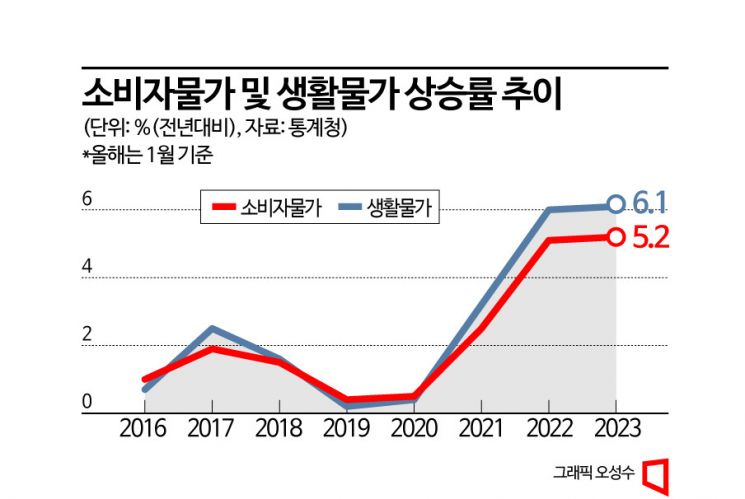
[Asia Economy Sejong=Reporter Dongwoo Lee, Sejong=Reporter Junhyung Lee] Consumer prices rose 5.2% last month compared to a year earlier. The sharp increase in electricity and gas rates due to the surge in international energy prices had a significant impact. Although the consumer price inflation rate had gradually slowed since the second half of last year, the rate of increase expanded again this year. The government has announced additional public utility fee hikes in the first half of the year, raising concerns that inflationary pressures may intensify for the time being.
According to the 'Consumer Price Trends' released by Statistics Korea on the 2nd, the consumer price inflation rate in January 2023 rose 5.2% compared to the same month last year. Except for last October, the inflation rate, which had gradually slowed since peaking in July, reversed to an upward trend by rising 0.2 percentage points from December. Compared to the previous month, it rose 0.8%, marking the largest increase since September 2018 (0.8%). The expansion of the inflation rate compared to the previous month occurred for the first time in three months since it rose from 5.6% in September last year to 5.7% in October. Consumer prices have maintained a 5% inflation rate for nine consecutive months since May last year (5.4%).
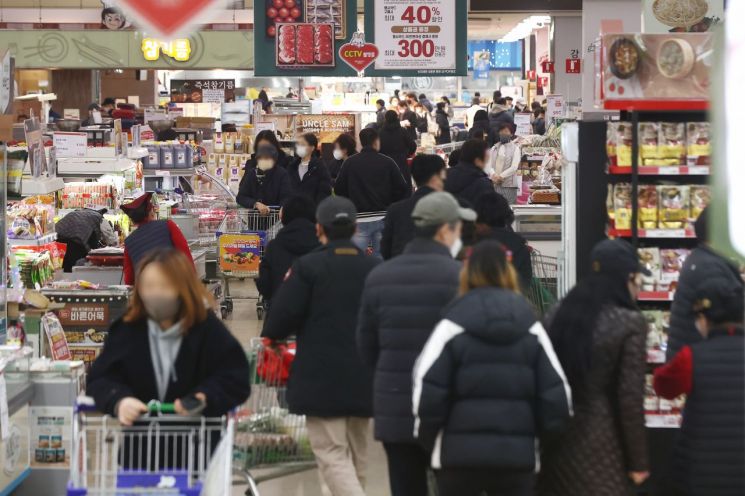
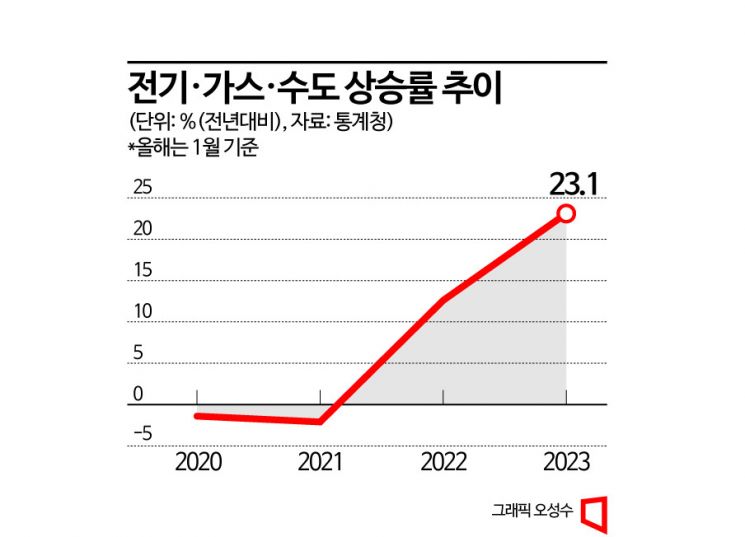
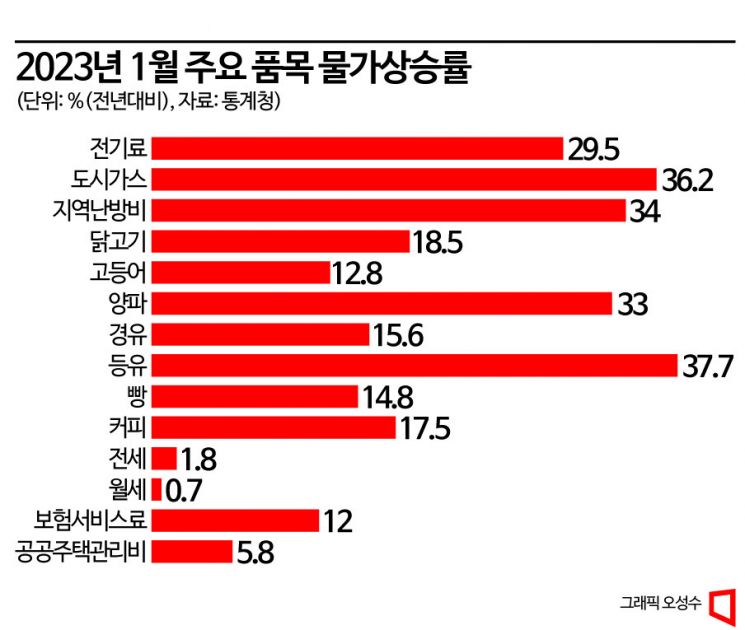
Increases in public utility fees such as electricity charges drove the rise in prices. Last month, electricity, gas, and water prices rose 28.3% compared to the same month last year. This is the highest level since Statistics Korea began separately calculating the increase rates for electricity, gas, and water in January 2010. In particular, electricity and gas charges surged by 29.5% and 36.2%, respectively. Kim Bokyung, Director of Economic Trend Statistics Review, explained, "Last month's inflation rate was largely influenced by the rise in electricity charges," adding, "The contribution of electricity, gas, and water to overall inflation increased by 0.17 percentage points compared to the previous month."
The core inflation rate, which excludes agricultural products and petroleum products and shows the underlying trend of prices, was 5.0%. Another core inflation indicator, the index excluding food and energy, rose 4.1%. The price increases for items closely related to daily living were also significant. Last month, fresh food and processed food prices rose 2.4% and 10.3%, respectively, compared to the same month last year, and the living cost index, which mainly consists of frequently purchased items and closely reflects perceived inflation, increased by 6.1%.
The industrial product inflation rate recorded 6.0%. Notably, petroleum products such as diesel (15.6%) and kerosene (37.7%) showed remarkable increases. However, the inflation rate for petroleum products slowed to 5.0% from 6.8% in the previous month. Agricultural, livestock, and fishery products rose 1.1%. Among these, agricultural products fell 0.2% compared to the same month last year, continuing the decline since last December (-1.6%). Livestock and fishery products increased by 0.6% and 7.8%, respectively.
Additional Public Utility Fee Hikes Are a Variable
The biggest factor driving inflation last month was the prolonged rise in energy and raw material prices since last year. The global supply chain, shaken by the Russia-Ukraine war in February last year, especially pushed up energy prices such as crude oil and gas, directly causing public utility fee hikes. Last year, electricity, gas, and water charges increased by 12.6%, with electricity rates rising sharply by 12.9% and city gas by 15.8%.
Considering this, the government also forecasted that inflation would show a 'high in the first half, low in the second half' pattern this year, expecting the inflation rate to decrease as the year progresses. The inflation rate is projected to be in the 4% range in the first half and in the 3% range in the second half, ultimately recording mid-3% levels.
The problem is that the government's announcement of additional public utility fee hikes in the second quarter could have a greater-than-expected impact on inflationary pressures. Since high inflation above 5% has persisted for nine months, increases in electricity, gas, and transportation fares could further burden the household economy.
Especially concerning is the rapid pace of increases in electricity and gas charges, which are directly linked to the household economy. The government has announced plans to significantly raise rates this year to improve the financial structure of Korea Electric Power Corporation and Korea Gas Corporation. Korea Gas Corporation believes that it must raise rates by 8.4 to 10.4 won per megajoule (MJ) this year to fully resolve outstanding payments by 2026, and there is a high possibility that the increase this year will be at least 1.5 times higher.
Increases in public utility fees such as transportation and water charges, as well as processed food prices, are also anticipated. Most of the 17 metropolitan cities and provinces nationwide are reviewing fare hikes for public transportation, starting with taxis, buses, and subways. From this month, the base fare for mid-sized taxis has risen from 3,800 won to 4,800 won. Seoul City is planning to raise bus and subway fares in April. Subway and city bus fares are expected to increase by at least 300 to 400 won.
The government is also closely examining the impact of high inflation in the first half of the year on the household economy. Deputy Prime Minister and Minister of Economy and Finance Choo Kyung-ho said at an emergency macroeconomic and financial meeting held at the Seoul Banking Hall on the same day, "Amid ongoing difficulties in the real sector, such as continued export sluggishness, inflation is expected to remain at a high level for the time being, and uncertainties remain high, so we cannot afford to let our guard down even for a moment."
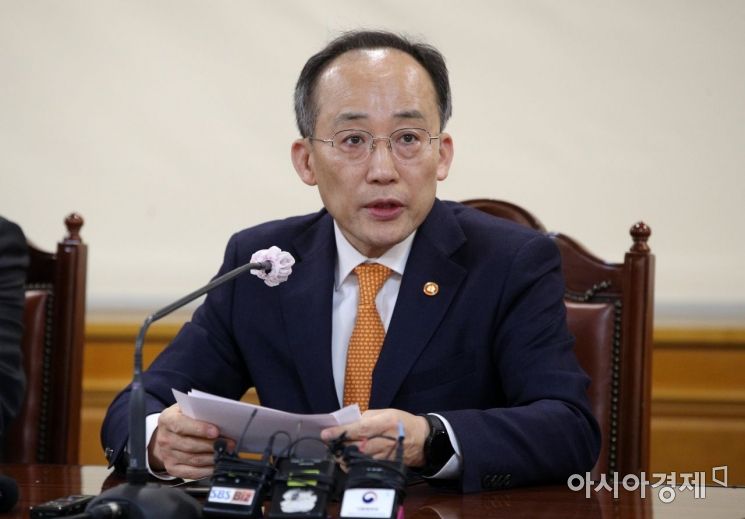 Deputy Prime Minister and Minister of Economy and Finance Choo Kyung-ho is presiding over the Emergency Macroeconomic and Financial Meeting held at the Bankers Hall in Myeong-dong, Jung-gu, Seoul on the 2nd. Photo by Hyunmin Kim kimhyun81@
© The Asia Business Daily(www.asiae.co.kr). All rights reserved.
![Clutching a Stolen Dior Bag, Saying "I Hate Being Poor but Real"... The Grotesque Con of a "Human Knockoff" [Slate]](https://cwcontent.asiae.co.kr/asiaresize/183/2026021902243444107_1771435474.jpg)

















