Song Jaehyuk, Head of Semiconductor Research Institute, Tasked with Expanding 3nm Ecosystem
Samsung Research Next-Gen Home Appliance Team... Must Increase AI Utilization
[Asia Economy Reporter Moon Chaeseok] Samsung Electronics' research and development (R&D) organization has shifted its operational goal from long-term technology exploration to short-term profitability expansion. This is because it needs to improve the yield rate of foundry finished products and dramatically enhance the profitability of the home appliance business, which posted a loss for the first time in eight years.
Samsung's R&D organization is divided into the Advanced Institute of Technology, Samsung Research, Samsung Semiconductor Research Institute, and Samsung Global Research (formerly Samsung Economic Research Institute).
Established in 1987, the Advanced Institute of Technology researches future technologies such as artificial intelligence (AI) algorithms, nanoelectronics, battery materials, and quantum technology, regardless of commercialization. Even if commercialized, it aims for several decades ahead. Most of the directors have served as presidents of the semiconductor division, including Lee Yoon-woo, Lim Hyung-kyu, Hwang Chang-gyu, Kim Ki-nam, Kwon Oh-hyun, and Kim Ki-nam. The Advanced Institute of Technology has achieved results such as the completion of full-color quantum dot (QD) displays in 2011, iris and facial recognition technology for the Galaxy S9 in 2018, and the development of high-efficiency long-cycle all-solid-state lithium metal batteries in 2020.
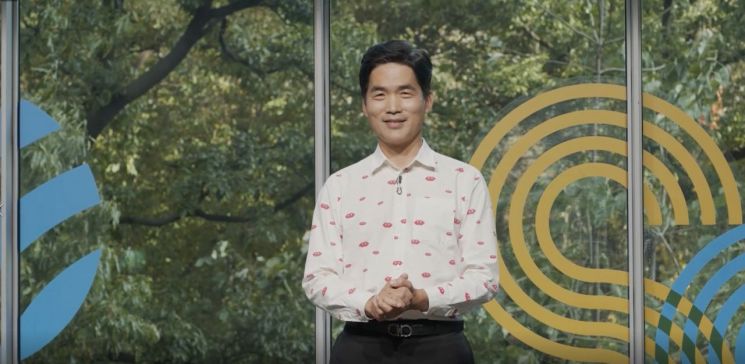 Seunghyun Jun, President of Samsung Electronics DX (Device Experience) Division and Head of Global R&D Collaboration at Samsung Research, delivering a welcome speech at the online 'Samsung Software Developer Conference' in November 2021.
 [Image source=Yonhap News]
Samsung Research is the leading research organization for sets (finished products) in the DX (Device Experience) division, which manufactures washing machines, refrigerators, and more. Since its establishment in 2017, it has focused on developing mid- to long-term technologies expected to be commercialized in about five years. If the Advanced Institute of Technology is an organization looking at distant horizons, Samsung Research is an organization running toward a destination reachable after a long walk. It serves as Samsung Electronics' AI R&D control tower. It mainly researches robots, automotive electronics (electric and electronic devices for vehicles), and intelligent software.
Established in 2014, the Samsung Semiconductor Research Institute conducts leading-edge research in the DS (Device Solutions) division. Directors such as Kang Ho-gyu and Jung Eun-seung, former heads of the system semiconductor and foundry divisions, have led the institute. However, in June last year, Song Jae-hyuk, president of the Memory Division (then vice president), took charge of the organization. It researches processes, devices, equipment technology, and new materials in the memory and system LSI semiconductor fields.
Additionally, Samsung creates separate R&D organizations within each business division as needed.
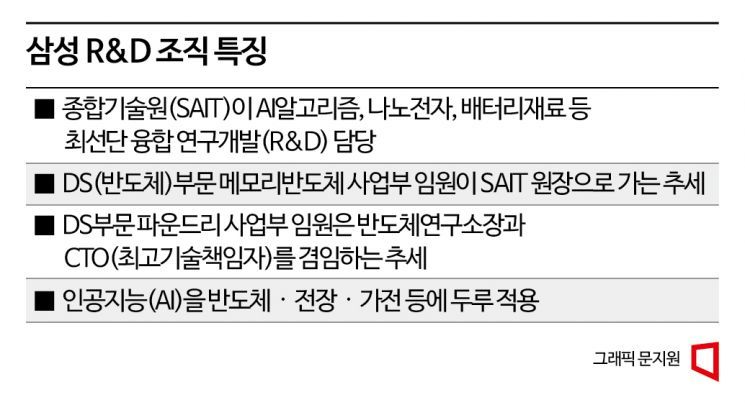
Among the various R&D organizations, the most notable recently are Samsung Research and the Semiconductor Research Institute. Samsung Research's immediate challenge is to improve the profitability of the home appliance business division, which was the only division to post a loss in the fourth quarter of last year. Last year, the home appliance division announced plans to increase the number of SmartThings platform subscribers within the company from the current 200 million to 500 million by 2025 using 'Calm Technology.' Key technologies include the 'AI Saving Mode,' which helps devices reduce electricity consumption automatically. Securing advanced AI technology is essential.
At the end of last year, Samsung Research established the Next-Generation Home Appliance Research Team, an internal organization dedicated to home appliance technology research. This reflects Samsung Electronics' urgency to recover from last year's poor performance. Furthermore, in this year's personnel reshuffle, Samsung sent former Research Director Seung Hyun-joon, a top AI expert, to serve as president in charge of global R&D cooperation. Samsung Research has been creating and managing AI research organizations in Korea, the United States, Canada, Russia, and the United Kingdom for six years. President Seung is a former Princeton University professor. Sending him to the U.S. is a directive for Samsung Research to leverage American networks to achieve results.
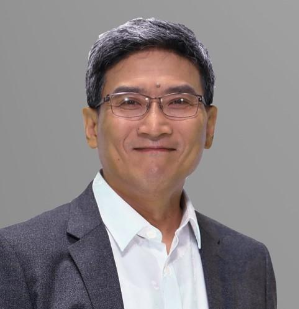 Song Jae-hyuk, President of Samsung Electronics Semiconductor Research Center.
 Photo by Samsung Electronics
The Semiconductor Research Institute also carries a heavy burden. The DS division must improve the yield of the first-generation 3-nanometer (nm; one-billionth of a meter) process. It must quickly establish mass production systems for the 3nm second generation in 2024, 2nm in 2025, and 1.4nm in 2027. Currently, its market share is only about one-quarter that of the number one, TSMC. Increasing yield in fine processes is necessary to attract more customers.
Appointing President Song as director in June last year was also unusual. The director was changed outside the regular personnel season. This was an abnormal personnel move aimed at technological innovation. Former Samsung Electronics president Lim Hyung-kyu, who served as director of the Advanced Institute of Technology, diagnosed, "To become the world's number one foundry, Samsung must catch up with TSMC within 20 years," adding, "To do this, it is essential to secure a wealth of excellent engineers." This is a message that the company must accelerate the development of in-house engineers.
Corporate analysis experts evaluate Samsung's R&D streamlining as a wise response. Kim Kyung-jun, CEO Score's CEO, said, "The more difficult the market conditions become, the more essential it is to streamline R&D management through selection and concentration," adding, "Since a major inflection point has come in technology (from DRAM to foundry), Samsung must stake its life on improving R&D efficiency."
© The Asia Business Daily(www.asiae.co.kr). All rights reserved.
![Clutching a Stolen Dior Bag, Saying "I Hate Being Poor but Real"... The Grotesque Con of a "Human Knockoff" [Slate]](https://cwcontent.asiae.co.kr/asiaresize/183/2026021902243444107_1771435474.jpg)
















