Eunpyeong District Residents Take First Step Toward Practical Measures for Reducing Household Waste
Waste Management Experts, Seoul City Officials, School Teachers and Students, and Residents Participate in Discussion
Residents' Opinions on Practical Methods Reflected in Resource Circulation and Carbon Neutrality Policies
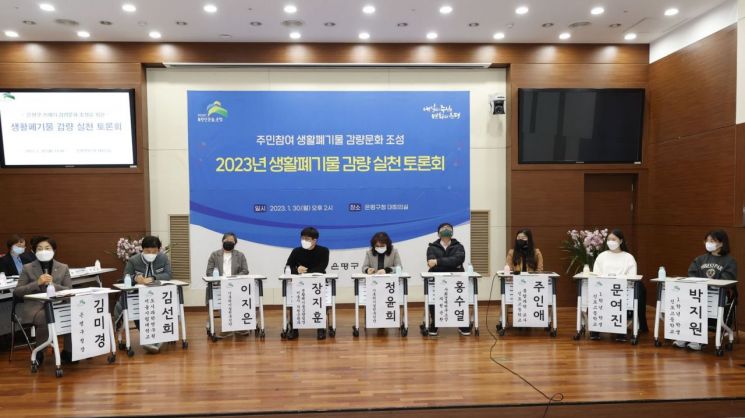
[Asia Economy Reporter Park Jong-il] Eunpyeong District (District Mayor Kim Mi-kyung) held a residents' forum on January 30th to discuss practical measures for reducing household waste.
The forum aimed to derive resident-led household waste reduction measures to take a step forward in achieving resource circulation and carbon neutrality. About 70 participants attended, including representatives from the district office, local cleaning contractors, the Private Kindergarten Association, participants in the Green Moa Moa project, and residents interested in waste reduction.
The forum proceeded with presentations of best practices and new projects, followed by expert discussions. The best practices introduced were ▲ Eunpyeong District’s ‘Garbage Diet Challenge! ZERO Eunpyeong Action Group’ and ▲ Shindo High School’s ‘Climate Crisis Overcoming Discussion Class’.
The expert discussion was chaired by District Mayor Kim Mi-kyung. Participants included Hong Soo-yeol, Director of the Resource Circulation Social Economy Research Institute; Kim Sun-hee from Seoul City University Urban Science Research Institute; the Eunpyeong District Climate Crisis Action Promotion Team; and Jang Ji-hoon, Head of Seoul City Resource Circulation and Household Waste Team.
A teacher and students from Shindo High School, who have experience with climate crisis response discussion classes, also participated and presented school-level waste reduction measures. They suggested easily implementable actions such as expanding vegetarian meals, accurately separating beverage containers at the individual student level, and walking or using public transportation for commuting.
Hong Soo-yeol, known as the "Garbage Doctor," said, “Reducing household waste requires reducing consumption and making secondhand goods recycling a daily habit,” adding, “We need to create a comprehensive local hub and expand zero-waste shops.”
Other experts proposed various ideas including institutionalizing soil recycling, expanding small-quantity grocery stores near transit stations, and strengthening the sense of ownership in waste separation.
This year’s new Eunpyeong District projects related to resource circulation and carbon neutrality introduced at the forum include ▲ a campaign to reduce 100g of waste per household per day ▲ ‘Cultivating Household Waste Reduction Habits’ in collaboration with schools ▲ resident participation in Eunpyeong-style 2050 Carbon Neutrality Promotion ▲ ZERO Eunpyeong Action Group’s Garbage Diet Project. Jang Ji-hoon, Head of Seoul City Household Waste Team, introduced zero-waste projects such as ‘Zero Cafe’ restricting disposable cup use.
Residents’ opinions included ▲ carbon neutrality and energy saving through non-heated diets ▲ enhanced education and promotion of accurate waste separation methods ▲ using recycled bags made from discarded banners instead of plastic bags for recyclable collection in the Green Moa Moa project.
The district plans to review institutionalization of practical measures that residents can fully implement to ensure definite effects based on the various opinions raised during the forum. It will continue to hold resident forums to accelerate the culture of household waste reduction.
District Mayor Kim Mi-kyung said, “We will strive to reflect the valuable opinions of residents in policies as soon as possible,” adding, “Reducing just two eggs per household can reduce waste by 8,000 tons annually. We ask all residents to join in practicing waste reduction.”
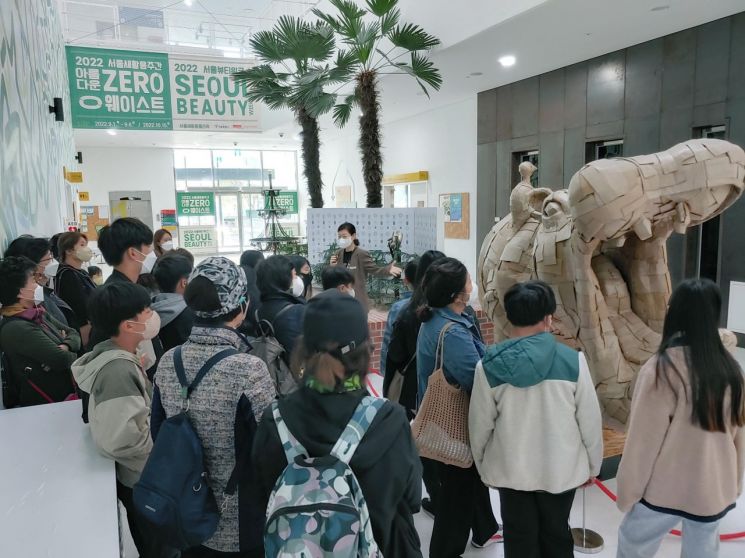
Geumcheon District Announces 2023 Village Community Contest for Waste Reduction
Three Categories: Expanding Waste Separation, Preventing Illegal Dumping, and Others
Up to 3 Million KRW Support per Project Type, 1:1 Business Consulting and Pre-Consultation Provided
Applications Accepted Until February 15 via Visit or Email to Cleaning Administration Division
Geumcheon District (District Mayor Yoo Sung-hoon) is recruiting participating groups for the ‘2023 Geumcheon District Village Community Contest for Waste Reduction’ from February 2 to 15 to create a pleasant urban environment.
This contest was designed to move away from government-led waste reduction projects and promote autonomous participation by village communities to spread awareness of waste reduction.
The contest categories are ▲ expanding waste separation ▲ illegal dumping prevention publicity activities ▲ other fields, with support up to 3 million KRW per project type until the total budget of 30 million KRW is exhausted. A 5% self-funding portion of the subsidy is required.
Any group or organization of three or more residents living in Geumcheon District or working or studying in Geumcheon District is eligible to participate.
Interested communities can download related forms such as the project plan from the ‘Notices & Announcements’ section on the Geumcheon District Office website, complete them, and submit via email or visit the Cleaning Administration Division on the 11th floor of Geumcheon District Office.
Submitted project plans will undergo a first departmental review, a second local subsidy review committee evaluation, and the final selection results will be announced on the website and individually notified to groups in March.
Geumcheon District will provide pre-consultations during the application period to help resident groups understand the contest. Support includes 1:1 business consulting, introduction of excellent existing projects, guidance on application writing, and budget planning and management.
Resident groups wishing to receive pre-consultation can apply by phone to the Cleaning Administration Division of Geumcheon District Office.
Since 2016, Geumcheon District has been promoting the ‘Village Community Contest for Waste Reduction’ with 71 resident groups currently participating, actively engaging in waste reduction activities and spreading awareness.
District Mayor Yoo Sung-hoon said, “We hope this contest will be an opportunity for residents to come up with ideas and take action to solve waste problems in their villages,” adding, “We ask for residents’ active interest and participation so that waste reduction awareness can spread beyond villages to the entire region.”
Gwanak District Leads Food Waste Reduction by Expanding Installation of Pay-by-Weight Food Waste Disposers
100 Additional Pay-by-Weight Food Waste Disposers to Be Installed in Apartment Complexes with 60 or More Households
Approximately 48% Reduction in Food Waste Achieved; Preferred Installation in Apartment Complexes
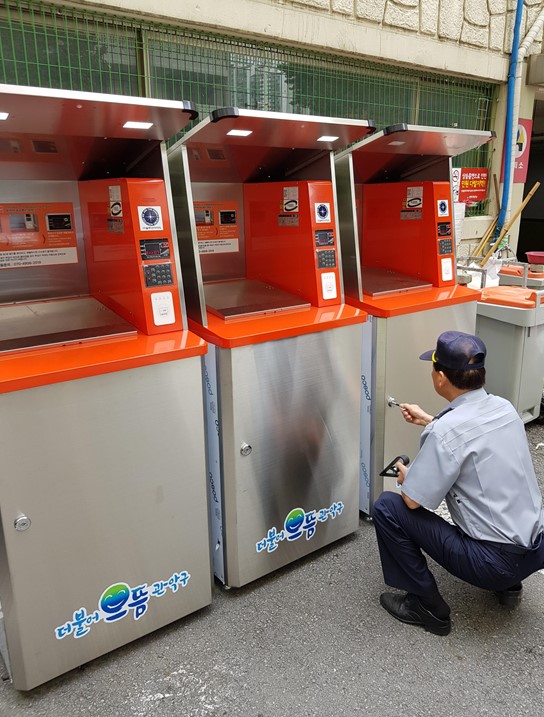
Gwanak District (District Mayor Park Jun-hee) is taking the lead in reducing food waste by installing pay-by-weight food waste disposers in apartment complexes.
The ‘pay-by-weight food waste disposer’ recognizes a registered card for each household when disposing of food waste and charges a fee based on the weight of the waste, helping reduce food waste.
Because fees are charged according to the weight disposed, it effectively encourages residents to reduce food waste and prevents illegal dumping by outsiders. It also allows residents to dispose of small amounts of food waste frequently without purchasing separate food waste bags.
Since 2018, the district has implemented the ‘Food Waste Pay-by-Weight Disposer Installation Project,’ installing 553 disposers in 52 apartment complexes and officetels with 60 or more households within the district.
To verify the project’s effectiveness, the district compared food waste amounts before and after disposer installation and confirmed about a 48% reduction in food waste disposal.
To expand installation, the district plans to invest a budget of 210 million KRW this year to install 100 additional disposers.
Eligible applicants are apartment complexes and officetels with 60 or more households, and applications are accepted on an ongoing basis until the budget is exhausted. If applications are insufficient, smaller complexes with 20 or more households and office facilities may also apply.
Applications must include a resolution from the residents’ representative meeting and be submitted by mail or in person to the Cleaning Administration Division of Gwanak District Office. For details, contact the Cleaning Administration Division at ☎02-879-6221.
A district official said, “We encourage many apartment complexes interested in reducing food waste to participate,” adding, “We will continue to lead waste reduction efforts to create a pleasant and clean Gwanak.”
© The Asia Business Daily(www.asiae.co.kr). All rights reserved.
![Clutching a Stolen Dior Bag, Saying "I Hate Being Poor but Real"... The Grotesque Con of a "Human Knockoff" [Slate]](https://cwcontent.asiae.co.kr/asiaresize/183/2026021902243444107_1771435474.jpg)

















