[Asia Economy Yang Nak-gyu, Military Specialist Reporter] The South Korean and U.S. military authorities have agreed to closely coordinate to ensure the timely and synchronized deployment of U.S. strategic assets to deter North Korea's nuclear and missile threats.
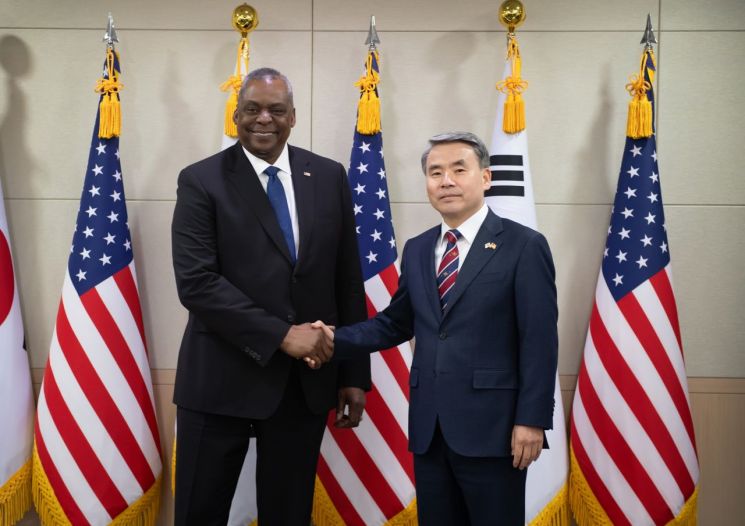
On the 31st, Defense Minister Lee Jong-seop and U.S. Secretary of Defense Lloyd Austin held talks at the Ministry of Defense building and discussed these matters. This meeting between the two ministers is the fourth in the past eight months and the first to commemorate the 70th anniversary of the South Korea-U.S. alliance this year.
Both sides agreed that the joint air exercise conducted under the deployment of U.S. strategic bombers at the end of 2022 demonstrated the alliance's diverse deterrence capabilities, and pledged to continue close consultations to ensure timely and coordinated deployment of strategic assets in the future.
Furthermore, the two ministers jointly reaffirmed measures to strengthen the U.S.'s extended deterrence execution capability to firmly guarantee the defense commitment to South Korea during this meeting. This means continuously enhancing the alliance's capabilities to deter and respond to North Korea's nuclear and missile threats, as agreed at the May 2023 South Korea-U.S. summit and the 54th Security Consultative Meeting (SCM), including ▲ information sharing ▲ joint planning and execution ▲ alliance consultation mechanisms.
Extended Deterrence Means Operation Exercise to be Conducted Next Month, Significantly Enhancing the Scale and Level of This Year’s Joint Exercises
The two countries reaffirmed their commitment to making substantial progress to complete the revision of the South Korea-U.S. Tailored Deterrence Strategy (TDS) before this year’s SCM. The two ministers decided to conduct an extended deterrence means operation exercise (DSC TTX) in February to expand alliance discussions on deterring and responding to North Korea’s nuclear threats. The plan is to further expand and strengthen the scale and level of joint exercises and training this year.
While strengthening joint exercises and training, including the scheduled first half of this year’s joint exercises, they agreed to reflect changes in the security environment, including North Korea’s recent attempts to advance its nuclear and missile capabilities. They will expand the scale and scope of this year’s joint field maneuver exercises and conduct large-scale joint combined firepower demonstrations.
At the press conference following the meeting, the two ministers strongly condemned North Korea’s missile launches, recent drone infiltrations, and continuous provocations violating United Nations Security Council resolutions, reaffirming that they will resolutely respond together with the international community to any future provocations by North Korea.
In particular, to strengthen trilateral security cooperation among South Korea, the U.S., and Japan, they agreed to hold a South Korea-U.S.-Japan security meeting (DTT) at the earliest possible date. The two ministers agreed to jointly develop concrete measures to promote the “real-time sharing of missile warning information” agreed upon by the three leaders at the Phnom Penh summit last November and to continue further discussions on this at the upcoming DTT.
Additionally, based on a shared understanding of a “free and open Indo-Pacific,” the two ministers agreed to strengthen the connectivity of their Indo-Pacific strategies and explore cooperation measures with allies in Southeast Asia and Pacific island countries. Furthermore, to mark the 70th anniversary of the South Korea-U.S. alliance and the armistice agreement, South Korea and the U.S. pledged to deepen cooperation to contribute to regional and global security.
© The Asia Business Daily(www.asiae.co.kr). All rights reserved.
![Clutching a Stolen Dior Bag, Saying "I Hate Being Poor but Real"... The Grotesque Con of a "Human Knockoff" [Slate]](https://cwcontent.asiae.co.kr/asiaresize/183/2026021902243444107_1771435474.jpg)















