"Price suppression is not possible"
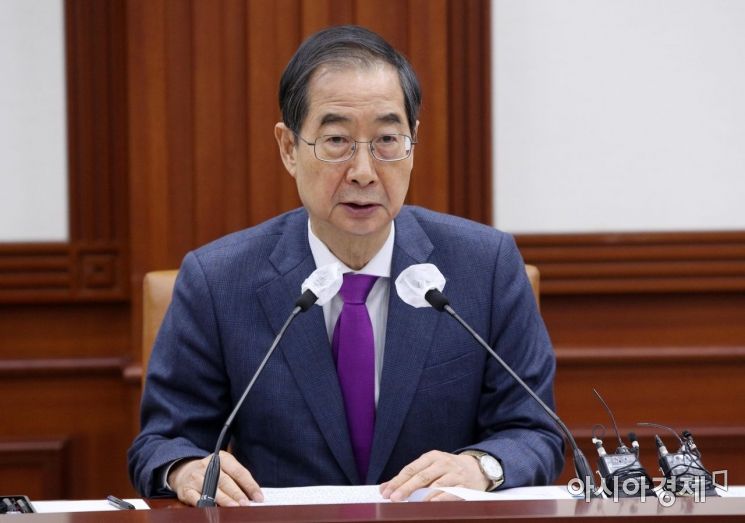
[Asia Economy Sejong=Reporter Song Seung-seop] Prime Minister Han Duck-soo criticized, “Energy support populism is truly the greatest harm that damages democracy.” This is interpreted as a criticism of both the Moon Jae-in administration’s policy of suppressing energy prices and the opposition party’s proposal for a 7 trillion won scale energy support plan.
On the 31st, Prime Minister Han met with reporters and stated, “If populism is not properly restrained or improved, the future of democracy in our country will be bleak and threatened.” His remarks came in response to a question asking whether the prime minister’s comments on populism and the government’s heating cost measures are on the same policy line.
At a Cabinet meeting held at the Government Seoul Office Building the previous day, Prime Minister Han said, “I feel heavy-hearted about the pain felt by the people due to the overlapping of cold waves and increases in public utility charges such as gas fees,” adding, “This has become an opportunity to reaffirm that policies that do not adjust prices according to market conditions are populist policies.” He implied that the root cause of the heating cost crisis was the failure to raise prices despite factors driving heating cost increases over several years during the previous administration.
Prime Minister Han criticized, “Although we need to adjust (energy) prices due to our regulations and the international economic environment, forcibly suppressing prices is an unsustainable policy,” and added, “Such measures are typical populism and efforts should be made to minimize them.” He further explained, “Energy measures are about preparing reasonable support plans starting with those most exposed to shocks, and it is difficult to consider them within the category of populism.”
Currently, the Presidential Office and the ruling and opposition parties are advocating different solutions to the sudden surge in heating costs ahead of the cold wave. The government is injecting a budget of 180 billion won to raise the energy voucher support payment for 1.18 million households from 152,000 won to 304,000 won. It is known that President Yoon Suk-yeol has instructed to consider expanding the heating cost support policy to the middle class. On the other hand, the Democratic Party of Korea is proposing to levy a ‘windfall tax’ on energy companies and provide energy price support funds amounting to 7.2 trillion won.
Prime Minister Han also shared his thoughts on various diplomatic issues. When asked whether South Korea is being forced to join the U.S.-led semiconductor regulations against China, he bluntly replied, “This is not something approaching South Korea due to recent geopolitical issues.” He added, “It is true that there are demands for China to improve its external economy, leading to the implementation of various regulations,” but also said, “We are making efforts to avoid significant damage to the relationship with China.”
Regarding China’s expression of regret over South Korea’s extension of visa issuance restrictions, he said, “We still need to be cautious about lifting (the restrictions).” Prime Minister Han stated, “We do not have sufficient data on the situation within China,” and added, “We will assess the situation and if we determine that we can sufficiently endure it, we will consider lifting the restrictions even before February 28.”
When asked about plans for a summit between President Yoon Suk-yeol and Prime Minister Kishida Fumio, he said, “There are currently no plans.” At the Korea-Japan bureau-level talks held the previous day, voices were raised for a high-level consultative meeting to resolve the forced labor issue. Prime Minister Han elaborated, “I think it is possible to meet at the ministerial level when the situation is appropriate.”
Regarding the economic outlook for next year, Prime Minister Han mentioned, “This morning, I had breakfast with an IMF economic policy official and discussed the global and Korean economies,” adding, “The first half of this year seems to be the most difficult, the second half will improve somewhat, and next year is expected to be better than this year.”
© The Asia Business Daily(www.asiae.co.kr). All rights reserved.
![Clutching a Stolen Dior Bag, Saying "I Hate Being Poor but Real"... The Grotesque Con of a "Human Knockoff" [Slate]](https://cwcontent.asiae.co.kr/asiaresize/183/2026021902243444107_1771435474.jpg)















