[Asia Economy Reporter Seungjin Lee] A partial amendment to the Game Industry Promotion Act (Game Act), focusing on the disclosure of information about 'probability-type items' in games, has passed the first hurdle in the National Assembly. The legislation regulating the core business model of the gaming industry is entering the final countdown. The industry is unable to hide its bewilderment.
Up to 2 Years Imprisonment for Violating Probability-Type Item Disclosure Obligations
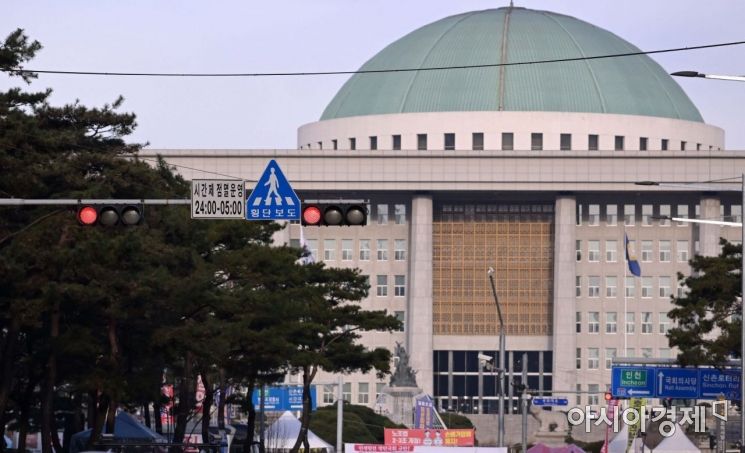
On the 30th, the Culture, Sports and Tourism Committee’s Subcommittee on Culture and Arts Legislation of the National Assembly merged and approved five proposed amendments to the Game Industry Act submitted by Democratic Party lawmakers Lee Sang-heon, Yoo Jeong-ju, Yoo Dong-su, Jeon Yong-gi, and People Power Party lawmaker Ha Tae-kyung.
The amendment to the Game Industry Act, which failed to pass once in the bill subcommittee on December 20 last year due to opposition from Democratic Party lawmaker Kim Yoon-duk, has now passed the subcommittee after two years since its proposal.
The approved amendment in the subcommittee will then be presented to the full committee meeting. Most bills that pass the subcommittee are also approved in the full committee. Bills that pass the full committee move on to the Legislation and Judiciary Committee, the final gateway before being submitted to the plenary session. Unless the bill is a contentious issue with conflicting opinions between the ruling and opposition parties, it usually passes the Legislation and Judiciary Committee without difficulty and is submitted to the plenary session, where it is mostly approved.
The newly passed amendment establishes a definition for probability-type items. Previously, there was no definition for probability-type items, and the gaming industry followed self-regulation. It also mandates the disclosure of the probabilities of probability-type items, requiring the display of the chances of obtaining items through draws. The entities responsible for disclosure are the developers, distributors, and providers. It is not yet clear what exactly 'providers' refers to, but there is an interpretation that it denotes app market operators such as Google and Apple or advertising agencies.
If the obligation to disclose probability-type items is violated, the Minister of Culture, Sports and Tourism can issue correction recommendations and orders. Failure to comply with correction orders may result in imprisonment of up to two years or a fine of up to 20 million KRW.
The Ministry of Culture, Sports and Tourism expressed a 'cautious' opinion on the ban of 'complete gacha' (multiple draws) proposed by lawmaker Yoo Dong-su and the establishment of a user committee proposed by lawmaker Ha Tae-kyung. The cautious opinion is effectively considered a 'rejection.'

Gaming Industry Calls It “Excessive Regulation”
The gaming industry unanimously calls the passed amendment an excessive regulation. They argue that since game companies are already voluntarily disclosing item probabilities, strengthening regulations would only benefit overseas game companies. They claim that even if the amendment is enforced, it would be difficult to impose the law on foreign game companies, potentially causing domestic companies to suffer reverse discrimination.
The industry also points out that the definition of probability-type items is vague, which could lead to overregulation. The amendment defines probability-type items as those whose types, effects, and performance are determined by chance elements when purchased by users. The industry argues that this definition could classify items that even game companies did not consider as probability-type items as such, leading to sanctions.
Earlier, the Korea Game Industry Association stated, “Since physical monitoring by the Game Rating and Administration Committee is impossible, it is efficient for knowledgeable operators to set their own responsibility boundaries and regulate themselves,” and added, “It is physically impossible to display probabilities on every advertisement and promotional material.”

No Suitable Alternatives to Probability-Type Items
The gaming industry is attempting to move away from revenue models dependent on probability-type items, but there are no suitable alternatives.
Recently, Nexon announced that its new title, KartRider: Drift, will not include probability-type items.
KartRider: Drift ranks within the top 5 in popularity, but its revenue ranking remains outside the top 50. For the game to be maintained stably, it needs to generate revenue, but without probability-type items, it is difficult to earn significant income.
One alternative, developing paid games like console games, is also challenging. The target market should be overseas, where demand for consoles is high, but domestic game companies have low recognition abroad. Additionally, development costs increase year by year, but due to user backlash, it is difficult to raise sales prices.
Each game company has been operating task forces (TF) since last year to develop new revenue models, but no clear alternatives have been presented yet.
© The Asia Business Daily(www.asiae.co.kr). All rights reserved.
![Clutching a Stolen Dior Bag, Saying "I Hate Being Poor but Real"... The Grotesque Con of a "Human Knockoff" [Slate]](https://cwcontent.asiae.co.kr/asiaresize/183/2026021902243444107_1771435474.jpg)

















