Opening of the National Assembly Plenary Session to Submit the Grain Management Act Proposal
Only the Opposition Votes After the Ruling Party Lawmakers Walk Out
Opposition Also Unilaterally Approves Itaewon Disaster Report
[Asia Economy Reporters Naju-seok and Kim Young-won] On the 30th, the main agenda of the Grain Management Act and the Itaewon Disaster National Assembly Investigation Committee report were passed in the plenary session solely by the opposition party. As the prosecution's investigation into Lee Jae-myung, leader of the Democratic Party of Korea, intensifies, the opposition is pushing contentious bills to pressure the government and ruling party. Fierce confrontations between the ruling and opposition parties are expected in the upcoming extraordinary session starting next month.
On the 30th, the National Assembly held a plenary session and the Grain Management Act amendment bill, directly submitted by the Agriculture, Forestry, Livestock, Food, and Maritime Affairs Committee, was passed solely by the opposition party. With the passage of the Grain Management Act agenda, it will proceed to a voting procedure in the plenary session in the future.
The National Assembly voted anonymously on the Grain Management Act amendment agenda, resulting in 157 votes in favor, 6 against, and 2 invalid votes, passing the bill. Members of the People Power Party who opposed the plenary session submission of the Grain Management Act left their seats as the vote began.
The Grain Management Act had passed the Agriculture, Forestry, Livestock, Food, and Maritime Affairs Committee plenary meeting on October 19 last year, but the Legislation and Judiciary Committee, which has the authority to review the system and wording, refused to submit it citing procedural issues such as unilateral processing by the opposition. Accordingly, the Agriculture, Forestry, Livestock, Food, and Maritime Affairs Committee directly submitted the bill to the plenary session on the 28th of last month, based on the National Assembly Act, which allows direct submission to the plenary if the Legislation and Judiciary Committee does not review other standing committee bills within 60 days and if more than three-fifths of the total members agree through consensus between standing committee secretaries or anonymous voting.
The ruling party blocks direct submission to plenary by submitting the Grain Management Act to the Legislation and Judiciary Committee... Democratic Party submits to plenary by vote
After the Agriculture, Forestry, Livestock, Food, and Maritime Affairs Committee’s direct submission, the Legislation and Judiciary Committee on the 16th of this month placed the Grain Management Act amendment bill on the agenda and referred it to the second subcommittee on legislation. Since the ruling party holds the chairmanship of the Legislation and Judiciary Committee (Kim Do-eup, People Power Party member), this move aims to block the opposition’s direct submission of the Grain Management Act amendment bill to the plenary session.
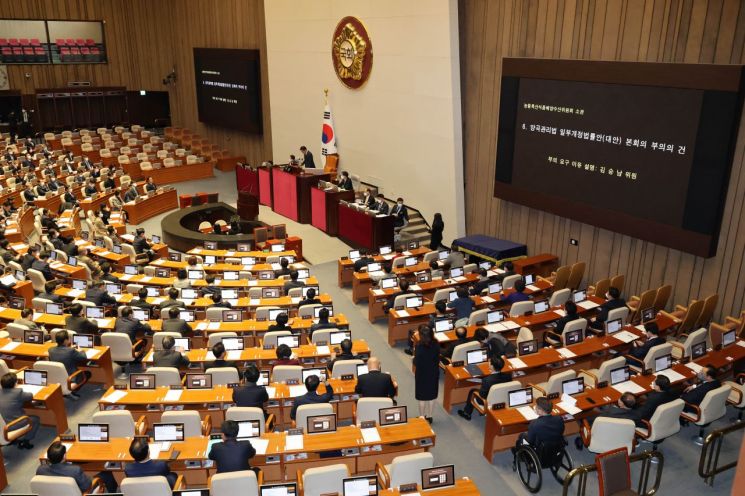
However, with the agenda passed in this plenary session, it is now possible to pass it in the next plenary session. Nonetheless, there remains a possibility of compromise through negotiations between the floor leaders of both parties or the ruling party’s proposal of amendments.
Immediately after the agenda was passed in the plenary session, National Assembly Speaker Kim Jin-pyo said, "Regarding the Grain Management Act amendment, there are opinions in favor from the perspective of stabilizing the rice market and opposing views due to concerns about fiscal burden and long-term price decline." He added, "Considering these opinions comprehensively, I urge the Agriculture, Forestry, Livestock, Food, and Maritime Affairs Committee to carefully deliberate on what is truly for the farmers and for both parties to prepare a reasonable alternative."
During the plenary session, four members from both ruling and opposition parties engaged in debate over the agenda. Ahn Byung-gil, a People Power Party member, criticized, "According to the Democratic Party’s logic, shouldn’t there be a mandatory purchase of Korean beef as well? Many fishermen face difficulties when mackerel prices fall; will the Democratic Party also create a mandatory purchase law for mackerel?" He warned, "According to an analysis by the Korea Rural Economic Institute, if this law passes, the annual rice purchase amount is estimated to reach 1.5 trillion won. This law, which aims to control rice prices, will ultimately only trap Korean farmers." He claimed, "The Democratic Party is using populism to incite the public and dilute the judicial risks facing Lee Jae-myung."
Choi Chun-sik, also from the People Power Party, opposed the bill, saying, "The Grain Management Act is an amendment bill that the Democratic Party forcibly passed through the standing committee’s subcommittee and plenary session." He criticized, "The per capita rice consumption is 155g, down 100g from 250g in 2000. Although rice consumption is decreasing every year, the Democratic Party is pushing a plan to solidify the overproduction structure of rice."
On the other hand, Lee Won-taek, a Democratic Party member, criticized, "The Legislation and Judiciary Committee did not conduct any review of the Grain Management Act amendment bill during the 60 days stipulated by the National Assembly Act." He also pointed out the referral of the Grain Management Act to the second subcommittee on legislation on the 16th of this month as "an act of tyranny."
Yoon Jun-byung, a Democratic Party member, explained, "The government did not keep its promise to isolate the market if rice prices fell last year. Democratic Party members have been pushing for amendments to the Grain Management Act to prevent government discretion abuse and to ensure that market isolation can effectively contribute to normalizing and stabilizing rice prices." Yoon particularly criticized, "President Yoon said the Grain Management Act is not helpful to farmers and that unlimited purchase is undesirable for agriculture. This statement reveals the president’s ignorance about the Grain Management Act amendment bill."
Itaewon National Assembly Investigation Committee report also passed solely by opposition... Show of strength in minority ruling
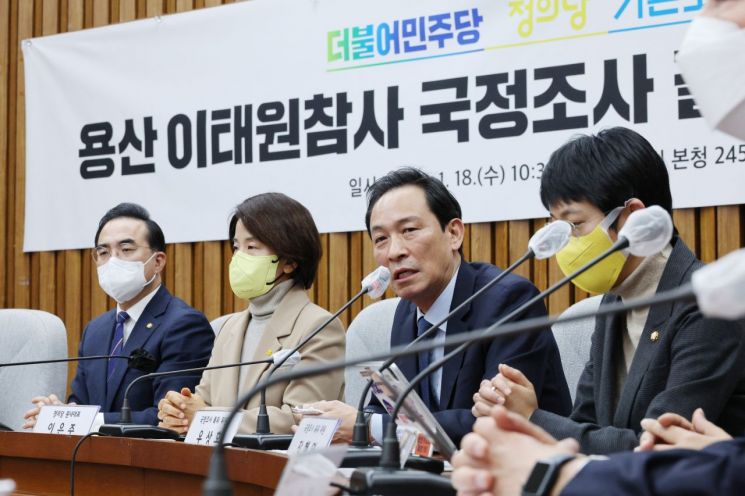
The Itaewon Disaster National Assembly Investigation Committee report was also passed unanimously with 158 members present voting in favor. People Power Party members who left the chamber during the Grain Management Act amendment vote did not participate in this vote either. The ruling party strongly opposed the report’s adoption process, especially the inclusion of measures such as filing charges against Minister of the Interior and Safety Lee Sang-min.
The ruling and opposition parties clashed in a debate over the report’s adoption. Park Hyung-soo of the People Power Party expressed opposition, saying, "The Democratic Party unilaterally passed a report they arbitrarily drafted. The committee’s administrative office had prepared a relatively neutral report, but the Democratic Party freely edited it and adopted it by majority power. To secure the legitimacy of democracy and majority rule, opportunities for minority opinions and sufficient debate must be guaranteed, but the unilateral adoption without any debate is a serious procedural flaw."
Park also pointed out the charges against Minister Lee, stating, "The Democratic Party’s insistence on prosecuting perjury charges, which are legally unfounded, appears to be a political move to achieve objectives by prosecuting government officials. Adopting such a flawed report diminishes the authority of the National Assembly and exposes its ignorance."
In response, Oh Young-hwan of the Democratic Party rebutted, "The public is greatly angered by the government’s shameless attitude that does not sympathize with the October 29 disaster and the special investigation team’s scapegoating investigation." He added, "Ahead of the report’s adoption in the plenary session, the ruling party again showed a shameless stance opposing adoption, neglecting their duties. President Yoon Seok-yeol should personally meet the bereaved families, apologize, and dismiss Minister Lee."
Meanwhile, the plenary session also approved an extension of the Special Committee on Criminal Justice System Reform’s (Sage Special Committee) activity period. Originally set to end on the 31st of this month, the activity period was extended by four months. Of the 244 members present, 211 voted in favor, 4 opposed, and 29 abstained.
© The Asia Business Daily(www.asiae.co.kr). All rights reserved.
![Clutching a Stolen Dior Bag, Saying "I Hate Being Poor but Real"... The Grotesque Con of a "Human Knockoff" [Slate]](https://cwcontent.asiae.co.kr/asiaresize/183/2026021902243444107_1771435474.jpg)
















