Noisy Pets and the New Term 'Cheung-gyeon Noise'
Cannot Regulate Because It's Not a Person
Legally, 'Cheunggan Noise' Does Not Include Pets
The era of 15 million pet owners in South Korea. One in four households in the country lives with a pet. As the number of households raising dogs increases, conflicts among residents due to noise caused by dogs in apartment complexes are deepening.
"The barking is noisy" vs "Muzzling dogs even at home is harsh"
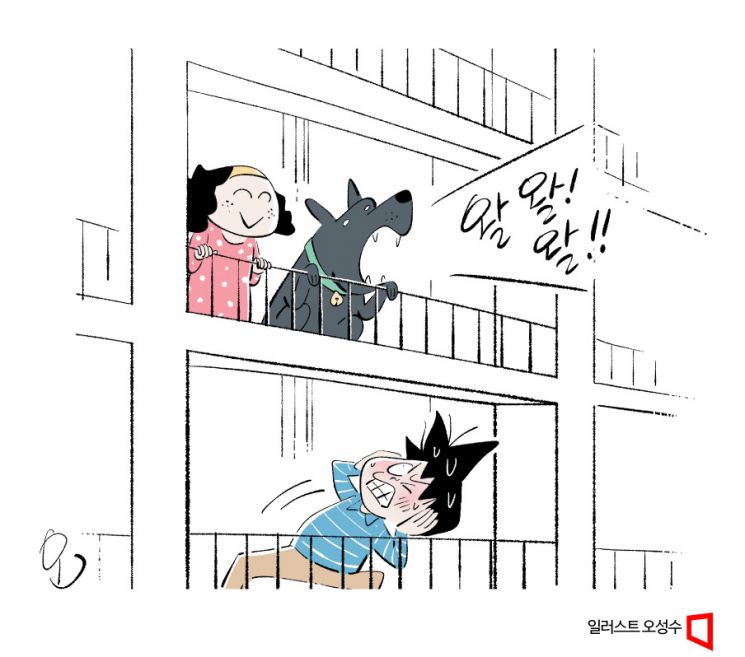
As population density rises and the number of pet owners in South Korea surges, dogs have emerged as a new source of conflict among neighbors. So much so that a new term, "floor-dog noise," has been coined to describe noise between floors caused by dogs.
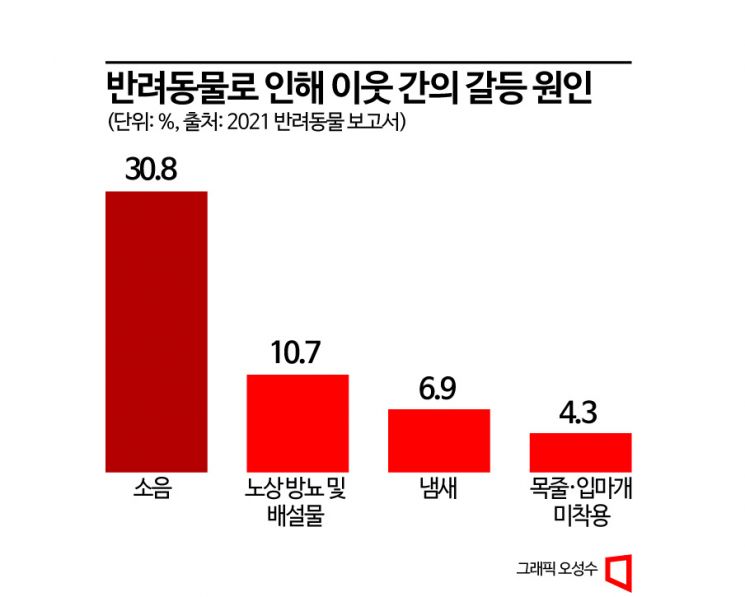
According to the '2021 Pet Report,' 56.9% of pet owners reported having experienced disputes with neighbors while raising pets. Noise ranked first at 30.8%, followed by ▲urination and feces in public areas (10.7%) ▲odor (6.9%) ▲failure to wear leashes or muzzles (4.3%).
Unlike traditional neighbor conflicts between lower and upper floors, floor-dog noise can escalate into a problem affecting the entire apartment complex, causing greater conflicts.
On the 23rd, in an apartment in Yeongcheon-si, Daegu, Mr. A was sentenced to a suspended prison term over dog noise issues. Mr. A reportedly threw a bread knife at a neighbor on the same floor who complained about his dog barking loudly and threatened, "Be careful, I have a knife ready."
A similar incident occurred in Chuncheon. On the 26th, the Chuncheon District Court sentenced Mr. B, in his 50s, to prison for attempting to kill a neighbor with whom he had longstanding animosity over dog noise. Mr. B was charged with attempting to murder a resident with a weapon in October last year while intoxicated. The trial was conducted as a citizen participation trial, with all nine jurors finding him guilty of attempted murder, and five of them recommending an eight-year prison sentence.
There is also a significant perception gap between pet owners and non-pet owners regarding pets. According to the Ministry of Agriculture, Food and Rural Affairs' '2021 National Awareness Survey on Animal Protection,' 79.5% of pet owners said they comply with pet etiquette, but only 28% of non-pet owners responded positively. While pet owners who raise dogs like children find their dogs lovable, non-pet owners feel significantly inconvenienced.
Complaints also arise not only from barking but from sounds like scratching floors and dogs constantly roaming around. Non-pet owners sigh, saying, "Children running around is noisy enough, now we have to worry about dogs running around too."
Pet owners express frustration. While people can be told to be quiet and not run around, it is difficult to do so with dogs. However, they argue that performing vocal cord surgery on dogs or muzzling them even at home is too harsh.
No legal regulation on pet noise under current law... What are the solutions?
Although complaints about pet noise are rapidly increasing, there are currently no regulations in South Korea regarding dog noise. Under current law, noise is defined as "loud sounds caused by human activities," so "dog noise" is not included. Floor noise refers to noise issues between households sharing floors in apartment complexes and only covers noise caused by the activities of residents or users.
Legally, floor noise is recognized when direct impact noise such as footsteps exceeds an average of 43dB for one minute during the day or when noise exceeding 57dB is heard three or more times within an hour. However, dog barking produces about 70dB of sound. Although this is comparable to floor noise in decibels, sounds such as pet barking, scratching, and footsteps are not included in legal noise definitions. Because pet noise cannot be legally regulated, local governments only issue warnings to the dog owners involved.
Some suggest vocal cord surgery or muzzling for dogs, but some pet owners oppose this due to concerns about animal abuse. Alternative solutions include installing mats along the dog's movement paths, placing sound-absorbing materials with noise reduction effects on walls and ceilings, and installing inner doors to block noise further. Sending dogs to doggy daycare during times when owners are away, such as work hours, can also be a solution.
Experts view frequent barking or aggressive behavior in dogs as signs of severe stress. Due to COVID-19, walking times have decreased, and frequent visits by delivery and courier personnel stimulate dogs. In such cases, experts recommend training by dog professionals or activities like walking and exercise to reduce stress.
© The Asia Business Daily(www.asiae.co.kr). All rights reserved.
![Clutching a Stolen Dior Bag, Saying "I Hate Being Poor but Real"... The Grotesque Con of a "Human Knockoff" [Slate]](https://cwcontent.asiae.co.kr/asiaresize/183/2026021902243444107_1771435474.jpg)

















