Per Capita Rice Consumption 56.7kg
Steadily Decreasing Since 1985
Eating One and a Half Bowls of Rice a Day
[Asia Economy Sejong=Reporter Lee Jun-hyung] Last year, the annual per capita rice consumption recorded the lowest level since statistics began. This is the result of nearly 30 years of continuous decline in rice consumption due to changes in dietary habits. However, the rate of decrease has slowed down due to the burden of dining out expenses and the expansion of the home meal replacement market.
According to the "2022 Grain Consumption Survey" released by Statistics Korea on the 27th, the annual per capita rice consumption last year was 56.7kg, a 0.4% decrease compared to the previous year (56.9kg). This is the lowest level since grain consumption statistics began in 1963. Rice consumption has steadily declined every year since 1985. Last year's rice consumption shrank to half the level of 30 years ago in 1992 (112.9kg).
The daily per capita rice consumption was recorded at 155.5g, a 0.2% decrease compared to the previous year (155.8g). Considering that approximately 100g of rice is needed to cook one bowl of rice, it means that the average person ate about one and a half bowls of rice per day.
The situation is similar even when including other grains. Last year, the annual per capita grain (rice + other grains) consumption was 64.7kg, a 0.5% decrease compared to the previous year (65kg). Compared to 30 years ago in 1992 (124.8kg), this is about a 48.2% reduction. Looking only at other grains, last year's per capita consumption was 8kg, a 2.4% decrease compared to the previous year (8.2kg). A Statistics Korea official explained, "The annual per capita grain consumption has been continuously decreasing since 1982."
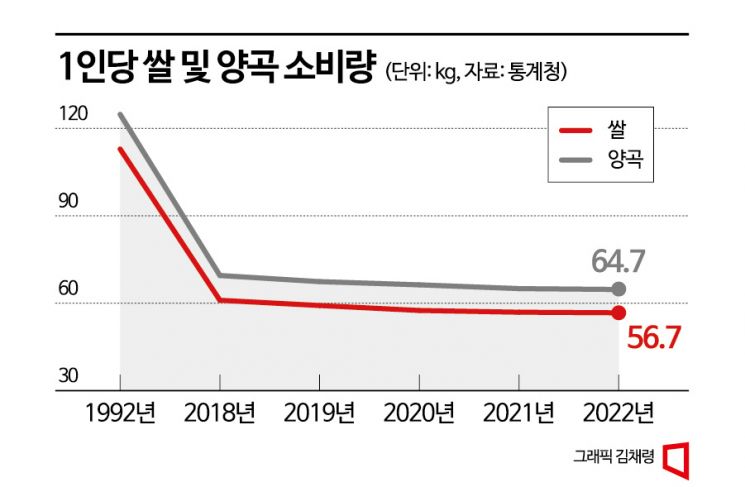
However, the rate of decrease has slowed. The annual per capita rice consumption decrease rate was 3.0% in 2019, 2.5% in 2020, 1.4% in 2021, and only 0.4% last year. The average decrease rate over the past 10 years as of last year is 1.9%.
The reduction in the rate of decline in rice consumption is analyzed to be due to increased demand for home-cooked meals as the burden of dining out expenses grew amid high inflation. The expansion of the home meal replacement market, including soups and stews, is also considered a factor that increased demand for home-cooked meals. A Ministry of Agriculture, Food and Rural Affairs official said, "The relatively small decrease in consumption among single-person households, who consume more rice, is also seen as a cause," adding, "However, it is necessary to observe whether the per capita rice consumption will continue to decrease slightly as it did last year."
The Ministry of Agriculture, Food and Rural Affairs analyzed that rice demand this year will reach 3.67 million tons. This is a re-estimation of this year's rice supply and demand situation based on the results of the grain consumption survey announced that day. Considering last year's rice production (3.76 million tons) and the government's market isolation plan (370,000 tons), rice supply is expected to be about 280,000 tons short of demand.
Accordingly, there is a possibility that the government may reduce the market isolation volume from the original plan. The Ministry of Agriculture, Food and Rural Affairs plans to hold the Grain Supply and Demand Stabilization Committee in early next month to decide whether to continue purchasing market-isolated rice.
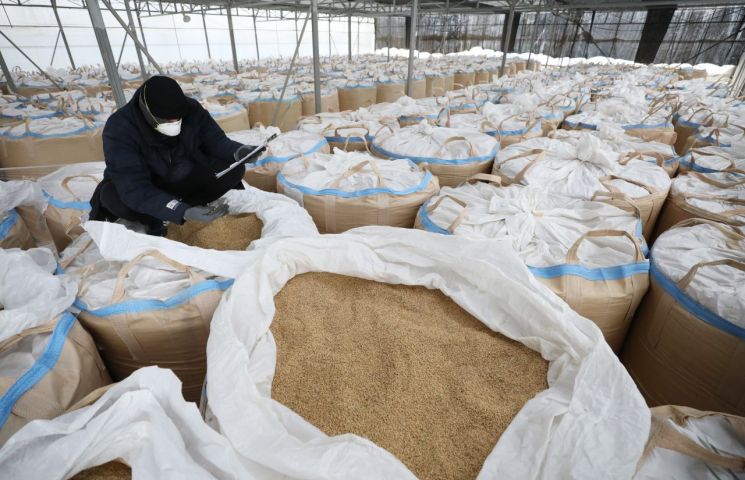 An official is inspecting the purchased rice at the Suracheong United Agricultural Cooperative Rice Processing Complex (RPC) in Bibong-myeon, Hwaseong-si, Gyeonggi-do. [Image source=Yonhap News]
© The Asia Business Daily(www.asiae.co.kr). All rights reserved.
![Clutching a Stolen Dior Bag, Saying "I Hate Being Poor but Real"... The Grotesque Con of a "Human Knockoff" [Slate]](https://cwcontent.asiae.co.kr/asiaresize/183/2026021902243444107_1771435474.jpg)
















