Mass Migration During Chunjie After 3 Years
Rampant Overcharging... Even Local Authorities Step In
[Asia Economy Beijing=Special Correspondent Kim Hyunjung] Following the lifting of the strict quarantine policy known as 'Zero COVID,' China's Spring Festival (Chunje, Chinese New Year) celebration is welcoming a large number of tourists for the first time in three years, but 'overcharging' is casting a shadow over the festivities. Reports of poor-quality meals being served at high prices or fees being imposed without prior notice at popular tourist spots have sparked widespread criticism.
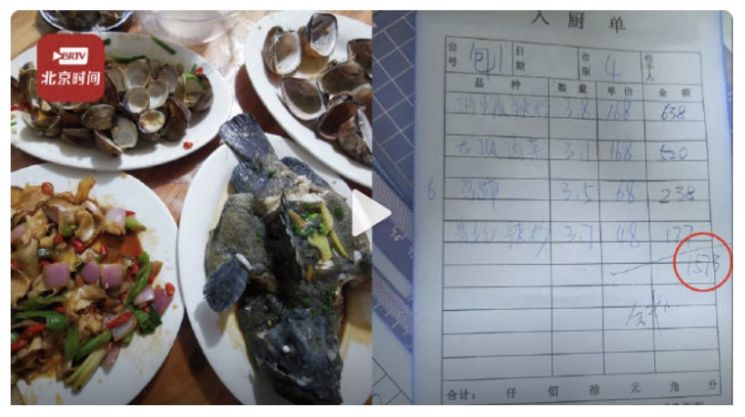
According to Beijing Sijian, a local Chinese internet media outlet, on the 24th, during the Chunje holiday period, a tourist visiting Silver Beach in Beihai, Guangxi Province, ordered four dishes at a restaurant and paid 1,500 yuan (approximately 270,000 KRW). The outlet pointed out, "The tourist ate four dishes including fried snails, steamed fish, and stir-fried broccoli, guided by a taxi driver, and paid 1,500 yuan," adding, "Nearby restaurants typically charge about 100 yuan per person on average." The tourist said, "I only realized I had been 'jaegae'd' after returning to the accommodation at night and felt despair." Netizens commented, "The taxi driver probably took a large middleman fee." In China, being overcharged is expressed as being 'jaegae'd.'
In Sanya, Hainan Province, a famous tourist destination, 'seafood jaegae' was rampant. According to local Jiupai News, tourists had to pay 700 yuan for six spotted shrimp in Sanya, and rockfish cost 1,000 yuan. Another tourist bought 500 yuan worth of seafood at the market but was forcibly charged an additional 400 yuan as a 'loss fee.' Jiupai pointed out, "There are many cases where rental car companies do not properly issue insurance certificates and then demand excessive repair costs," adding, "Someone is targeting tourists' wallets."
Although prices are not always high, the quality of food served is sometimes so poor that it shocks customers. According to local media Hongxing News, a tourist ordered a bowl of noodles costing 20 yuan on Huimin Street, a food alley in Xi'an. However, the large bowl contained only six strands of noodles, and the tourist filmed a video expressing anger while counting the noodles and posted it online. Some large restaurants in Xi'an removed their usual menus and used temporary notices with prices specific to the Chunje period.
When this video became a hot topic on the 25th, local authorities intervened and demanded corrective action. On the following day, the 26th, the local market supervision authority issued a directive to the restaurant involved to increase the amount of noodles and ordered a refund for the problematic noodle price. Nearby merchants also criticized the restaurant, calling it a "disgrace to the neighborhood."
On the 19th, the Market Supervision and Administration Department of China's National Economic Management Bureau announced that it would closely monitor market prices during the Chunje period and strictly investigate and punish various illegal activities and 'overcharging' issues. The State Council also held a press conference stating, "We will carefully observe consumption in the hotel, tourism, and food industries and standardize prices," instructing, "Distinguish between 'price recovery' and 'arbitrary price increases,' and operators must clearly disclose and display all prices and fees."
© The Asia Business Daily(www.asiae.co.kr). All rights reserved.
![Clutching a Stolen Dior Bag, Saying "I Hate Being Poor but Real"... The Grotesque Con of a "Human Knockoff" [Slate]](https://cwcontent.asiae.co.kr/asiaresize/183/2026021902243444107_1771435474.jpg)















