[Asia Economy Reporters Suyeon Woo and Hyunseok Yoo] Hyundai Motor Company is significantly increasing its new investments to the 10 trillion won level this year. Despite anticipating that the business environment will be more challenging than ever before, the company judged that since the global finished car market is in a period of upheaval, failing to invest timely could lead to falling behind at any time. Following record-high sales last year, Hyundai Motor expects double-digit sales growth this year as well.
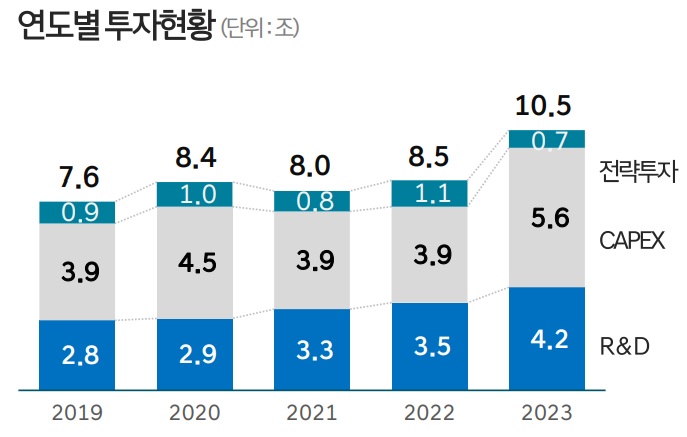
On the 26th, Hyundai Motor announced that it set its new investment target for this year at 10.5 trillion won. It allocated 4.2 trillion won for research and development (R&D), 5.6 trillion won for capital expenditures (CAPEX), and 700 billion won for strategic investments.
The reason Hyundai Motor devised such an aggressive investment plan is due to the forecast that the business conditions will improve compared to last year. Despite the semiconductor supply shortage last year, Hyundai Motor set a new record for the highest sales ever.
This year, with semiconductor supply stabilization and an improved sales mix focused on high value-added models, the annual sales target was raised to 4.32 million units, more than 10% higher than the previous year. The company also set a target for annual sales growth of 10.5 to 11.5% compared to last year.
Hyundai Motor also foresees the possibility of worsening business conditions due to additional interest rate hikes and sales contraction caused by economic recession. However, it expects global automobile market demand to remain solid. Hyundai Motor’s forecast for global automobile market demand is 78.81 million units, a 3.8% increase from the previous year. A Hyundai Motor official stated, "As the semiconductor supply shortage improves, production is increasing, but inventory levels in major markets remain low, so we expect there to be pent-up demand."
Hyundai Motor recorded operating profit in the 9 trillion won range last year, setting a new record for performance. Operating profit last year was 9.8198 trillion won, a 47% increase from the previous year, and sales revenue was 142.5275 trillion won, up 21%.
Sales revenue in the fourth quarter of last year was 38.5236 trillion won, a 24.2% increase compared to the same period the previous year. Sales expansion, improved sales mix centered on Genesis and sports utility vehicles (SUVs), and exchange rate effects contributed to the increase. The average KRW-USD exchange rate in Q4 2022 rose 14.9% year-on-year to 1,359 won.
In the fourth quarter of last year, Hyundai Motor sold 1,038,874 units in the global market, an 8.1% increase compared to the same period the previous year. In the domestic market, high value-added models such as the newly launched Grandeur and Genesis lineup at the end of last year showed steady sales, resulting in 192,049 units sold, a 3.3% increase year-on-year. In overseas markets, production increased due to improved parts supply, and strong sales centered on eco-friendly vehicles such as the global full-scale launch of the Ioniq 6 were observed. Sales reached 846,825 units, a 9.3% increase compared to the previous year.
The cost of sales ratio fell 1.1 percentage points year-on-year to 79.8%. This decline was due to increased operating rates from improved parts supply and favorable exchange rate effects. Selling and administrative expenses increased due to higher new car marketing costs. However, the ratio of selling and administrative expenses to sales revenue decreased by 2.7 percentage points year-on-year to 11.5%.
Hyundai Motor expects production expansion due to improved operating rates going forward but anticipates that unpredictable business conditions will continue due to global uncertainties such as geopolitical impacts including inter-country conflicts, inflation expansion, and demand contraction concerns from interest rate hikes. The company also cited increased marketing costs due to exchange rate volatility and intensified competition among manufacturers as burdens on management activities.
The global automobile market is expected to continue high growth in the eco-friendly vehicle sector, centered on electric vehicles, influenced by stricter environmental regulations in major countries, increased investment in eco-friendly infrastructure, and expanded preference for eco-friendly vehicles. Accordingly, the company plans to increase sales focused on high value-added models such as the new Santa Fe while expanding its domestic and overseas lineup of new electric vehicles, including starting exports of the Ioniq 6.
© The Asia Business Daily(www.asiae.co.kr). All rights reserved.
![Clutching a Stolen Dior Bag, Saying "I Hate Being Poor but Real"... The Grotesque Con of a "Human Knockoff" [Slate]](https://cwcontent.asiae.co.kr/asiaresize/183/2026021902243444107_1771435474.jpg)

















