Court: "Only Loss of Ownership... Unjust Enrichment Claims Not Allowed"
[Asia Economy Reporter Heo Kyung-jun] Descendants filed a lawsuit claiming that the government arbitrarily sold ancestral land whose ownership was recognized during the Japanese colonial period, but they lost the case.
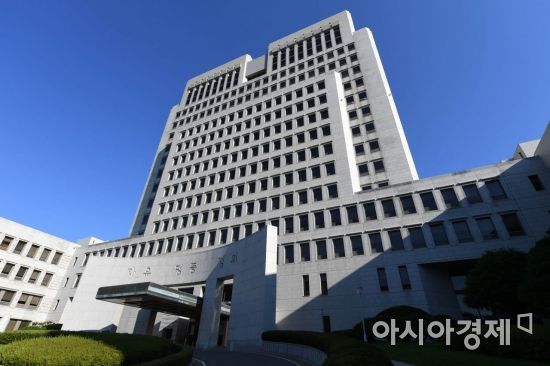
The Supreme Court's 3rd Division (Presiding Justice Ahn Cheol-sang) sent the appeal in the unjust enrichment refund lawsuit filed by the heirs of landowner Mr. A against the state back to the Seoul Central District Court with the judgment that the plaintiff lost.
Mr. A was recognized as the owner of land in the Pyeongtaek area in 1917 during the Japanese colonial period. Later, the cadastral records were destroyed during the Korean War, and in 1977, the forest land register was restored without listing the owner. In 1986, the government, unaware that Mr. A’s land ownership had been recognized, completed the registration of ownership preservation, and in 1997, sold the land to Mr. B for 54.99 million KRW, completing the transfer of ownership registration.
The descendants of Mr. A filed a lawsuit against Mr. B in 2017 to cancel the ownership transfer registration (a lawsuit to reclaim ancestral land), but ultimately lost because Mr. B’s registration acquisition by prescription was completed. Subsequently, Mr. A’s descendants filed a lawsuit against the government claiming state compensation and unjust enrichment refund.
The first trial dismissed the state compensation claim. Mr. A’s heirs did not claim unjust enrichment refund at the first trial stage. The second trial also dismissed the state compensation claim but partially accepted the unjust enrichment refund claim. Mr. A’s heirs argued that the government gained unjust enrichment corresponding to the land ownership, but the court recognized only the sale proceeds received from Mr. B as unjust enrichment and ruled that the heirs be paid a total of 54.99 million KRW.
However, the Supreme Court denied the establishment of the obligation to refund unjust enrichment. It held that the damage suffered by the heirs was the loss of ownership, and the sale proceeds themselves were not the damage suffered by the heirs.
The Supreme Court stated, "Depending on whether the requirements for state compensation are met, only a state compensation claim is possible, and one cannot seek unjust enrichment refund against a person who made a void registration and then disposed of it to a third party."
A Supreme Court official explained, "This ruling is the first to establish the legal principle that even if a person without rights completes registration on real estate owned by another without cause, sells it to a third party, and the registration acquisition by prescription is completed, they are not obligated to refund unjust enrichment."
© The Asia Business Daily(www.asiae.co.kr). All rights reserved.
![Clutching a Stolen Dior Bag, Saying "I Hate Being Poor but Real"... The Grotesque Con of a "Human Knockoff" [Slate]](https://cwcontent.asiae.co.kr/asiaresize/183/2026021902243444107_1771435474.jpg)















