Growth Trend in Traditional Oil Market After Stagnation
Gaining Spotlight as Ingredient Due to Increased Home Dining and Health Trends
Emerging as a Key Export Food Thanks to K-Culture Popularity
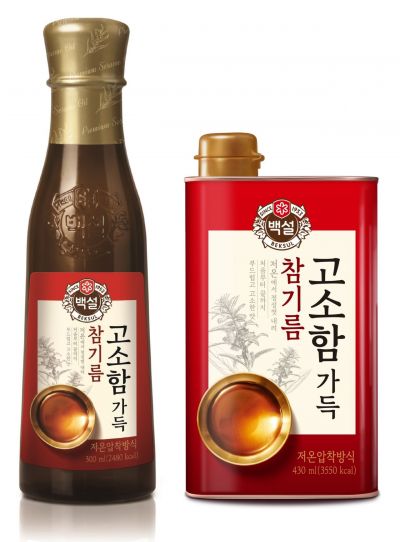
The traditional oil market, once dominated by sesame oil, is diversifying. Since the COVID-19 pandemic, as interest in health has grown, more consumers are choosing to use healthy oils in cooking. Along with a preference for domestic ingredients, premium products made from organic ingredients or through special manufacturing methods are also gaining attention. Perilla oil, which had been relatively overlooked, is also experiencing significant growth as it is being widely used in cooking.
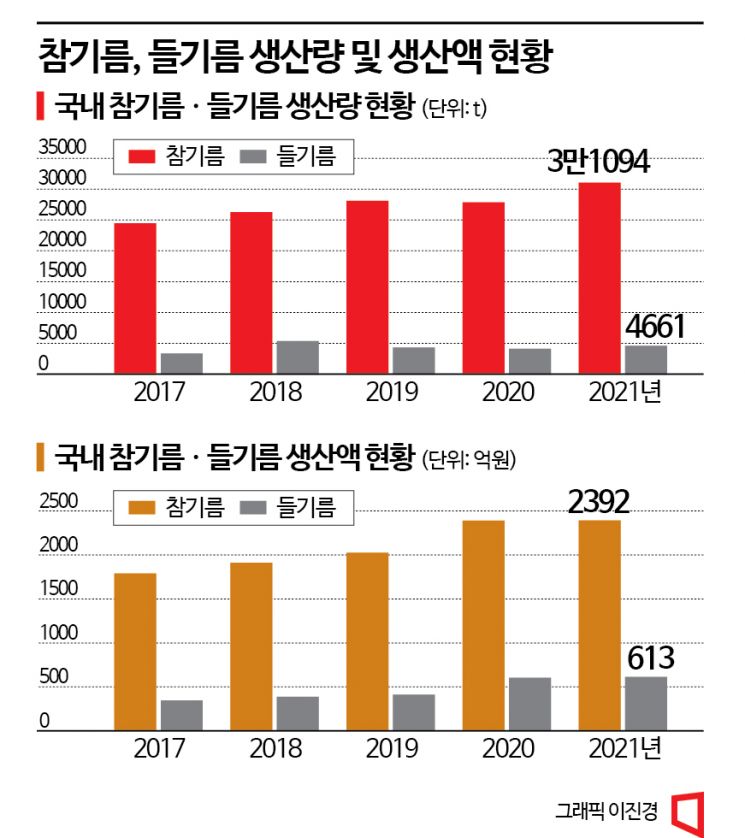
According to the Korea Agro-Fisheries & Food Trade Corporation on the 18th, sesame oil production increased by 26.9% over four years, from 24,495 tons in 2017 to 31,094 tons in 2021. During the same period, production value also rose by 33.7%, from 179 billion KRW to 239.2 billion KRW. Both production volume and value have steadily increased each year, influenced by the rise in home dining during the COVID-19 pandemic. Perilla oil production jumped 57% from 3,433 tons in 2017 to 5,421 tons in 2018, then declined for two consecutive years to 4,395 tons in 2019 and 4,187 tons in 2020, before slightly increasing to 4,661 tons in 2021. However, production value nearly doubled from 34.6 billion KRW in 2017 to 61.3 billion KRW in 2021. The production value, which was around 41.1 billion KRW in 2019, surged 47% to 60.5 billion KRW in 2020, attributed to increased overall production costs due to transportation expenses and rising international oil prices amid the COVID-19 pandemic.
Traditional oils are broadly classified into two types. Sesame oil is extracted by pressing sesame seeds, while perilla oil is obtained by pressing perilla seeds. Besides the difference in raw materials, perilla oil generally has a slightly darker color than sesame oil. Typically, perilla oil has a richer nutty flavor than sesame oil, though this varies by product. In Korea, perilla oil is widely used in various dishes, including stir-fried and seasoned vegetable dishes. It also serves as a spice or is added to seasonings.
While sesame oil still holds a large share of the traditional oil market, the share of perilla oil is steadily increasing and is estimated by the industry to be in the 10% range. This shift is largely due to perilla oil becoming a familiar ingredient to consumers, as it is frequently used in recipes by renowned chefs, unlike in the past when it was used only in specific dishes. Perilla oil contains a high amount of healthy unsaturated fatty acids, with omega-3 essential fatty acids accounting for more than half of its composition. The increased interest in healthy food after COVID-19 is a global trend. Awareness of various dietary approaches such as veganism, vegetarianism, and keto has risen, leading to a preference for products without animal ingredients. Accordingly, the industry analyzes that more consumers are seeking plant-based oils like sesame oil and perilla oil.
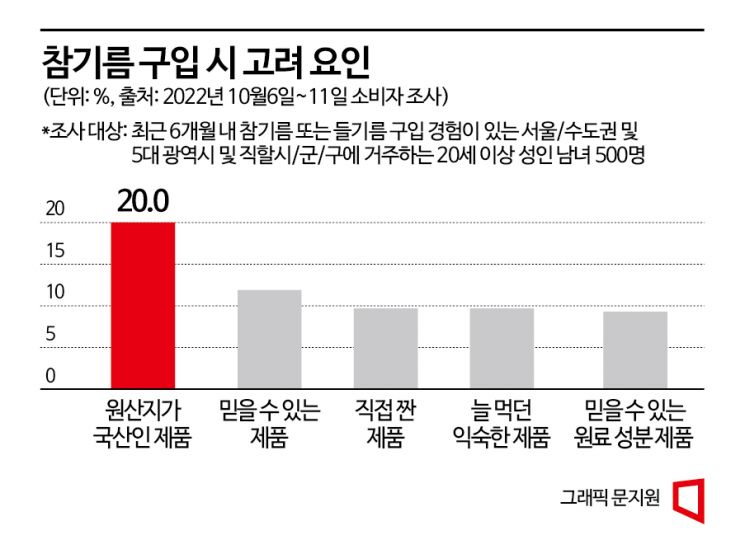
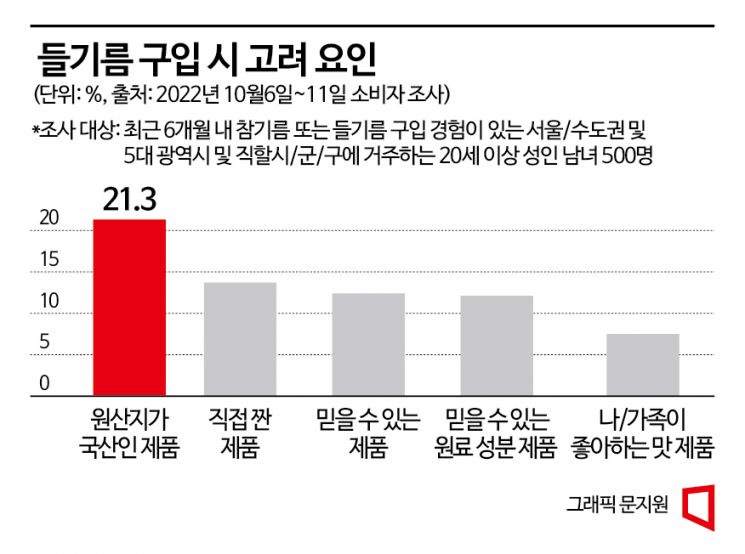
Consumer perceptions align with this trend. According to a consumer survey conducted last year by the Korea Agro-Fisheries & Food Trade Corporation targeting 500 men and women aged 20 and over who had purchased sesame or perilla oil within the past six months, the most important factor when purchasing sesame oil was ‘domestic origin (20%)’. This was followed by ‘trustworthy product’ at 11.9% and ‘freshly pressed product’ at 9.7%. Overall, the demand for health foods has increased, leading to stricter standards for trust and quality. For perilla oil, consumers placed even greater importance on origin. When asked about the most important factor in purchasing perilla oil, 21.3% answered ‘domestic origin’, followed by ‘freshly pressed product’ (13.7%) and ‘trustworthy product’ (12.4%).
The industry is responding to these consumer perceptions by offering a variety of products. There is significant demand for premium products such as raw sesame oil and raw perilla oil that consider health benefits, beyond the typical product forms. The domestic traditional oil market is centered around major food companies such as Ottogi, CJ CheilJedang, Sempio, and Daesang. It is difficult to ascertain the distribution scale or status of small-scale businesses like traditional oil shops known as ‘Gireumjip’ or mills. As of 2021, the industry estimates the sesame oil market to be around 400 billion KRW and the perilla oil market around 100 billion KRW.
Efforts targeting overseas markets are also active. Although awareness of Korean traditional oils remains limited, interest in ‘healthy oils’ has gradually increased due to the impact of COVID-19. Riding the popularity of Korean dramas and Korean cuisine, known as ‘K-Culture’, sesame oil is emerging as a key export item. According to customs export-import trade statistics, sesame oil exports reached 9 million USD in 2021, a 119.6% increase from 4.1 million USD in 2017. Notably, in 2020, exports surged 54.7% year-on-year to 8.23 million USD. This significant growth is attributed to the global increase in home dining as COVID-19 spread and the rising popularity of Korean cuisine, frequently featured in Korean dramas and films. Perilla oil exports increased 95.5% from 2.22 million USD in 2017 to 4.34 million USD in 2019 but then declined to 3.09 million USD in 2020 and 1.56 million USD in 2021.
An industry official said, "The traditional oil market had been stagnant due to decreased home dining and the rise of single-person households. However, since COVID-19, demand has increased significantly due to more home dining, and the trend toward valuing health has brought renewed attention to premium products."
© The Asia Business Daily(www.asiae.co.kr). All rights reserved.
![Clutching a Stolen Dior Bag, Saying "I Hate Being Poor but Real"... The Grotesque Con of a "Human Knockoff" [Slate]](https://cwcontent.asiae.co.kr/asiaresize/183/2026021902243444107_1771435474.jpg)

















