'Forum Held to Strengthen Competitiveness of K-Content'
[Asia Economy Reporter Oh Su-yeon] As K-content has global competitiveness, there is a claim that support should be expanded as much as for 'national advanced strategic industries' such as semiconductors.
On the 16th, Byeon Jae-il of the Democratic Party, Kim Young-sik of the People Power Party, and the Media Future Research Institute held the 'Forum 4 for Institutional Improvement to Strengthen K-Content Competitiveness' at the National Assembly Members' Office Building under the theme of 'Measures to Secure the Global Competitiveness of Domestic OTT.'
Forum participants reached a consensus that since the online video service (OTT) market has reached its limits, global expansion is necessary to realize economies of scale.
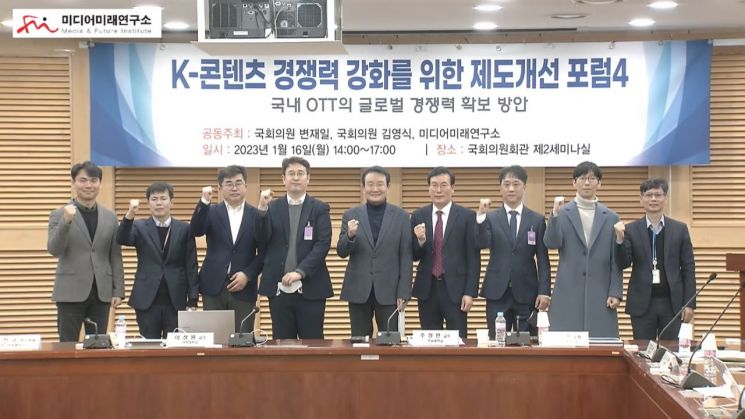 Participants of the 'Forum 4 on Institutional Improvements to Strengthen K-Content Competitiveness' are taking a commemorative photo.
 [Photo by Media Mirae Research Institute YouTube]
Professor Lee Sang-won of Kyung Hee University, who gave a presentation, said, "To enter the global market, indirect entry through strategic alliances with local broadcasting and telecommunications operators or global content providers, such as co-productions, should be pursued," adding, "It is important to consider that economies of scale in content must be realized."
In the following presentation, Lee Chan-gu, a research fellow at the Media Future Research Institute, emphasized, "We should aim for highly competitive Korean content to enter the global market through our own platforms," and added, "If we focus only on creating Korean content and plugging it into Netflix, we may turn ourselves into a subcontracting base for global OTTs. Support policies should be created to load Korean content onto Korean platforms."
Lee particularly argued for the need to expand tax credits to compete with overseas OTTs. He said, "Overseas, tax credits range from 20 to 30%, and up to 40% in some cases. Domestic tax benefits should be provided at levels similar to those abroad," and added, "The national advanced strategic industries bill passed in early January raised the tax credit to 15% within two weeks, but OTT is as important as semiconductors. There is room to increase tax credits for the content industry as well."
Representative Byeon also stated in his opening remarks that an increase in OTT tax credits is necessary. He said, "It is difficult to include K-content in the Advanced Strategic Industries Act because it does not meet the requirements. However, K-content has another kind of influence," and added, "K-content is a field that can elevate Korea's status. I think at least investment tax credits could be granted comparable to those for advanced strategic industries."
Kim Guk-jin, director of the Media Future Research Institute, said, "Among the top 14 Netflix contents announced by Business Insider last year, 'Ojingeo Game' (Squid Game) was number one in terms of viewership. It also ranked first in the Rotten Tomatoes score, which is a measure of quality," emphasizing, "Supporting number one content has been the industrial policy of past governments as a national strategic industry. Now is the time to recognize and devise support measures for the content sector's world-class competitiveness."
In the subsequent discussion, Go Chang-nam, director of TVING, said, "To enter the global market, the core must be strong. Last year, content investment costs increased tremendously, and we received 250 billion KRW in external investment, all of which was spent on original content," adding, "The problem is whether this can be sustained. TVING alone cannot do it. Institutional improvements and support are very much needed."
Lee Dong-jung, director of the Broadcasting Promotion Planning Division at the Ministry of Science and ICT, said, "There is a view that if tax credits for production costs are combined with investment tax credits, it could lead to double taxation," but added, "However, the detailed requirements for tax credits are stipulated in the Enforcement Decree and Enforcement Rules of the Restriction of Special Taxation Act, and the conditions are strict. We will discuss with tax authorities ways to relax these conditions so that OTT platforms can also receive production cost tax credit benefits."
© The Asia Business Daily(www.asiae.co.kr). All rights reserved.
![Clutching a Stolen Dior Bag, Saying "I Hate Being Poor but Real"... The Grotesque Con of a "Human Knockoff" [Slate]](https://cwcontent.asiae.co.kr/asiaresize/183/2026021902243444107_1771435474.jpg)















