Opening a Store Without Face-to-Face Staff in Texas
Only Humans Make Burgers in the Kitchen
Walmart and Starbucks Accelerate Automation Investments
[Asia Economy Reporter Jeong Hyunjin] The world's largest fast-food chain, McDonald's, opened a new drive-thru (DT) store near Fort Worth, Texas last month. According to the Guardian and other daily newspapers on the 9th (local time), this store is equipped with a fully automated system where customers receive their food directly via a conveyor belt without any staff attending to them when ordering through mobile or touchscreen.
There are employees in the kitchen preparing the food, but no staff directly face the customers. When a customer who pre-ordered stands at the end of the conveyor belt, a fully prepared Big Mac appears. McDonald's emphasized that this system will "provide faster and easier service to customers than before."
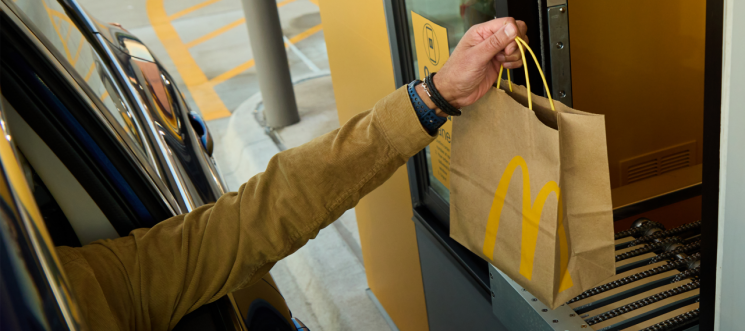 A customer is sitting in their car at a drive-thru store near Fort Worth, Texas, USA, taking products from the conveyor belt. (Photo by McDonald's official website)
McDonald's plans to accelerate the construction of 'automation' infrastructure centered on drive-thru stores going forward. They intend to apply the results of investments poured in over several years to the field one after another, increasing order processing speed, reducing labor costs, and maximizing profitability.
◆ McDonald's Strengthening Its Drive-Thru Advantage
McDonald's new automated store experiment focuses on expanding drive-thru stores rather than in-store dining. According to Bloomberg News, McDonald's has been seeking to expand drive-thru stores since the pandemic. Bloomberg reported that even before the COVID-19 crisis, two-thirds of sales came from drive-thru. CNN emphasized that since speed is crucial in competition with other fast-food chains, products must be made available quickly at the drive-thru.
Chris Kempczinski, McDonald's CEO, stated in an interview with major foreign media on the 6th that drive-thru lanes are so crowded that they cannot accommodate more vehicles. He explained that the experiment in Texas will be reviewed to determine whether it can be introduced not only in this store but worldwide. As the number of customers using drive-thru increases and speed becomes a competitive edge, introducing automation systems in the product production and delivery process is seen as a way to enhance growth potential, and McDonald's is investing accordingly.
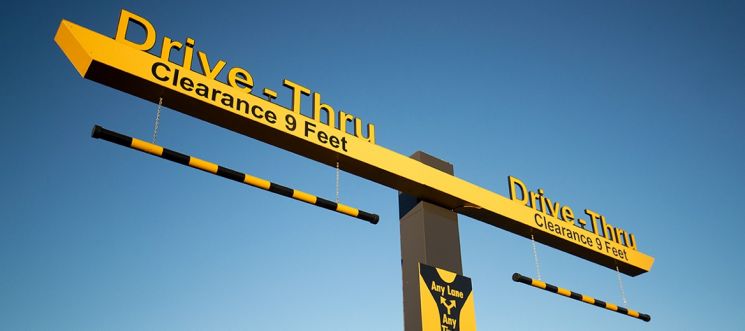
In South Korea, McDonald's made it possible to pay via Hi-Pass at drive-thru stores last month. Shinhan Card Hi-Pass card users can automatically pay without prior registration just by driving through McDonald's drive-thru. This is interpreted as an effort to resolve consumer inconvenience through payment system automation. Currently, payment is available at McDonald's Songpa Jamsil DT store and Goyang Samsong DT store, and Shinhan Card plans to expand the service to 30 major McDonald's stores nationwide by the first half of next year.
◆ "Investing 25% of Capital Expenditure in Automation Over the Next 5 Years"
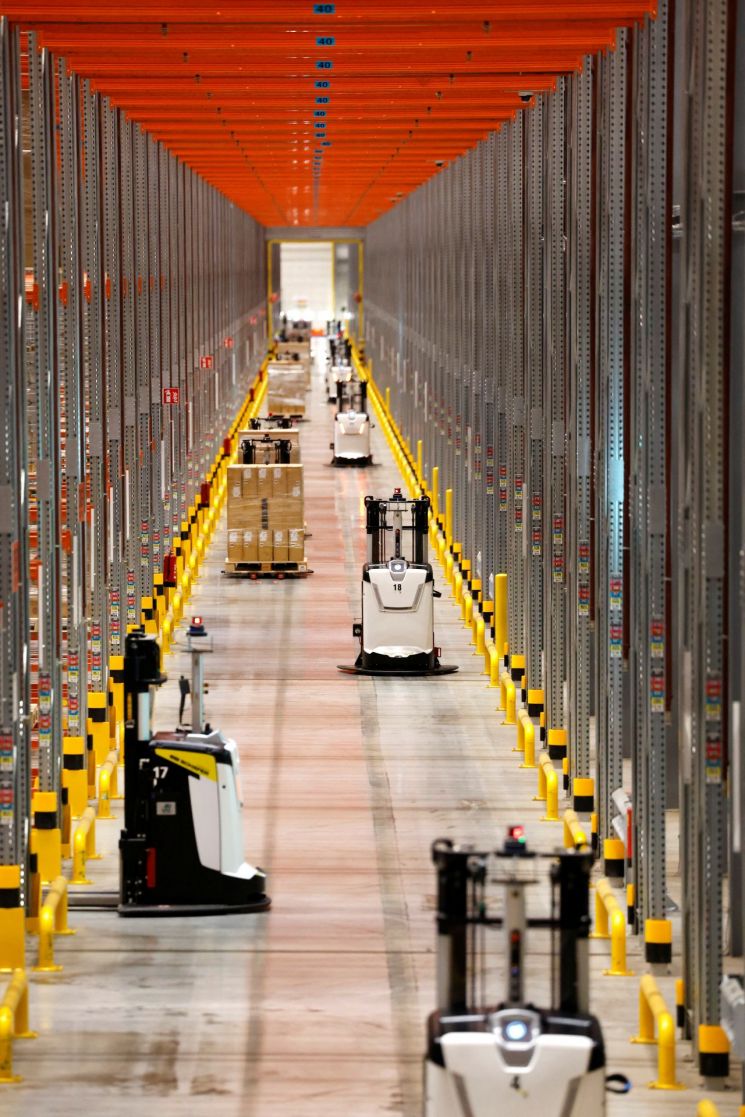
McDonald's is not the only retailer and consumer goods company focusing on automating product processes. According to the New York Times (NYT) and others, Walmart, the largest U.S. retailer, acquired robotics technology company Alert Innovation last October. Walmart has already deployed robots in logistics warehouses to select and pack products ordered online. Alert has been developing this technology with Walmart since 2016.
Starbucks is also pouring investments into automation. Last September, Howard Schultz, Starbucks founder, emphasized that automation systems would reduce beverage preparation time and simplify manufacturing methods to increase efficiency. Starbucks explained that by building automation systems such as machines that automatically fill ice cups with ice, the time to make a Mocha Frappuccino is reduced from the previous 1 minute 27 seconds to 35 seconds. Starbucks announced it will invest $450 million in equipment upgrades in fiscal year 2023.
According to a survey conducted by global consulting firm McKinsey in August last year targeting 65 executives in the automotive, grocery, life sciences, healthcare, pharmaceuticals, logistics, retail, and consumer goods sectors, respondents expected that companies' capital expenditure on automation over the next five years would be around 25%. McKinsey reported, "Among the surveyed industries, the retail and consumer goods sector is expected to spend the most capital on automation over the next five years." In the retail and consumer goods sector, 23% of respondents said they would invest more than $500 million in automation over the next five years, showing a strong willingness to pour massive funds.
◆ Where Do Employees Go When Processes Are Automated?
Corporate automation is directly related to employment issues. According to Bloomberg, McDonald's CEO Kempczinski explained the company's future strategy on the 6th and simultaneously stated, "To accelerate new store openings to meet surging demand, we plan to reduce staff. The layoffs will be completed by April 3." The strategy is to increase the number of stores but reduce the number of employees to improve profitability.
Starbucks maintains its position that automation is not intended to replace baristas but to automate and simplify tasks to make them easier.
© The Asia Business Daily(www.asiae.co.kr). All rights reserved.
![Clutching a Stolen Dior Bag, Saying "I Hate Being Poor but Real"... The Grotesque Con of a "Human Knockoff" [Slate]](https://cwcontent.asiae.co.kr/asiaresize/183/2026021902243444107_1771435474.jpg)

















