The Leading Variant of the Week May Change
13 Cases of U.S. XBB.1.5 Variant Detected
Prolonged Spread Possible Due to Various Variants
26% Positivity Rate Among Short-Term Visitors from China
Challenges Ahead Before Final Return to Normal Life
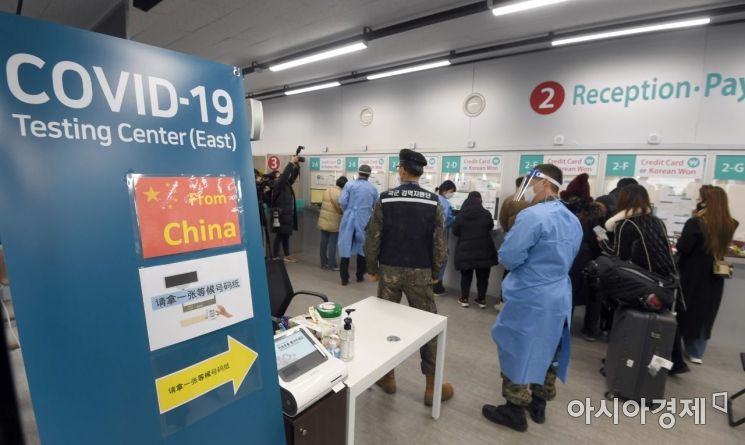 On the 2nd, when the government reinstated the mandatory COVID-19 PCR testing for arrivals from China, passengers from China were waiting to be tested at the COVID-19 Arrival Testing Center in Terminal 1 of Incheon International Airport.
 Yeongjongdo - Photo by Kang Jin-hyung aymsdream@
[Asia Economy Reporter Lee Gwan-ju] The BA.5 variant, which has led the domestic COVID-19 outbreak so far, is decreasing, while the BN.1 variant is increasing its share and is expected to become the dominant strain soon. Meanwhile, the number of confirmed cases from China is also rising, with one in four short-term entrants from China testing positive in a single day. Changes in the dominant variant and blocking the influx from China are expected to be the ‘final hurdle’ before lifting the indoor mask mandate.
According to the Central Disease Control Headquarters (CDCH) on the 5th, the most detected variant in Korea last week (December 25?31) was the BA.5 variant, which had led the outbreak. However, the share of BA.5 dropped by 7.9 percentage points from the previous week to 38.2%. Conversely, the BN.1 variant increased by 8.9 percentage points during the same period, reaching 33.3%. If this trend continues, BN.1 is predicted to become the dominant strain domestically this week.
Additionally, the XBB.1.5 variant currently spreading in the United States was first detected domestically on the 8th of last month and has since been found in a total of 13 cases (6 domestic, 7 imported). As of the end of last month, the XBB.1.5 variant accounted for 40.5% of cases in the U.S. The BQ.1 and BQ.1.1 variants, which are spreading in the U.S. and Europe, showed shares of 7.0% and 5.5%, respectively.
The BN.1 variant is derived from BA.2.75, known as ‘Kentauros,’ and was first identified domestically on September 22 of last year. If BN.1 surpasses BA.5 within four months, it is expected that BN.1 will be the central variant with other variants circulating alongside it for some time. This could place a significant burden on the quarantine system. Lim Sook-young, head of the CDCH Situation Management Division, explained, “The characteristic of BN.1 is that it has somewhat increased immune evasion ability compared to BA.2.75,” adding, “This allows it to evade immunity.” Although the winter resurgence is showing a slight decline, the prolonged outbreak due to various variants is still possible.
The consecutive confirmed cases among entrants from China add to the tension. Among 281 short-term entrants from China who arrived on the 3rd, 73 (26.0%) tested positive through PCR tests after entry. The government mandated PCR testing for short-term entrants from China starting on the 2nd, and over two days (2nd?3rd), 136 out of 590 confirmed cases (23.0%) were detected. With the mandatory submission of a negative test certificate before entry starting on the 5th, the number of confirmed cases is expected to decrease somewhat.
The problem is that the variants spreading in China differ somewhat from those in Korea. Variant analysis of entrants from China last week showed 77% BA.5 and 21.5% BF.7. The domestic detection rate of the BF.7 variant during the same period was only 3.4%. If there are gaps in quarantine measures for entrants from China, it could trigger simultaneous outbreaks of multiple variants. Cho Kyu-hong, 1st Deputy Head of the Central Disaster and Safety Countermeasures Headquarters (Minister of Health and Welfare), said, “We must not lower our guard to prevent the COVID-19 outbreak in China from spreading domestically.”
After three years of the COVID-19 outbreak, the lifting of the indoor mask mandate, which essentially signifies the transition to an ‘endemic’ phase (periodic infectious disease outbreaks), has come to the forefront. The emergence of new variants and the influx from China represent the final challenge. Lim said, “The criteria announced regarding the adjustment of the mask mandate are whether the 7th wave has passed its peak and is stably maintained, and whether the medical response capacity is sufficiently prepared.” He added, “We will fully assess the impact of the COVID-19 situation in China on Korea and decide the timing of adjustments accordingly.”
© The Asia Business Daily(www.asiae.co.kr). All rights reserved.
![Clutching a Stolen Dior Bag, Saying "I Hate Being Poor but Real"... The Grotesque Con of a "Human Knockoff" [Slate]](https://cwcontent.asiae.co.kr/asiaresize/183/2026021902243444107_1771435474.jpg)















