Latest K2 Tank Units Replaced by Export Shipments to Poland
Numerous Aging M-Series Tanks... Compared to North Korean Forces
[Asia Economy Yang Nak-gyu, Military Specialist Reporter] Although North Korea's armored forces are strengthening, there are criticisms that our military is actually retreating. In particular, urgent measures are needed as our military is sending even the latest tanks that should be deployed to overseas markets for export.
Unable to Repair Aging Army Tanks
According to the military on the 5th, the M-series tanks operated by the Army are the M48A3K tank (about 200 units) and the M48A5K tank (about 400 units). However, the M48 series tanks lack the ability to ford rivers and cannot fire while on the move. They also do not have active protection systems (technology that detects and tracks threats such as anti-tank missiles and protects itself) or explosive reactive armor. The M-series tanks operated in seven divisions are severely aged, causing their mobility to drop from 50 km/h to 20-30 km/h.
Repair and maintenance costs were also high. As of 2011, a total budget of 17.339 billion KRW was allocated for maintenance of the M48A5K tanks. This means an average annual maintenance cost of 35 million KRW per tank. Notably, out of 4,773 repair parts, 906 items have been discontinued. The production of tank barrels has also ceased since 2019.
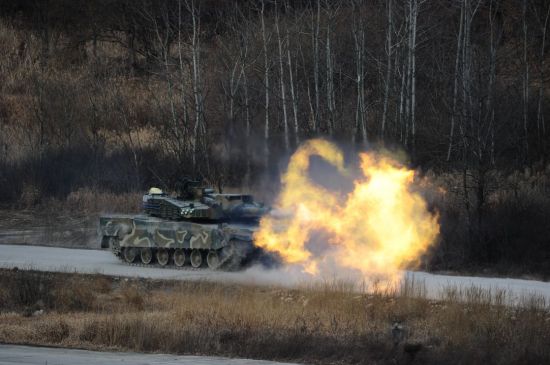
In response, the Army hastened the introduction of the K2 tank. Starting from 2014, it began deployment with 100 units in the first production batch, 106 units in the second batch, and is currently producing 54 units in the third batch. The third batch was planned to be distributed across regions such as Gyeonggi and Gangwon with 10 units last year, 18 units this year, and 4 units in 2024. However, with the export of K2 tanks to Poland, these units are being sent overseas instead of being deployed to the Army.
The problem is that there is no budget for the fourth production batch this year despite this situation. The military sees the need to deploy over 150 units through the fourth batch. However, since additional tanks are not being produced and production is being diverted to exports, the military strength is inevitably weakening.
Will Domestic Powerpacks Be Installed in the Fourth Production Batch?
The ‘powerpack’ to be installed in the K2 tank is also an issue. A powerpack is a term combining the engine and transmission. It is a core device that drives the tank, which costs over 10 billion KRW per unit, and controls speed and direction. The powerpack is known as the ‘heart of the tank.’
The military attempted to domestically produce the powerpack but has repeatedly failed in development. The development project for the domestic transmission of the K2 tank powerpack was undertaken by SNT Heavy Industries from 2005 to 2014 with an investment of 48.5 billion KRW. However, even though the second batch of K2 tanks began production in 2016, the domestic transmission for the powerpack did not pass durability tests. Subsequently, in 2018, the Defense Acquisition Program Administration decided to equip a hybrid powerpack combining a domestic engine and a German transmission.
Recently, Hyundai Rotem, which produces the K2 tank, terminated its contract with SNT Heavy Industries, the manufacturer of the transmission in the powerpack. Due to this termination, SNT Heavy Industries had to compensate Hyundai Rotem over 20 billion KRW.
Some argue that for reasons such as royalties and localization, the domestic powerpack should be installed in the fourth production batch. The Ministry of National Defense and the Defense Acquisition Program Administration revised defense standards due to repeated failures in domestic powerpack development. They moved away from the vague expression ‘no defects during testing’ to specifically define defects. Defects are defined as loss of basic transmission functions such as shifting, steering, braking, or severe performance degradation that prevents further testing. This has sparked controversy over preferential treatment for the company.
North Korean Tanks Are Undergoing Performance Upgrades
While our armored forces are weakening, North Korea is reinforcing its tanks. North Korea currently possesses about 3,500 tanks, with the main battle tanks being the ‘Chonmaho’ and ‘Pokpung-ho.’
The Chonmaho is an upgraded version of the Russian T-62 tank. It first appeared at North Korea’s military parade on October 10, 2010. Currently, at least 1,000 units are in operation. It is equipped with a new computer system, thermal imaging, and an automatic loader. The Chonmaho’s hull length is 6.63 meters, width 3.52 meters, height 2.4 meters, with a top speed of 50 km/h, operational range of 450 km, and weight of 40 tons.
The Pokpung-ho tank was developed in the 1990s by the Second Economic Committee and the Second Academy of Defense Science under the Workers' Party of Korea and has been produced at the Ryugyong Electronics Factory since 2002. The Pokpung-ho’s hull is about 7 meters long, 3.5 meters wide, and 2.2 meters high. Its top speed is 60 km/h, operational range up to 500 km, and it weighs 44 tons.
The Pokpung-ho is an upgraded main battle tank based on the former Soviet T-62, presumed to be equipped with a new 125mm or 115mm main gun. It is armed with a more powerful 14.5mm Soviet KPV anti-aircraft machine gun compared to the 12.7mm machine guns mounted on older North Korean tanks, enhancing firepower to counter attack helicopters from South Korea and the U.S. It is equipped with a laser rangefinder and infrared searchlight, and is believed to have a modernized fire control system compared to previous North Korean tanks, improving accuracy.
An industry insider said, “The K2 tank uses an automatic loading system, reducing crew numbers, which can respond to the trend of decreasing military personnel. Moreover, the fourth production batch can generate employment for 12,000 people and an economic ripple effect of 5.33 trillion KRW.”
© The Asia Business Daily(www.asiae.co.kr). All rights reserved.
![Clutching a Stolen Dior Bag, Saying "I Hate Being Poor but Real"... The Grotesque Con of a "Human Knockoff" [Slate]](https://cwcontent.asiae.co.kr/asiaresize/183/2026021902243444107_1771435474.jpg)














