Ministry of Land, Infrastructure and Transport 2023 Key Work Plan
Guaranteeing Citizens' Mobility Rights... Full-Scale Mobility Era
Infrastructure Development for Full Autonomous Driving by 2027
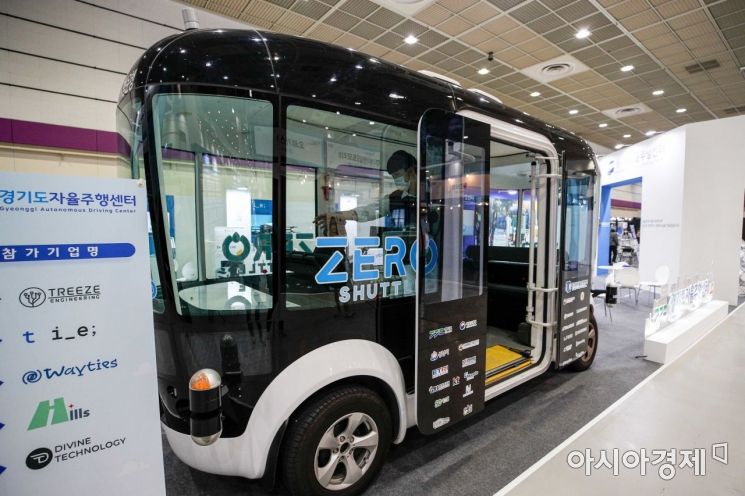 Gyeonggi-do autonomous vehicles are exhibited at the '2022 Smart Mobility Logistics Industry Exhibition' held at COEX in Gangnam-gu, Seoul. / Photo by Jinhyung Kang aymsdream@
[Asia Economy Reporter Noh Kyung-jo] The metropolitan area express railroads (GTX) lines A, B, and C will be opened on schedule to drastically reduce commuting times in the metropolitan area to around 30 minutes and establish the basis for guaranteeing mobility rights as a fundamental right of the people. Platform taxis such as Kakao Taxi will introduce destination non-disclosure and pre-fixed fare systems to improve service quality. Infrastructure construction will also begin to realize the era of fully autonomous driving by 2027.
On the 3rd, the Ministry of Land, Infrastructure and Transport announced the major work plan for 2023 under the theme of "Realizing Transportation Innovation for Public Convenience and Future Industry Foundation" at the Blue House State Guest House.
For GTX, Line A will complete comprehensive test runs on the publicly funded section and tunnel excavation on the privately funded section in the second half of this year. Line B will start design work on the publicly funded section and select preferred negotiation candidates for the privately funded section this month. Line C will complete the private sector eligibility review next month and sign the implementation agreement in the second half of the year.
The Daegok-Sosa Line and Byeollae Line will open in the second half of this year and next year, respectively, and the Daejang-Hongdae Line and Wirye-Gwacheon Line projects will also be accelerated. The extension of Seoul Subway Line 5 is also included in this year’s work plan.
Regarding metropolitan buses and Bus Rapid Transit (BRT), the supply of charter buses will increase from 135 to 203 trips, and the number of semi-public operation routes will expand from 101 to 153. The scope of demand-responsive transport (DRT) services will be widened, and a pilot project for general metropolitan bus express routes will be launched in June.
Taxi restrictions will be reviewed for lifting in over 40 regions nationwide. Along with improving the service quality of platform taxis, measures to improve driver treatment, fares, licenses, and the industrial structure will be prepared in the first half of the year.
The Ministry also announced plans to enact the Basic Transportation Policy Act in the second half of the year and establish the "Basic Transportation Plan" as the highest-level plan. Related research projects are currently underway.
Bus fare support to eliminate blind spots for transportation-vulnerable groups will be expanded from city buses to intercity buses within the same metropolitan transportation area. In regions where bus routes are reduced, alternative means will be operated, and plans to revitalize taxis exclusively for transportation-vulnerable groups will be prepared in the second half of the year.
Bold regulatory improvements will also support private-led future mobility innovation. The Cooperative Intelligent Transport System (C-ITS), which shares information in real time between vehicles and between vehicles and roads, will be built nationwide without delay, and the autonomous driving dedicated advanced test complex (K-City) will be upgraded according to technology development demands.
Earlier, preparations for institutional arrangements for the commercialization of autonomous vehicles began, and the Autonomous Vehicle Act will be amended by the end of this year to introduce a performance certification system to enable faster operation. The number of pilot operation zones will increase to more than 20, and the Mobility Act, which includes regulatory exemptions, is planned to be enacted in March.
A Ministry official said, "To fully implement the mobility innovation roadmap announced last September, the Mobility and Automobile Bureau was launched last month," adding, "In addition, through the establishment of the Drone Industry Development Strategy 3.0 and expansion of unmanned delivery, we will also realize aviation mobility and smart logistics mobility."
© The Asia Business Daily(www.asiae.co.kr). All rights reserved.
![Clutching a Stolen Dior Bag, Saying "I Hate Being Poor but Real"... The Grotesque Con of a "Human Knockoff" [Slate]](https://cwcontent.asiae.co.kr/asiaresize/183/2026021902243444107_1771435474.jpg)















