Strengthened Standards for Interfloor Noise from the 2nd
Increased Possibility of Dispute Resolution and Compensation
Irregular Interfloor Noise...Challenges in Proving Damage
[Asia Economy Reporter Yoon Seul-gi] From the 2nd, the standards for inter-floor noise generated by running or walking inside apartments will be strengthened. The government expects that the strengthened inter-floor noise standards will reduce the level of annoyance felt in daily life to less than half, but there are also concerns that there are limits to improving the chronic inter-floor noise problem.
According to the Ministry of Environment, from the 2nd, the 1-minute equivalent noise level standard for 'direct impact noise' generated by running or walking among inter-floor noises will be lowered by 4dB from the existing standard to 39dB (decibels) during the daytime (6 a.m. to 10 p.m.) and 34dB during the nighttime (10 p.m. to 6 a.m.) under the "Regulations on the Scope and Standards of Inter-floor Noise in Multi-family Housing."
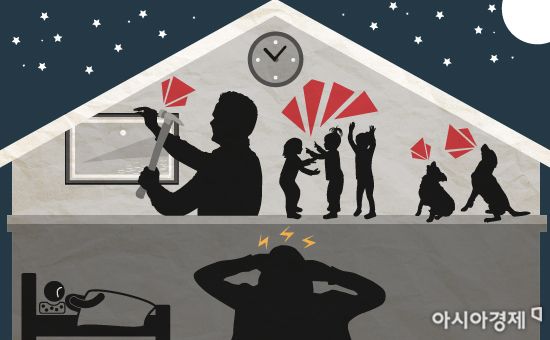 From the 2nd, the government will strengthen the 1-minute equivalent noise level standards for 'direct impact noise' caused by running or walking, which is a type of noise between floors.
Inter-floor noise is largely divided into direct impact noise and airborne noise. The direct impact noise standards consist of two types: '1-minute equivalent noise level' and 'maximum noise level' (57dB during the day and 52dB at night). In this revision, only the 1-minute equivalent noise level standard has been strengthened. The airborne noise standards (45dB during the day and 40dB at night) remain unchanged.
Exceptions applied to older apartments are also reduced. The existing regulations allowed an additional 5dB to be added to the inter-floor noise standards for multi-family housing approved before June 2005. The new regulations maintain the 5dB addition until 2024, after which only 2dB will be added.
However, it is uncertain whether this will lead to actual effects. Cha Sang-gon, director of the Residential Culture Improvement Research Institute, pointed out, "If inter-floor noise data measured without prior notice is used in court, it may violate the Personal Information Protection Act," adding, "Since consent must be obtained from the noise provider, noise measurement may not proceed smoothly."
Also, since the average value measured over 1 minute is recognized as noise, there is a possibility that damage caused by intermittent inter-floor noise may not be proven. The long-standing issue of poor construction by contractors, which has been cited as a major cause of inter-floor noise, remains unresolved.
 The photo is not related to the specific content of the article. Photo by Yonhap News.
However, it is expected to have a certain effect in improving lifestyle habits that cause inter-floor noise. The government predicted that once the strengthened inter-floor noise standards are implemented, the level of annoyance felt in daily life under the current daytime inter-floor noise standard (1-minute equivalent noise level of 43dB) will decrease from 30% to 13%, reducing the actual perceived annoyance to less than half compared to before.
Additionally, when inter-floor noise disputes occur, the possibility of having the damage recognized during the dispute resolution process through inter-floor noise dispute mediation institutions increases. If it is confirmed that the noise exceeds the inter-floor noise standards and the noise-generating behavior does not stop, compensation mediation can be received through the Central Environmental Dispute Mediation Committee (Ministry of Environment) or the Multi-family Housing Management Dispute Mediation Committee (Ministry of Land, Infrastructure and Transport).
The Ministry of Environment plans to conduct a pilot project in the first half of the year to provide inter-floor noise consultations near workplaces for office workers. It will also carry out a free noise meter rental project in cooperation with local governments.
© The Asia Business Daily(www.asiae.co.kr). All rights reserved.
![Clutching a Stolen Dior Bag, Saying "I Hate Being Poor but Real"... The Grotesque Con of a "Human Knockoff" [Slate]](https://cwcontent.asiae.co.kr/asiaresize/183/2026021902243444107_1771435474.jpg)















