In-Person Event Held for the First Time in 3 Years Since COVID-19
Traffic Control in Jongno Area from 9:30 PM on the 31st
[Asia Economy Reporter Yoon Seul-gi] To welcome the Year of the Black Rabbit in 2023, the year of Gyemyo (癸卯年), bell-ringing events will be held across the country on New Year's Eve.
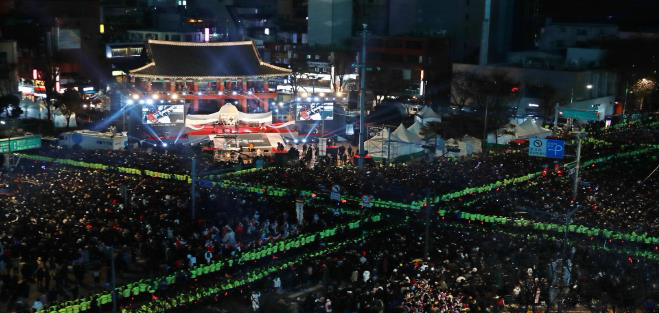
For the first time in three years since 2019, the New Year's Eve bell-ringing ceremony will be held at Bosingak in Gwancheol-dong, Jongno-gu, Seoul. According to the Seoul Metropolitan Government, the bell-ringing event at Bosingak will begin with a pre-ceremony starting at 10:50 PM on the 31st. This year's bell-ringing event will be broadcast live from Gwanghwamun Square and Dongdaemun Design Plaza (DDP) in conjunction with the Bosingak ceremony.
The 10 citizen representatives participating in the Bosingak bell-ringing ceremony include notable figures who made headlines in Korean society this year, such as soccer player Jo Gyu-seong, a key player in Korea's advancement to the Round of 16 in the Qatar World Cup.
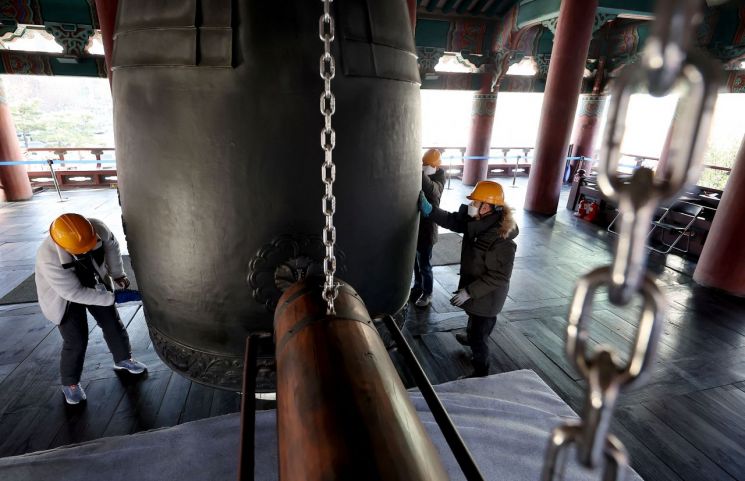 On the afternoon of the 28th, ahead of the New Year, employees from the Cultural Heritage Policy Division of Seoul City Hall are thoroughly cleaning the dust off the bell at Bosingak in Jongno-gu, Seoul, in preparation for the New Year's Eve bell-ringing event held for the first time in three years. Photo by Yonhap News
It is expected that around 100,000 people will gather near Bosingak on the day. The Seoul Metropolitan Government announced that it will implement safety measures including traffic control to manage crowd density.
At six nearby subway stations including Jonggak Station and Gwanghwamun Station, more than five times the usual number of safety personnel (a total of 104) will be on duty. Police and fire authorities will also deploy additional personnel. On Line 1 of the subway, trains will pass through Jonggak Station without stopping from 11 PM on the 31st until 1 AM the next day. During this no-stop period, all entrances to Jonggak Station will be completely closed.
The police will fully restrict traffic around Bosingak in Jongno-gu, where the New Year's Eve bell-ringing event takes place, from 9:30 PM on the 31st until 1:30 AM on January 1st. Both directions of traffic will be blocked at intersections from Sejong-daero to Jongno 2-ga, Anguk-dong intersection to Gwanggyo intersection, and Gwanggyo intersection to Euljiro 1-ga intersection.
Additionally, about 180 traffic police officers will be deployed at major intersections including around Bosingak, and 84 signboards and 140 banners will be installed to guide vehicles to detours, minimizing traffic congestion and inconvenience to citizens.
After the event, public transportation will be extended until 2 AM to ensure safe return home for citizens. The operating hours of Seoul Subway Lines 1 through 8 will be extended to run until 2 AM based on the last train schedule on January 1st.
Meanwhile, Gwangju will also hear the New Year's Eve bell for the first time in three years. Gwangju City will hold a year-end and New Year festival for about 70 minutes starting at 11:30 PM on the 31st at the 5·18 Democracy Square and Minju Bell Pavilion area.
Daegu City will hold a New Year's Eve bell event starting at 10 PM on the 31st at a special stage in front of the Dalgubeol Bell at the National Debt Repayment Movement Memorial Park. The bell-ringing ceremony will include 33 bell ringers, including heads of major institutions and organizations as well as proud citizens who shone this year. After the bell-ringing, Daegu Mayor Hong Joon-pyo will deliver a New Year's address, followed by a chorus of "Guchanga" with citizens and a multimedia fireworks show.
Busan will also hold a bell-ringing event. Busan Mayor Park Hyung-joon, Busan City Council Chairman Ahn Seong-min, Busan Superintendent of Education Ha Yun-su, and 24 citizen representatives will participate in ringing the bell 33 times. Prior to the bell-ringing, starting at 6 PM on the 31st, a large rabbit moon photo zone will be set up around the event site, and a wish ball writing event for the New Year will be held.
The New Year's Eve bell originally comes from a Buddhist event where each temple rings the bell 108 times on Je-seok or Daehui-il to eliminate the 108 worldly desires of sentient beings.
The number of bell rings is 33, a custom also derived from Buddhism. It symbolizes the bell ringing widely in Doricheon (the 33 heavens) to pray for national peace and the well-being of the people. Doricheon refers to the summit of Mount Sumeru, the center of the world, and originates from a Buddhist myth where Avalokitesvara Bodhisattva split into 33 heavens to save sentient beings from evil.
© The Asia Business Daily(www.asiae.co.kr). All rights reserved.
![Clutching a Stolen Dior Bag, Saying "I Hate Being Poor but Real"... The Grotesque Con of a "Human Knockoff" [Slate]](https://cwcontent.asiae.co.kr/asiaresize/183/2026021902243444107_1771435474.jpg)
















