Visible Defense Achievements Expected with Military Reconnaissance Satellites
Kim Yo-jong "It's Worth Trying"... Suggests ICBM Normal Trajectory
Political Anniversaries Clustered in 'Jeongjubyeon' Year... "Emphasizing Confrontation Dynamics"
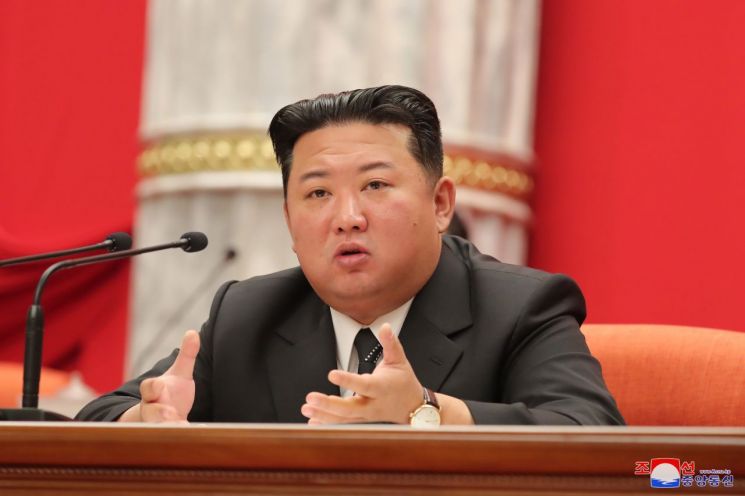
[Asia Economy Reporter Jang Hee-jun] North Korea is set to hold a Workers' Party plenary meeting this week to discuss the direction of national governance for the new year. Amid heightened military tensions this year, attention is focused on whether Chairman Kim Jong-un will present a progressive stance regarding nuclear and strategic weapons development. Since the plenary meeting has replaced the New Year's address, there is also interest in whether new messages toward South Korea and the United States will emerge.
On the 1st of this month, North Korea announced the convening of the 8th Central Committee's 6th plenary meeting scheduled for late this month, during a Politburo meeting presided over by Chairman Kim. The main agenda items include reviewing this year's party and state policies, next year's work plans, and a series of important issues arising in the current stage of party and revolutionary development.
The "series of important issues" is presumed to refer to military policy, an area where North Korea has concentrated its capabilities in recent years. North Korea declared the legalization of its nuclear forces in early September and, in November, boasted of launching the intercontinental ballistic missile (ICBM) Hwasong-17 at its maximum altitude and range.
Amid unstable circumstances, North Korea has highlighted strengthening "self-defensive" national defense capabilities as this year's greatest achievement to safeguard the regime. Therefore, the new year's goals are likely to focus on accelerating nuclear force enhancement and the development of new strategic weapons. Specifically, "military reconnaissance satellite development" and "normal-angle ICBM launches" are cited.
The North Korean National Aerospace Development Administration recently announced through the Korean Central News Agency that "preparations for the first military reconnaissance satellite will be completed by April 2023." As a stepping stone, on the 18th, they claimed to have conducted a crucial final-stage test for reconnaissance satellite development at the Sohae Satellite Launching Station in Dongchang-ri, Cholsan County, North Pyongan Province. Additionally, a statement by Party Vice Director Kim Yo-jong on the 20th, reacting sharply to doubts about ICBM launch capabilities, has drawn attention. At that time, Vice Director Kim said, "It is something that will be seen soon, and won't it be clear once it is seen?" implying a normal-angle launch.
Next year is also politically significant. It marks the 75th anniversary of the founding of the Korean People's Army (February 8), the 70th anniversary of the armistice agreement, which North Korea claims as the "Victory Day of the Fatherland Liberation War" (July 27), and the 75th anniversary of the establishment of the regime (September 9), all major political anniversaries.
Anniversaries ending in 5 or 10 years are considered milestone years, and North Korea has traditionally held grand commemorative events on such occasions. Recently, satellite images have continuously captured preparations for large-scale military parades centered around the Mirim Airfield area in Pyongyang. It cannot be ruled out that North Korea might use these anniversaries to further escalate threats toward South Korea and the United States, emphasizing confrontation.
However, since past plenary meetings have not separately addressed inter-Korean relations, the likelihood of new South Korea-related policies or messages emerging from this meeting is considered low. Nevertheless, given North Korea's recent justification of the "need to strengthen nuclear forces" amid intensifying U.S.-China hegemonic competition, there is speculation that they may announce a groundbreaking stance related to nuclear force advancement.
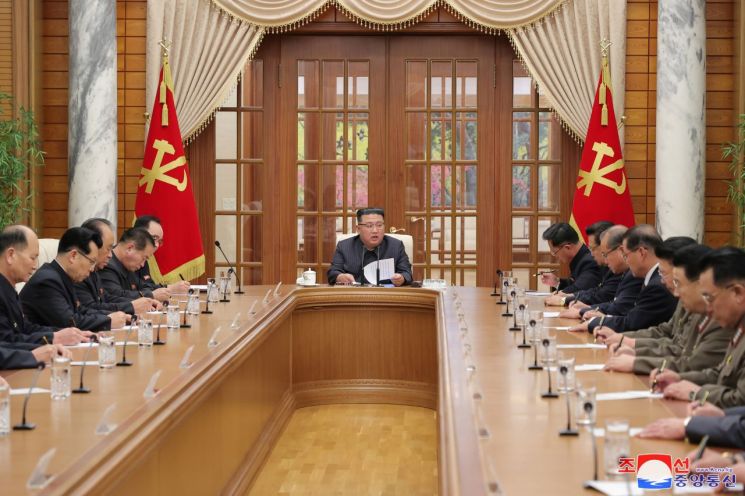 Scene from the 11th Political Bureau Meeting of the 8th Central Committee of the Workers' Party of Korea held on November 30, presided over by Kim Jong-un, Chairman of the State Affairs Commission of North Korea [Image source=Yonhap News]
In addition, it is expected that the "food issue," which North Korea has recently focused on, will be given significant attention. Next year marks the third year of the "Five-Year National Economic Development Plan," and Chairman Kim has emphasized it as "an important year to establish a decisive guarantee for plan completion."
Accordingly, North Korea is likely to maintain a policy of revising and reinforcing existing plans while pushing forward projects that raise targets above this year’s levels or visibly improve people's livelihoods.
This year, North Korea completed the Yeonpo Greenhouse Farm, promoted rural housing construction, and modernized local industrial factories. Unusually, they held a "Flour Food Exhibition" featuring many Western dishes, and through the October 5th edition of the Rodong Sinmun, they set a goal to "increase gross domestic product by more than 1.4 times and people's consumption production by more than 1.3 times compared to 2020 by 2025."
Meanwhile, year-end plenary meetings in North Korea typically take place over 4 to 5 days during the last week of December. In 2019 and 2021, after holding year-end plenary meetings, state media such as the Rodong Sinmun on January 1st of the new year extensively reported the results. This time, it is expected that the plenary meeting will similarly replace the New Year's address. In the 2019 plenary meeting, North Korea escalated threats toward the U.S. while hinting at the possibility of dialogue, whereas in 2021, there was no separate mention of policies toward South Korea or the U.S.
© The Asia Business Daily(www.asiae.co.kr). All rights reserved.
![Clutching a Stolen Dior Bag, Saying "I Hate Being Poor but Real"... The Grotesque Con of a "Human Knockoff" [Slate]](https://cwcontent.asiae.co.kr/asiaresize/183/2026021902243444107_1771435474.jpg)
















