Democratic Party The Better Future to Hold Electoral System Reform Forum on 21st
Current Single-Member District System Causes Poor Representation and Wasted Votes
Full-Scale Discussions on Electoral System Overhaul Underway
[Asia Economy Reporter Naju-seok] Will the 'winner-takes-all' single-member district system be maintained in the next general election? Ahead of the 2024 general election, discussions on electoral district reform have begun in earnest within the Democratic Party of Korea. The direction of political reform is to overcome the limitations of the single-member district system (where only one representative is elected per region).
On the 21st, the Democratic Party's policy opinion and political action group 'The Better Future' held an 'Electoral System Reform Forum' at the National Assembly. At this event, they discussed electoral district reform measures focusing on proportional representation reform and the introduction of a multi-member district system. Experts and lawmakers pointed out that the current electoral system causes political polarization, can be an obstacle to regional balanced development, and lacks representativeness.
Im Mi-ae, Chairperson of the Democratic Party's Gyeongbuk Provincial Committee, who participated as a discussant, introduced the reality where votes from Democratic Party supporters in the Gyeongbuk region become wasted votes. Chairperson Im said, "Many people talk about a multi-party system, but (Democratic Party supporters in the Gyeongbuk region) say they would even like to try a two-party system," adding, "The focus of electoral system reform should be on preparing realistic alternatives to overcome regionalism."
She also criticized the argument that rural areas should maintain the single-member district system during discussions on the multi-member district system. This argument was used to justify maintaining the single-member district system to preserve rural representation. Regarding this, Chairperson Im stated, "Yeongju, Yeongyang, Uljin, and Bonghwa form one electoral district, but it has already lost regional representativeness," and added, "The claim that the single-member district system is necessary because of rural areas no longer holds."
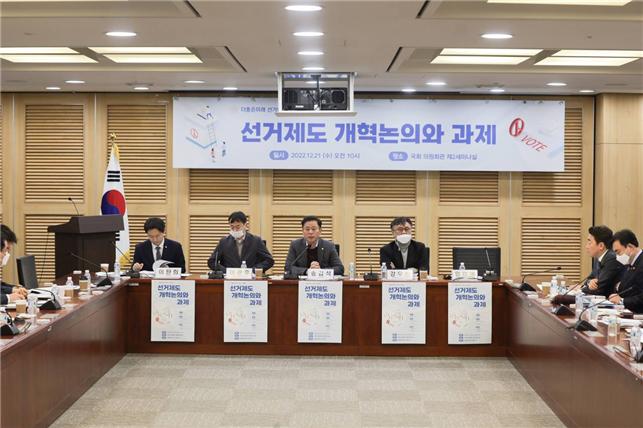
Kang Woo-jin, a professor in the Department of Political Science and Diplomacy at Kyungpook National University, who presented at the forum, pointed out that the current electoral system fundamentally has problems with representativeness. Professor Kang said, "Since democratization, Korean youth have been overwhelmingly underrepresented," noting, "There were only 4 representatives in their 20s and 91 in their 30s, accounting for just 5% of the 2,700 elected officials," and criticized, "Over 35 years of democratization, Korean democracy's representativeness has been heavily biased toward highly educated, over 50s, and graduates from metropolitan universities."
He added, "More than half of Korean youth believe that the National Assembly does not represent them."
Professor Kang also said, "Looking at the 21st National Assembly, one-third of all members (103 members) are graduates of SKY (Seoul National University, Yonsei University, Korea University), with an average age of 55, male, and their occupation being politicians," and emphasized, "Electoral reform is crucial in how to represent groups that have not been represented in the current cartel-like system."
Lee Kwan-hoo, a researcher at Sogang University Social Science Research Institute, said, "The single-member district system elects elites in a way that does not secure the diversity of the people," but also pointed out, "This system results in many wasted votes, makes gerrymandering (unfair electoral district delimitation) easy, and strengthens regional bias." Lee said, "If political indifference, cynicism, and populism increase under the single-member district system, it could weaken voter representativeness," and added, "The equality of votes can also be practically damaged depending on how electoral districts are drawn."
He mentioned, "In Korea's case, as the number of metropolitan area representatives increases according to population proportion, interest in regional imbalance and budget support may decrease," and noted, "One of the reasons regional balanced development weakened during the Moon Jae-in administration was the increase in metropolitan area representatives." This points out that the single-member district system can act as a catalyst accelerating regional imbalance.
Concerns over Hate in the 2024 General Election... Electoral Districts Based on Living Areas as a Solution
At the forum, concrete solutions were also presented. Lee Tan-hee, a Democratic Party lawmaker and member of The Better Future's electoral law task force, argued for the necessity of transitioning from the single-member district system to electoral districts based on living areas. Lee said, "The 2024 general election could be the worst negative election in history," expressing concern, "With the support bases of the two major parties (Democratic Party and People Power Party) divided, the fight will be over 2-3%, and while the parties may compete to win votes, it is easier to prevent the other side from getting votes. Politics is heading that way, and the next general election could be a hateful negative election."
He added, "The method of each party nominating one candidate in finely divided electoral districts limits voters' choices," and argued, "If electoral districts are grouped by living areas and 4-5 candidates are elected from one district, voters can choose both the party and the candidate, which would increase representativeness."
Kang Hoon-sik, a Democratic Party lawmaker and representative of The Better Future, said, "The goal is to establish The Better Future's position," and added, "There are various alternatives and demands related to electoral law reform, so I felt the need to hear more opinions."
© The Asia Business Daily(www.asiae.co.kr). All rights reserved.
![Clutching a Stolen Dior Bag, Saying "I Hate Being Poor but Real"... The Grotesque Con of a "Human Knockoff" [Slate]](https://cwcontent.asiae.co.kr/asiaresize/183/2026021902243444107_1771435474.jpg)















