[Asia Economy New York=Special Correspondent Joselgina] The U.S. central bank, the Federal Reserve (Fed), implemented a so-called ‘big step’ by raising the benchmark interest rate by 0.5 percentage points at once, signaling a slowdown in the pace of tightening. However, the dot plot confirmed that monetary tightening will continue for the time being, with next year’s rate forecast raised to 5.1%. Fed Chair Jerome Powell dismissed market expectations of a pivot, stating, "We are not considering rate cuts yet."
◆Fed Big Step as Expected, Korea-U.S. Interest Rate Gap Widens to 1.25%P
On the 14th (local time), the Fed announced after the Federal Open Market Committee (FOMC) regular meeting that it would raise the federal funds rate by 0.5 percentage points from the previous 3.75?4.0% to 4.25?4.5%. This marked a slowdown from the previous four consecutive giant steps (0.75 percentage point hikes). As a result, the U.S. benchmark interest rate reached its highest level since 2007.
This pace adjustment had been anticipated for some time. Chair Powell had hinted at a slowdown as early as December, and recently released inflation data indicated that the worst phase might be over. At the press conference, Powell said, "Now, the speed of increases is not as important as the level of the terminal rate," adding, "How long to maintain the tightening stance will also be an important question."
The FOMC stated in its statement that "sufficient restrictive policy is necessary to bring inflation back to the 2% target," and that in deciding the pace of rate hikes, it would consider "the cumulative restrictive monetary policy, the lagged effects of monetary policy on economic activity and inflation, and economic and financial developments." This is largely similar to the November statement.
With the Fed’s rate decision, the interest rate gap between South Korea (3.25%) and the U.S. widened to 1?1.25 percentage points, approaching the largest historical Korea-U.S. rate inversion of 1.50 percentage points. This has heightened concerns about foreign capital outflows and the depreciation of the Korean won. However, the burden on the Bank of Korea to raise rates is expected to ease somewhat. The market expects the Bank of Korea’s Monetary Policy Committee to raise rates by 0.25 percentage points at the January 13 monetary policy meeting next year.
◆Next Year’s Rate Forecast Raised to 5.1%...Powell Says "No Consideration of Cuts"
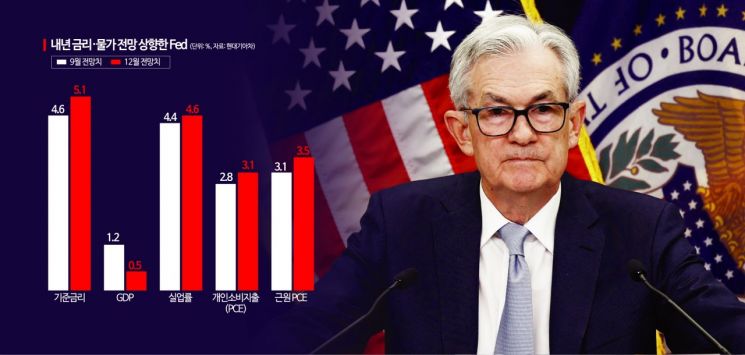
On the same day, the Fed raised the median terminal rate forecast for next year to 5.1% in the dot plot compiled from members’ projections, clearly signaling its intention to maintain "higher rates for longer." The dot plot’s 5.00?5.25% range (median 5.1%) for next year is 0.5 percentage points higher than the September forecast of 4.5?4.75% (median 4.6%).
It signals an additional 0.75 percentage point rate hike next year. Powell noted, "Seventeen out of 19 FOMC participants expect the terminal rate next year to be above 5%," and assessed that "the policy stance is not yet sufficiently restrictive, so continued rate hikes are appropriate."
This rate outlook exceeds initial market expectations. Powell said, "We have raised rate forecasts each time we released the Summary of Economic Projections (SEP) this year," adding, "I am not confident that we will not raise them again. It will depend on future data," leaving open the possibility of further upward revisions.
When asked about plans for rate cuts next year, Powell firmly stated, "We are not considering rate cuts yet." He emphasized, "The Fed’s focus is on maintaining sufficiently restrictive policy to achieve the 2% inflation target, not on cutting rates," adding, "The SEP does not reflect any possibility of rate cuts."
This reflects the Fed’s assessment that achieving the ‘price stability’ goal is not as easy as expected. According to the SEP released that day, the Fed’s preferred inflation gauge, the core Personal Consumption Expenditures (PCE) price index forecast for next year, was revised upward to 3.5% from the September forecast of 3.1%. This suggests that high inflation may become entrenched, and the Fed’s tightening stance may continue.
While acknowledging recent consumer price index (CPI) figures that fell short of expectations, Powell remained cautious, stating, "Much more evidence is needed to be confident that inflation is consistently declining." Citing concerns about an overheated labor market, he said, "Commodity prices have turned down quite quickly, but housing and service inflation are unlikely to fall quickly. We may need to raise rates even higher."
◆Additional Big Step or Baby Step...Eyes on February
The market’s focus is on the size of the next rate hike. Due to repeated messages about assessing the impact of cumulative tightening on the economy, there is speculation that the Fed may narrow the hike to a ‘baby step’ (0.25 percentage point increase) at the first FOMC meeting of next year, scheduled for January 31?February 1.
Investment bank Citi evaluated, "Powell’s remarks that the terminal rate level is more important than the speed suggest the possibility of a 0.25 percentage point hike in February." Wells Fargo also sees a high likelihood of a 0.25 percentage point increase. Conversely, Jefferies weighs more on a big step in February followed by a baby step in March.
At the press conference, Powell said, "There is a long way to go," but avoided giving specific answers about the size of future hikes. He said, "How high and how long is more important than how much we raise," and "We will decide the size of hikes based on incoming data and economic and financial conditions." When asked if they would raise rates by 0.25 percentage points incrementally while monitoring the situation, he replied, "We have not decided," but added, "We will slow the pace."
The U.S. GDP growth rate for this year is projected at 0.5%. The growth forecast for next year was revised down from 1.2% in September to 0.5%. The unemployment rate forecast for next year was adjusted from 4.4% to 4.6%.
The New York stock market closed lower across the board. The more hawkish-than-expected stance dampened market hopes for a pivot. The Nasdaq index, which is sensitive to interest rates and tech stocks, fell 0.76% from the previous session. Gina Volbin, CEO of Volbin Asset Management, said, "Investors did not show the same hope as the previous day when they cheered signs of slowing inflation in the Fed’s decision," adding, "The Santa rally hopes have collapsed." In the Korean KOSPI market, investor sentiment also weakened, and the index started lower on the morning of the 15th.
© The Asia Business Daily(www.asiae.co.kr). All rights reserved.
![Clutching a Stolen Dior Bag, Saying "I Hate Being Poor but Real"... The Grotesque Con of a "Human Knockoff" [Slate]](https://cwcontent.asiae.co.kr/asiaresize/183/2026021902243444107_1771435474.jpg)















