Loss of Party Function to Resolve Conflicts
Increase in 'Direct Action' Forms Such as Protests and Uprisings
Decrease in National Assembly Members' Bill Passage Rate
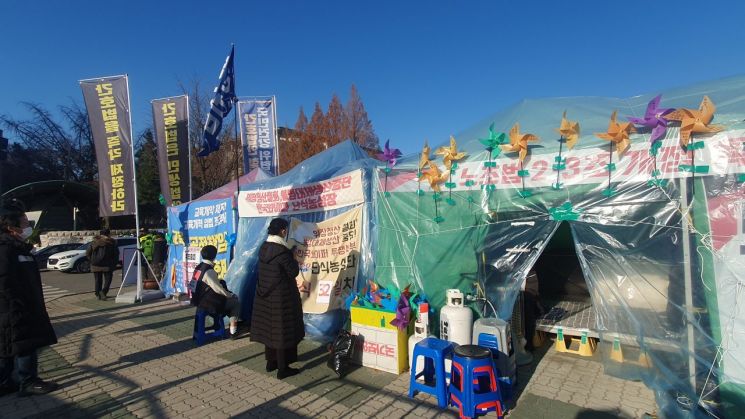
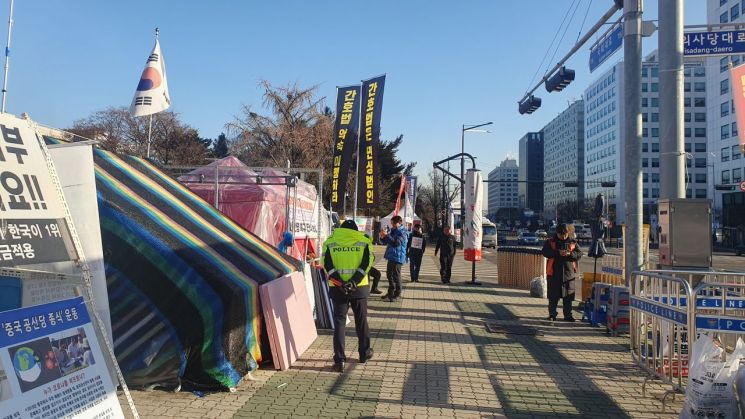
[Asia Economy Reporter Koo Chae-eun] At 10 a.m. last Thursday, when a cold wave of minus 1 degree Celsius hit, in front of National Assembly Station in Yeongdeungpo-gu, Seoul. Between Gate 2 and Gate 1 of the National Assembly, the sidewalks and areas near Exit 6 and Exit 1 were so densely packed with pickets, banners, flags, protest tents, and makeshift shelters that movement was difficult due to the congestion.
The area formerly used as the ‘press conference site in front of the National Assembly main gate’ was now occupied by protest tents with banners reading ‘Urgent Amendment of Articles 2 and 3 of the Labor Union Act,’ ‘Stop Education Reform,’ and ‘Strong Opposition to the Anti-Discrimination Act.’ A lone protester holding a sign saying ‘Please Keep Your Promise on the Enactment of the Nursing Act’ was also noticeable. Some groups said that because the space in front of the main gate was cramped, they moved their tents to the opposite side in front of the Geumsan Building and Hyundai Capital.
At the protest site that day, Lee Young-hoon, chairman of the Public Solidarity Labor Union of the Korean Confederation of Trade Unions’ General Federation, said, “We started a hunger strike from Monday (the 5th),” adding, “It is a desperate time as tens of trillions of won in the budget can change overnight.” He explained, “We came out to demand the establishment of a budget to abolish discrimination in welfare between public officials and public workers because the meal expenses of public workers are included in the basic salary, which does not even reach the minimum wage.”
The Korean Nurses Association was also holding a placard that read ‘Bipartisan Common Presidential Pledge: Enactment of the Nursing Act.’ A representative of the Nurses Association said, “The Nursing Act bill was a common pledge made by both ruling and opposition parties during the presidential election, but it has not even been submitted to the Legislation and Judiciary Committee, so we have been continuously holding one-person protests and Wednesday rallies for over a year out of frustration.” He added, “I think the nursing community showed a united strength, which is why it at least passed the standing committee.” The Nurses Association held a general rally on the 2nd in the Yeongnam region, the constituency of Kim Do-eup, chairman of the Legislation and Judiciary Committee and a member of the People Power Party, and Jeong Jeom-sik, the committee’s secretary.
The National Assembly Continues a Head-to-Head Full-Scale Confrontation... Losing Its Original Function of Resolving Conflicts
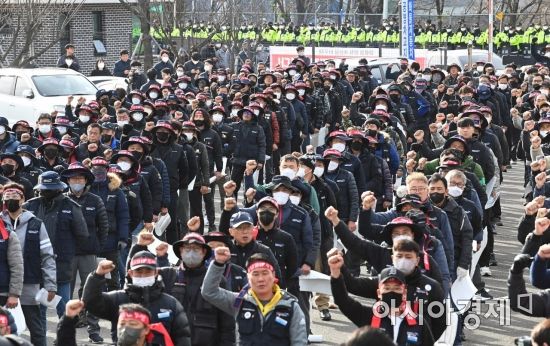
As the ruling and opposition parties persist in extreme confrontation and ‘head-to-head full-scale battles,’ direct actions such as outdoor protests, one-person demonstrations, tent sit-ins, and rallies are increasing. Since the political sphere is failing to fulfill its original role of mediating social conflicts, stakeholder groups are increasingly taking to the streets in the form of direct actions. According to the National Police Agency, the number of reported assemblies and demonstrations was 138,636 in 2020, a 7% increase from the previous year (129,637). The numbers had been below 100,000 from 2016 (83,427), 2017 (68,913), and 2018 (81,358) but surged sharply after 2019. From January to August this year, there were 251 cases of illegal demonstrations violating the Assembly and Demonstration Act, exceeding the four-year average of 246 cases.
The political sphere has also failed to narrow conflicts over bills with sunset clauses. The Safety Freight Rate System (Cargo Truck Transportation Business Act) and the ‘8-hour Additional Overtime Work System’ (Amendment to Article 53 of the Labor Standards Act), which passed the Land, Infrastructure and Transport Committee subcommittee and plenary session solely by the Democratic Party, are representative examples. Both laws have a sunset clause expiring on December 31. In the case of the Safety Freight Rate System, the Cargo Solidarity ended its general strike in June this year, providing ample time for the National Assembly to mediate, but the special committee on livelihood issues and subcommittees were disrupted due to confrontation between the ruling and opposition parties, failing to reach an agreement in time.
Political commentator Lee Jong-hoon said, “Since President Yoon Suk-yeol’s inauguration, the political confrontation has become a head-to-head standoff, and politics is amplifying and maximizing conflicts rather than mediating them.” He added, “Both parties only look at their own supporters, and under the two-party system, the foundation for national unity has been lost. As a result, direct actions by stakeholder groups inevitably increase.”
Legislation Approval Rate of Bills Proposed by National Assembly Members Drops to 23.06%, Down 7.54 Percentage Points
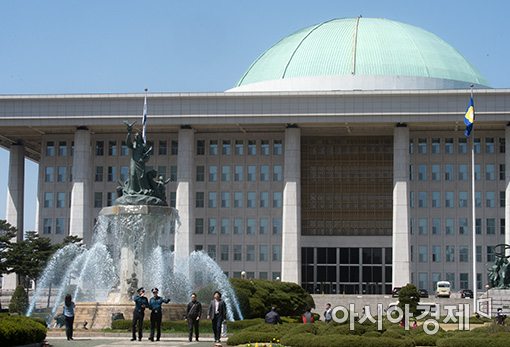 National Assembly Building / Photo by Asia Economy DB
There are also criticisms that the bill subcommittee, which plays a pivotal role in bill discussions, is stained by political strife, and conflicts are not being resolved within the political sphere. A National Assembly official said, “At this time, lawmakers tend to make statements just to have an ‘alibi’ recorded in the minutes and are more focused on quickly attending constituency events in preparation for the general election.”
Another official mentioned, “In the past, subcommittees would review bills two or three times and discuss thoroughly to reduce contentious issues, but nowadays, it feels like all decisions are effectively delegated to the parties.” A senior Democratic Party lawmaker said, “Currently, the factional conflicts are even more severe than during the post-liberation pro- and anti-communist movements,” adding, “Since both sides only look at their supporters, hardliners lead, and the chicken game-style division accelerates.”
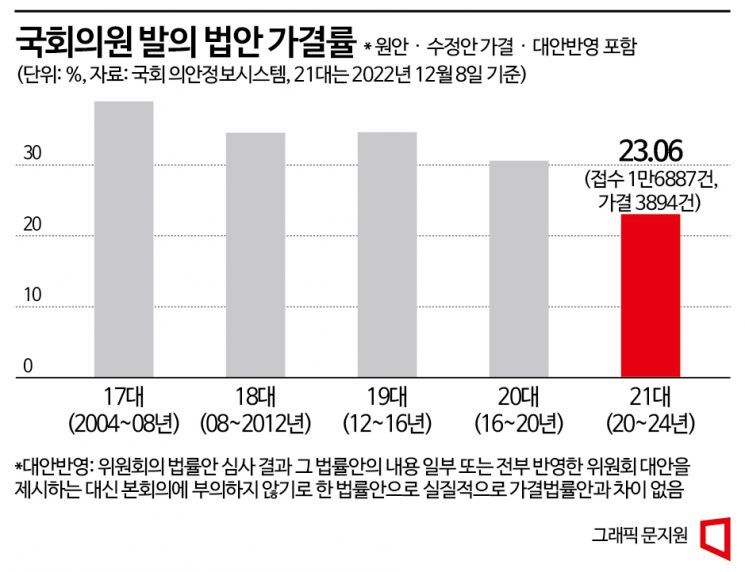
The bill approval rate of the 21st National Assembly members has decreased compared to previous years. According to the National Assembly Bill Information System, the approval rates for bills proposed by lawmakers were around 35% in the 17th (38.97%), 18th (34.55%), and 19th National Assemblies (34.62%). In contrast, the approval rate for bills proposed by the 21st National Assembly members is 23.06%, a decrease of 7.54 percentage points compared to the 20th National Assembly (2016?2020), which was 30.60%.
Professor Shin Yul of Myongji University said, “Political parties exist to resolve conflicts of collective interests, but as society moves toward late capitalism, they are adjusting conflicts of individual interests, and in the process, social conflicts are being disguised as political strife.” He pointed out, “Political parties should play a role in mediating and reducing social conflicts, but the National Assembly has lost that function, and the bigger problem is that this is no longer an unfamiliar scene.”
© The Asia Business Daily(www.asiae.co.kr). All rights reserved.
![Clutching a Stolen Dior Bag, Saying "I Hate Being Poor but Real"... The Grotesque Con of a "Human Knockoff" [Slate]](https://cwcontent.asiae.co.kr/asiaresize/183/2026021902243444107_1771435474.jpg)


















