Government Confrontation and Public Apathy Weaken Strike Momentum
Steel and Petrochemical Industries Face 3 Trillion Won Losses... Compensation Lawsuits Also Discussed
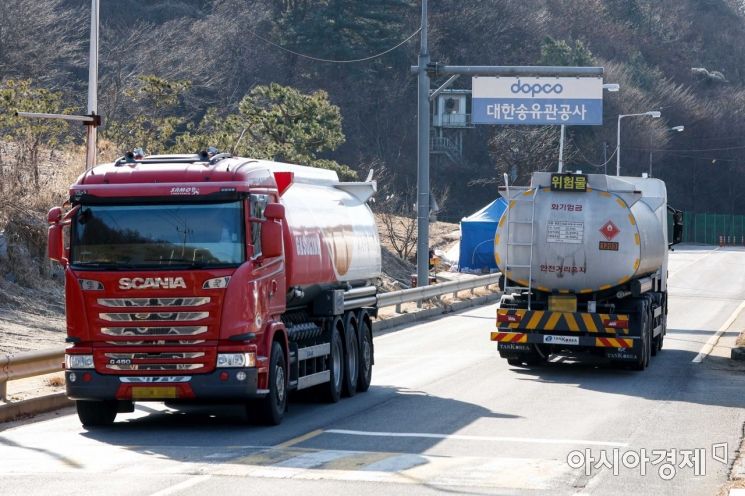 On the 8th, when the government issued an order to commence work to the Cargo Solidarity in the steel and petrochemical sectors, tanker trucks were operating on the road in front of the Seoul branch of Daehan Oil Pipeline Corporation in Seongnam, Gyeonggi Province. / Seongnam - Photo by Kang Jin-hyung aymsdream@
[Asia Economy Reporters Kyungjo Noh, Wanyong Cha] The Cargo Solidarity Headquarters of the Korean Confederation of Trade Unions Public Transport Workers' Union decided to suspend the general strike on the 9th. It has been 16 days since the strike began demanding the continuation and expansion of the Safe Freight Rate System.
The Cargo Solidarity announced that the vote on whether to end the strike and return to work, held from 9 a.m. that day, was passed. Among the 3,575 union members who participated in the vote, 2,211 (61.84%) voted in favor of ending the strike, 1,343 (37.55%) opposed, and 21 (0.58%) votes were invalid.
This strike tied the record for the longest strike duration and the second strike in a year, a record previously set in 2003. The government's firm response was positively evaluated as establishing law and principles.
However, the prolonged strike due to the 'strong versus strong' confrontation between the government and the Cargo Solidarity left the industry with losses amounting to trillions of won. The damage incurred amid an economic downturn caused by export and private consumption slumps is critical to the Korean economy.
◆Record for Longest Strike Duration... Momentum Weakens Due to Public Indifference= This strike was very similar to the 2003 strike when Cargo Solidarity set the record for the longest strike duration. At that time, Cargo Solidarity held two strikes (in May and August), leaving a record of 16 days for the longest strike.
This year's first strike by Cargo Solidarity occurred in June, one month after the new government took office. At that time, President Yoon Suk-yeol expressed the opinion that government intervention in labor-management relations was undesirable and emphasized law and principles. However, as industrial damage increased over time, the strike was temporarily resolved by agreeing to extend the Safe Freight Rate System and discuss extension deadlines and item expansion in the National Assembly.
After a bill to extend the Safe Freight Rate System's sunset clause by three years was proposed in the National Assembly, Cargo Solidarity started a strike on the 24th of last month, demanding the permanent establishment of the system and expansion of items.
Cargo Solidarity stated that the net monthly income of cargo workers is 3.67 million won. This is based on working an average of 14 hours a day and 24 days a month. When converted to an hourly wage, it amounts to 10,000 won, which is at the minimum wage level. They also said that since the introduction of the Safe Freight Rate System, the experience of overloading in the cement category has decreased from 30% to 10%, and the proportion of long driving hours exceeding 12 hours has also declined.
However, Cargo Solidarity is effectively returning empty-handed from this strike. Analysts say the strike momentum weakened due to the government's firm response, public indifference, and lack of sympathetic strikes.
◆Difficult Road Ahead for Sunset Clause Extension... Industry Damage Response= Although the general strike has ended, the abolition of the Safe Freight Rate System's sunset clause and item expansion demanded by Cargo Solidarity remain as tasks.
The Safe Freight Rate System guarantees a minimum transportation fee to cargo workers to prevent overwork, speeding, and overloading. It was temporarily introduced in March 2020 for cement and container cargo and is set to expire at the end of this year.
Cargo Solidarity initially argued that the scope of the Safe Freight Rate System should be expanded to steel products, automobiles, hazardous materials, feed and grains, and parcel delivery trunk lines, and that it should be implemented permanently. However, during the prolonged confrontation with the government, Cargo Solidarity shifted toward legislating a three-year extension plan, while the government brought up reconsideration options including abolition.
The National Assembly also supported the government's firm stance. Even if the bill passes the National Assembly, President Yoon Suk-yeol may exercise his veto power. Considering various scenarios, the situation is unfavorable for Cargo Solidarity. Even if the sunset clause extension is dramatically agreed upon, it seems difficult to realize item expansion.
The Cargo Solidarity strike caused the industry losses exceeding 3 trillion won. The government announced the day before that shipments of steel products and petrochemical products fell to 48% and 20% of normal levels, respectively, and the total shipment disruption amounted to 2.6 trillion won.
Consequently, the possibility of damage claims from the industry has also been raised. Earlier, the Korea Land and Housing Corporation (LH) announced it was considering filing a lawsuit for damages due to construction delays in public housing caused by the Cargo Solidarity strike.
The government also stated that in lawsuits for damages related to this general strike, support is possible not only for public institutions but also for private companies. Kim Soo-sang, Director of the Transport and Logistics Office at the Ministry of Land, Infrastructure and Transport, said the day before, "It is appropriate for the private sector to first handle the damage on their own, but if there are requests for difficulties, the government will provide additional support where possible."
© The Asia Business Daily(www.asiae.co.kr). All rights reserved.
![Clutching a Stolen Dior Bag, Saying "I Hate Being Poor but Real"... The Grotesque Con of a "Human Knockoff" [Slate]](https://cwcontent.asiae.co.kr/asiaresize/183/2026021902243444107_1771435474.jpg)















