Exchange Rate Drops Over 140 Won in a Month and a Half
International Flights Increase and Exchange Rate Stabilization Resolve Performance Obstacles
[Asia Economy Reporter Hyunseok Yoo] Airlines' earnings are rapidly improving. The won-dollar exchange rate, which had been a burden for airlines, has fallen below 1,300 won. Factors that had been blocking performance improvement, such as a significant increase in international passengers, are all improving.
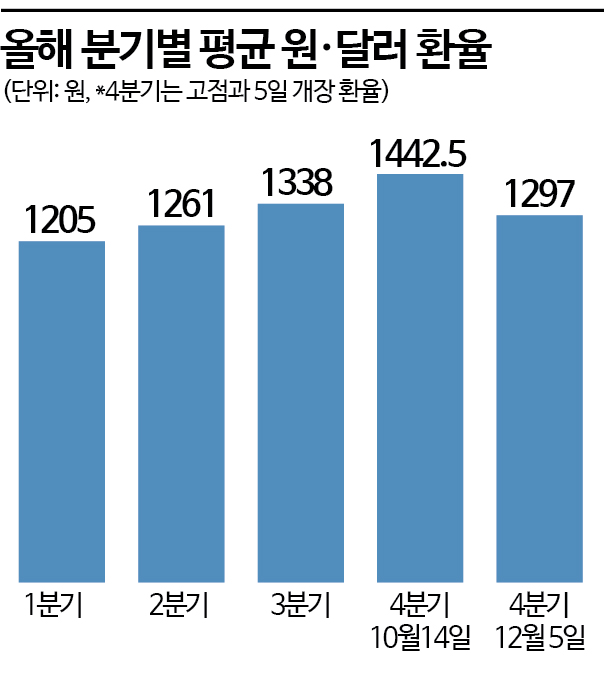
On the 5th, in the Seoul foreign exchange market, the won-dollar exchange rate opened at 1,297 won, down 2.9 won from the previous trading day's closing price of 1,299.9 won. The exchange rate had been rising throughout this year but has shifted to a downward trend in the fourth quarter. The won-dollar exchange rate averaged 1,205 won in the first quarter, rose to an average of 1,261 won in the second quarter, and then increased to 1,338 won in the third quarter. After reaching 1,442.5 won on October 14, it dropped by more than 140 won in about a month and a half.
The exchange rate greatly affects airline earnings. Airlines pay aircraft lease debts and fuel costs in foreign currency. As a result, they recorded large foreign exchange losses in the third quarter. Foreign exchange losses refer to losses incurred due to exchange rate fluctuations when disposing of overseas bonds and debts. Airlines often borrow funds to purchase or lease aircraft. Korean Air recorded foreign exchange losses of 206.8 billion won, Asiana Airlines 62.1 billion won, Jeju Air 9.9 billion won, Jin Air 5.3 billion won, and T'way Air 5.2 billion won. All of these increased more than two to three times compared to the same period last year, affecting net income. Foreign exchange losses are included in net income.
In addition, losses were also seen in operating profit. Low-cost carriers (LCCs) were particularly affected. Although their third-quarter sales mostly increased two to three times this year, they only managed to reduce the deficit in operating profit. Jeju Air's sales increased by 187% to 195.7 billion won compared to the same period last year, but the operating loss decreased by only about 30 billion won from 91.3 billion won to 61.6 billion won. T'way Air's sales increased by 198.7% to 158.4 billion won, but the operating loss decreased by about 7 billion won from 39 billion won in the third quarter last year to 32.3 billion won.
However, with the exchange rate falling in the fourth quarter, it is expected to contribute to performance improvement. In particular, recent remarks by Jerome Powell, Chairman of the U.S. Federal Reserve (Fed), at an event hosted by the Brookings Institution in Washington D.C., stating that "the time to slow the pace of rate hikes could come as early as the December meeting," have raised expectations for a slowdown in rate hikes, which seems to have influenced the exchange rate.
Another positive factor is the rapid increase in international passengers recently. According to the Ministry of Land, Infrastructure and Transport's Aviation Information Portal, the number of international air passengers in November was 3,081,338. This is a 22.1% increase compared to 2,522,903 in October and a significant increase compared to 369,475 in the same period last year. Especially compared to 6,964,045 in November 2019 before COVID-19, it has recovered to 45%.
An industry insider said, "Looking at airlines' third-quarter earnings, sales increased significantly, but operating profit was not achieved due to the exchange rate," adding, "Although the exchange rate has been falling recently and the situation is gradually recovering, concerns about passenger recovery due to the economic recession still remain, so it cannot be viewed as entirely positive."
© The Asia Business Daily(www.asiae.co.kr). All rights reserved.
![Clutching a Stolen Dior Bag, Saying "I Hate Being Poor but Real"... The Grotesque Con of a "Human Knockoff" [Slate]](https://cwcontent.asiae.co.kr/asiaresize/183/2026021902243444107_1771435474.jpg)















