Surcharge Applied from 10 PM
Drivers Welcome the Move
Concerns Over Accompanied Increase in Saapgeum Fees
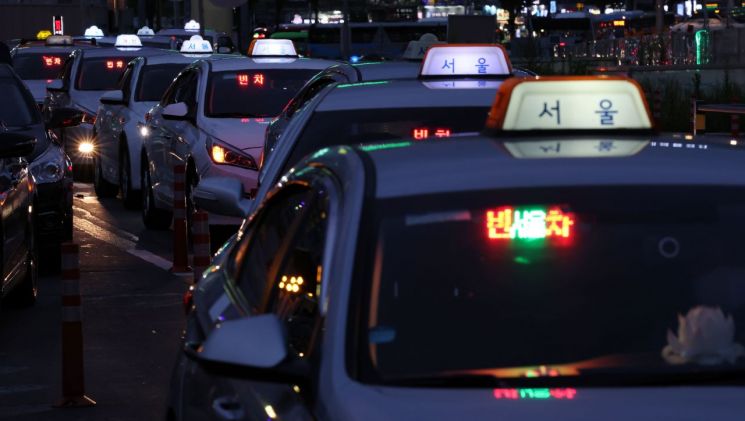
[Asia Economy Reporter Seongpil Cho] From this month, the late-night surcharge for taxis in Seoul starts two hours earlier than before, beginning at 10 PM. From 11 PM to 2 AM the next day, a 40% surcharge, double the basic rate of 20%, is applied.
According to the Seoul Metropolitan Government on the 3rd, the basic fare for a mid-sized taxi, normally 3,800 won, rises to 4,600 won from 10 PM to 11 PM and from 2 AM to 4 AM, and jumps to 5,300 won from 11 PM to 2 AM. This is the first adjustment to Seoul’s late-night surcharge rates in 40 years since 1982. However, the out-of-city surcharge rate, applied when leaving Seoul, remains at the current 20%. For deluxe and large taxis, which previously did not have late-night or out-of-city surcharges, a uniform 20% late-night surcharge is now applied from 10 PM to 4 AM. The out-of-city surcharge for these taxis is also set at 20%, the same as for mid-sized taxis.
Seoul plans to raise the basic taxi fare starting February 1 next year. The mid-sized taxi fare will increase by 1,000 won (26.3%) from the current 3,800 won to 4,800 won. The distance covered by the basic fare will be reduced from 2 km to 1.6 km. The distance fare standard, previously 132 meters per 100 won, will change to 131 meters, and the time fare standard, previously 31 seconds per 100 won, will be shortened to 30 seconds. For deluxe and large taxis, the basic fare applied up to 3 km (currently 6,500 won) will increase to 7,000 won.
Taxi drivers generally welcome the expansion of the late-night surcharge. They expect their income to increase somewhat, as working conditions have been quite poor. However, among corporate taxi drivers, while they welcome the fare increase, there are concerns that the daily quota payments they must pay to their companies might also rise accordingly.
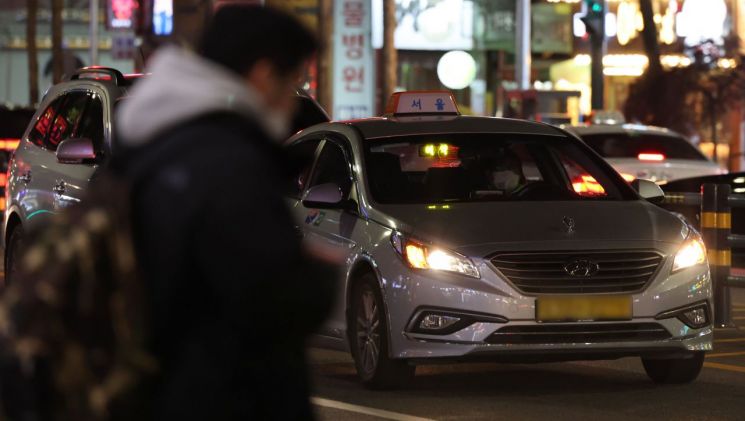 A taxi operating in downtown Seoul on the afternoon of the 1st, when the late-night surcharge adjustment for taxi fares was implemented. [Image source=Yonhap News]
The city expects the expansion of the late-night surcharge to lead to an increase in taxi supply. Although the personal taxi rotation system (mandatory day off) was fully lifted from the 10th of last month, the number of taxis operating late at night did not increase significantly. A city official said, "To ensure smooth transportation during peak seasons such as year-end and New Year, about 25,000 taxis need to be operating. Since the surcharge adjustment, which can be seen as an actual incentive, has been implemented, we expect the number of operating taxis to gradually increase."
On the first day of the late-night surcharge expansion, the number of taxis operating at night increased by about 19% compared to the previous day. According to the city, from 11 PM on the 1st to 2 AM on the 2nd, 23,649 taxis operated within the city. Compared to 19,945 taxis operating during the same hours on November 30, the day before, this is an 18.6% (3,704 taxis) increase.
The increase in night taxis was led by personal taxis. Personal taxis rose from 12,166 to 16,195, a 33.1% increase, while corporate taxis decreased from 7,779 to 7,454, a 4.2% decrease. Compared to a week earlier on November 24, personal taxis surged by 60.6%, from 10,083 to 16,195. Corporate taxis increased by 15.2% (from 6,470 to 7,454), resulting in an overall night taxi increase rate of 42.9%.
However, November 24 was the day of South Korea’s first group stage match in the Qatar World Cup, and the number of taxis operating was significantly lower than usual. Even considering this, the city analyzed that the late-night surcharge adjustment has had a positive effect on expanding taxi supply.
© The Asia Business Daily(www.asiae.co.kr). All rights reserved.
![Clutching a Stolen Dior Bag, Saying "I Hate Being Poor but Real"... The Grotesque Con of a "Human Knockoff" [Slate]](https://cwcontent.asiae.co.kr/asiaresize/183/2026021902243444107_1771435474.jpg)
















