[Asia Economy Sejong=Reporter Kwon Haeyoung] Although the consumer price inflation rate, which had been fluctuating in the high 5% range, eased to 5.0% last month, forecasts suggest that high inflation in the 5% range will persist until early next year. This is because the base effect from a year ago (November last year), when prices rose sharply, temporarily influenced the figures, and the core inflation index, which shows the underlying trend of prices, remains at its highest level since the global financial crisis. The prolonged Ukraine war and the possibility of rising oil prices again are also fueling inflation concerns.
According to the 'November Consumer Price Trends' released by Statistics Korea on the 2nd, the consumer price index last month was 109.10 (2020=100), up 5.0% compared to the same month last year. This is the lowest inflation rate since April (4.8%). However, the core inflation (index excluding agricultural products and petroleum) recorded 107.78, rising 4.8% year-on-year. For two consecutive months, it recorded 4.8%, the highest level since February 2009 (5.2%) during the global financial crisis. Among core inflation components, the index excluding food and energy rose 4.3% year-on-year, increasing from 4.2% in the previous month. This is the largest jump since December 2008 (4.5%).
Core inflation excludes seasonal factors and temporary shocks to show the long-term trend of prices. While consumer price inflation peaked in July (6.3%) and then slowed, core inflation has yet to show a peak. This also means that even if supply-side factors such as oil prices are resolved, demand-side inflationary pressures remain high, making it likely that prices will continue to trend upward.
By item, processed foods, personal services, and electricity, gas, and water charges continued to rise sharply. Industrial products rose 5.9%, with processed foods up 9.4% and petroleum products up 5.6%. Although the petroleum price increase has significantly declined from its peak of 39.6% in June, processed foods have steadily risen from 7.9% in June, 8.2% in July, to 9.5% in October, remaining at a high level. Bread (15.8%) and snacks (14.5%) saw significant price increases.
For personal services, dining out rose 8.6%, and insurance service fees increased 14.9%, resulting in a 6.2% rise. Although the increase in dining out slowed from 9.0% in September and 8.9% in October, the upward trend continued, centered on items like raw fish (9.0%). Among the 5.0% inflation rate, processed foods and dining out contributed 0.81 percentage points and 1.10 percentage points, respectively.
Electricity, gas, and water charges rose 23.1% last month, the same as the previous month, due to a public utility rate hike in October. This is the largest increase since statistics compilation began in January 2010.
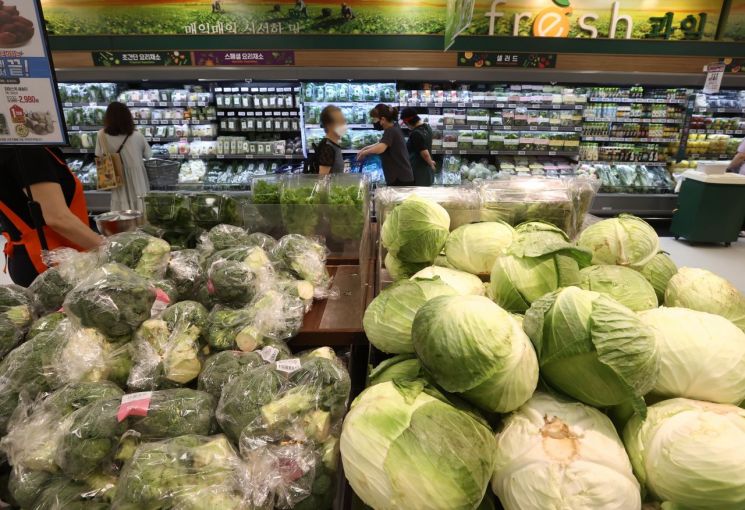
Agricultural, livestock, and fishery products rose 0.3% compared to the previous month, significantly lower than the 5.2% increase in the previous month. Agricultural products fell 2.0%, while livestock and fishery products rose 1.1% and 6.8%, respectively. Among agricultural products, vegetables such as cucumber (-35.3%), lettuce (-34.3%), and pumpkin (-34.9%) saw large declines.
Although the inflation rate slowed significantly from 5.7% in October to 5.0% in November, it is premature to conclude that prices are falling because core inflation remains high and the base effect is still in play. Consumer prices rose 3.7% in November last year due to increases in agricultural, livestock, fishery products, and petroleum prices, marking the highest level in 9 years and 11 months. The Bank of Korea also expects high inflation in the 5% range to continue until the first quarter of next year.
Earlier, Bank of Korea Governor Lee Chang-yong predicted that "November will be a very exceptional month" regarding inflation. Governor Lee stated, "Last November, vegetable prices rose 7-8%, and oil prices increased significantly, so the inflation indicator is likely to be considerably lower than in October," adding, "Once the base effect disappears early next year, the inflation rate is expected to remain in the 5% range again in January and February."
The prolonged Ukraine war and winter energy concerns in Europe leave the possibility of oil prices rising again. If the exchange rate, which has stabilized due to major countries' interest rate hikes, rises again, import prices could also surge. Eo Unseon, head of the Economic Trend Statistics Division at Statistics Korea, said, "Processed food prices are expected to continue rising, and petroleum prices may also increase further," adding, "Prices are expected to fluctuate around the current level."
A Ministry of Economy and Finance official said, "Although the inflation rate in November slowed due to improved supply conditions for agricultural products centered on vegetables such as cabbage and radish, domestic and external risks such as year-end and early-year product price adjustments and logistics disruptions caused by the Cargo Solidarity's collective transport refusal still remain," adding, "We will continue to closely monitor inflation and prioritize price stability for the time being."
© The Asia Business Daily(www.asiae.co.kr). All rights reserved.
![Clutching a Stolen Dior Bag, Saying "I Hate Being Poor but Real"... The Grotesque Con of a "Human Knockoff" [Slate]](https://cwcontent.asiae.co.kr/asiaresize/183/2026021902243444107_1771435474.jpg)















