Next Week, Dunchon Jugong and Jangwi Xi Launch Successive Subscription
Despite Raised Interim Payment Loan Standards, High-Interest Burden Persists
Subscription Waiters Crunch Numbers
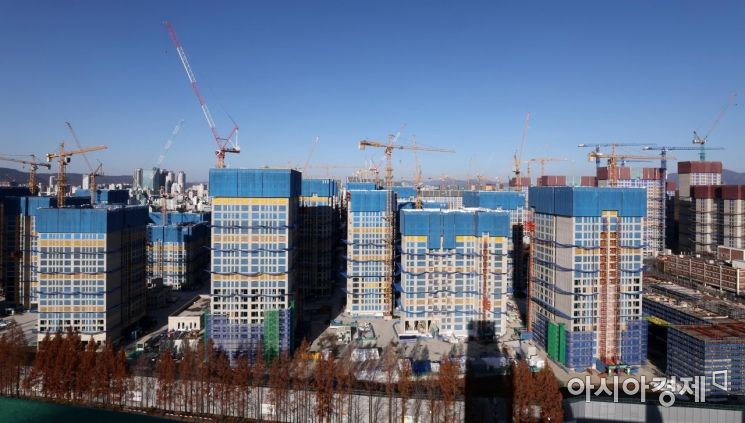 The reconstruction site of Dunchon Jugong Apartment in Gangdong-gu, Seoul./Photo by Hyunmin Kim kimhyun81@
[Asia Economy Reporter Kim Hyemin] The interest rate on interim payment loans is emerging as a variable affecting subscription success. Although a large number of units are being offered for sale in Seoul after a long time, concerns are growing over whether winners can afford the loan interest due to high interest rates. Experts advise carefully assessing financial capacity before applying, as real estate prices are falling and interest rates continue to rise.
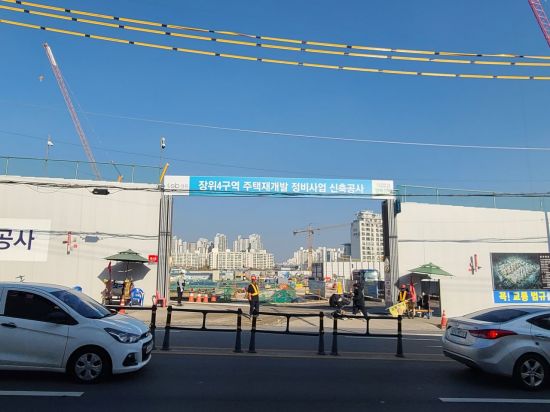
According to the sales industry on the 2nd, the interest rates for interim payment loans for Olympic Park Foreon (Dunchon Jugong Reconstruction) and Jangwi Xi (Jangwi 4 District Redevelopment), which will accept subscription applications next week, will be determined in the first half of next year when the first interim payment is made. A sales industry official said, "The exact interest rate can only be known once the bank is selected, but it is usually set 1 to 2 months before the first payment." The first interim payment dates are June next year for Olympic Park Foreon and April for Jangwi Xi.
Although it is difficult to predict interest rates for the first half of next year, the consensus is that it is unlikely rates will decrease by then. Considering that mortgage loan interest rates recently rose to as high as 8%, it is pointed out that interim payment loan interest rates may form around 6-7%. At a 7% interest rate, the loan interest alone on a 1 billion KRW sale price would be about 40 million KRW.
It is also possible that interim payment loan interest rates could be higher than mortgage loan rates. Interim payment loans are structured based on guarantees from external institutions such as the Housing and Urban Guarantee Corporation (HUG) and the Korea Housing Finance Corporation (HF), with construction companies adding their credit and signing agreements with specific banks to provide loans to prospective residents. Due to this group loan structure, the interest rate can sometimes be 1-2 percentage points lower than individual mortgage loans. However, since there is no separate collateral and the loan is based on the construction company's credit, the rate could be set at a level comparable to unsecured credit loans, which are higher than mortgage loans. A sales industry official said, "It is difficult to say that group loans will always have lower interest rates," adding, "It is better to assume the rate will be higher rather than expecting it to be lower, as a higher rate could become a burden."
The loan limit and interest payment timing for interim payment loans must also be considered. The criteria for interim payment loans have been raised from 900 million KRW to 1.2 billion KRW in sale price, increasing opportunities to obtain loans. Dunchon Jugong allows loans up to 59㎡ exclusive area, and Jangwi Xi allows loans for units 84㎡ and above. The loan limits are set at 40% and 50% of the sale price, respectively. The interim payment proportions are 60% and 50%, respectively. For a sale price of 1 billion KRW, Olympic Park Foreon requires 600 million KRW as interim payments, of which 400 million KRW can be borrowed. The remaining interim payments beyond the 20% contract deposit must be prepared by the buyer.
Dunchon Jugong requires monthly interest payments, but Jangwi Xi requires the interim payment loan interest to be paid in a lump sum upon move-in. Until then, the construction company pays the interest on behalf of the buyer in a deferred payment structure. With a 10% contract deposit, the immediate burden is reduced, but a large sum is required later. However, this can be covered by the balance loan received at move-in. Interim payment loans convert to balance loans upon move-in, and if the market price is high at that time or the property is outside regulated areas, the balance loan limit may increase. The more loan is available, the more capacity there is to repay loan interest. Of course, the opposite scenario must also be considered. Interest burden at the time of balance loan should also be taken into account.
Both complexes are subject to the price ceiling system, requiring actual residence for two years from the move-in date, which is another variable. This means it is impossible to cover the sale price by renting out the property on a jeonse (long-term deposit lease) basis when funds are insufficient for the balance payment. Ye Kyung-hee, senior researcher at Real Estate R114, said, "Although this is a rare opportunity to apply for large-scale complexes in Seoul, it is necessary to carefully examine whether you can afford the payments until move-in," adding, "If you do not carefully plan your financing, you may have to give up even after winning the subscription."
© The Asia Business Daily(www.asiae.co.kr). All rights reserved.
![Clutching a Stolen Dior Bag, Saying "I Hate Being Poor but Real"... The Grotesque Con of a "Human Knockoff" [Slate]](https://cwcontent.asiae.co.kr/asiaresize/183/2026021902243444107_1771435474.jpg)
















