KISDI Proposes Amendment Including 'Net Neutrality Principle' Legislation
Experts Point Out "Lack of Justification for Guideline Legislation"
Both Period and Value-Added Telecom Operators Oppose "Regulation Strengthening"
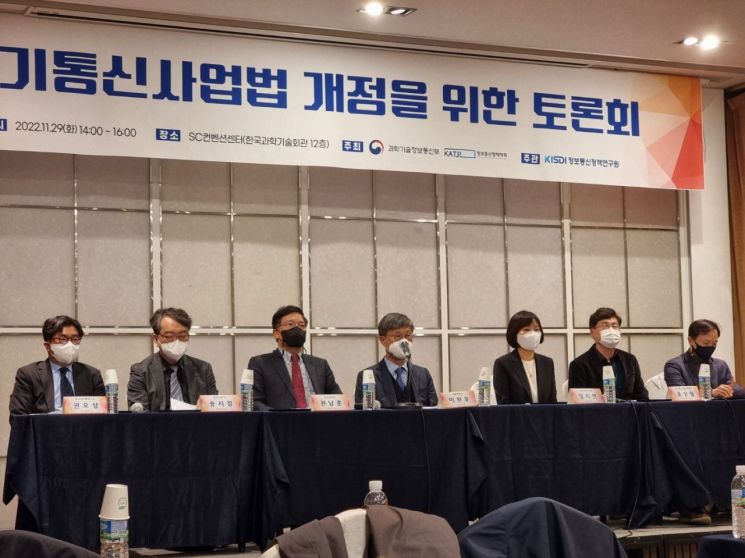 The Ministry of Science and ICT held a public forum on the 29th to discuss amendments to the "Telecommunications Business Act" in response to the digital era. The photo shows participants attending the public forum. Photo by Cha Min-young
[Asia Economy Reporter Minyoung Cha] As the government moves to amend the long-standing Telecommunications Business Act for the first time in 38 years to keep pace with the digital era, the state-run research institute Korea Information Society Development Institute (KISDI) has argued that the previously guideline-level 'net neutrality' should be legislated. However, among experts, there are concerns that there is insufficient justification to legislate the net neutrality guidelines that were painstakingly agreed upon, along with suggestions that a precise legal definition is necessary.
At the public forum held on the 29th by the Ministry of Science and ICT to discuss the amendment plan for the Telecommunications Business Act, 16 tentative amendments related to telecommunications business operations, user protection, fair competition and cooperation, and telecommunications resource management were introduced. These results were derived based on research and review conducted by an expert forum organized by KISDI since July. The government’s amendment plan is expected to be finalized around next year after a process of collecting opinions.
Legislation of Net Neutrality... Experts Urge Caution
The proposed amendments include basic principles for network usage applicable to both facilities-based and value-added telecommunications service providers. The plan is to codify these basic principles into law to ensure effective sanctions in case of disputes, moving beyond the current guideline level on net neutrality. However, the detailed provisions related to net neutrality prohibiting unreasonable discrimination do not deviate from the consensus reached in the existing guidelines.
Opposing views have been raised among experts. Professor Namhoon Kwon of Konkuk University said, "I hope the amendments related to net neutrality will be approached cautiously," adding, "After numerous discussions, voluntary regulations were created in the form of guidelines, so it is questionable whether there is a need for new discussions on whether these should be firm principles enshrined in law." Kwon Osang, director of the Media Future Research Institute, also pointed out, "There is insufficient reason for the amendment, questioning whether the law is being made because something related to net neutrality is not working."
Both facilities-based and value-added telecommunications service providers have shown lukewarm responses. Yoon Sangpil, head of external cooperation at the Korea Telecommunications Operators Association (KTOA), said, "Considering the current telecommunications market environment where the influence of value-added service providers is continuously growing and the urgent need for investment to advance telecommunications networks in the future, it is more urgent to legislate fair principles for network usage and provision rather than strengthening net neutrality regulations." Jo Younggi, secretary-general of the Korea Internet Corporations Association, also noted, "Transparency must be secured across overall network operations related to network usage," adding, "Although many refer to cases in major foreign countries regarding network usage, from the regulator’s perspective, the situation is similar to Korea."
Support for MVNOs Regarding Sunset Clause on Wholesale Provision Obligation
KISDI sided with the MVNO (Mobile Virtual Network Operator) industry in the conflict between mobile carriers and MVNOs over the sunset clause on the wholesale provision obligation. The MVNO industry has been advocating for the abolition of the sunset clause, while mobile carriers have opposed the system, calling it excessive government regulation of the private sector. KISDI plans to improve the system by deleting the legal principle for price determination and allowing the introduction of various wholesale price calculation principles. Currently, the retail-minus principle is to be deleted, and detailed calculation standards will be delegated to official notices.
The telecommunications industry immediately reacted negatively. Yoon Sangpil of KTOA criticized, "Deleting the principle for determining MVNO wholesale prices effectively strengthens government discretion," adding, "Strengthening regulations on operators without logical grounds, claiming that wholesale price reductions are insufficient, amounts to unilateral regulatory tightening." Jung Jiyeon, secretary-general of the Korea Consumer Federation, said, "Currently, the MVNO market is abnormal with 49 operators competing, so there needs to be consideration on how consumer issues will be resolved if the system is abolished," adding, "It seems necessary to supplement the system by assigning responsibility rather than burdening operators."
Strengthening Stability Obligations for Facilities-Based and Value-Added Telecom Operators
The obligation for facilities-based telecommunications operators to ensure the stability of telecommunications services will also be specified in the bill. Major facilities-based operators will have their technical and managerial measures obligations concretized. A basis to request submission of implementation results will be established, and the possibility of publicly disclosing annual reports on service stability measures is under consideration.
Large content providers (CPs) will also be required to ensure digital safety. A basis to request statistical data for designating mandatory operators will be established, and data related to service stability from value-added service providers will also be collected. The scope of domestic agent duties will include data submission obligations. Regarding this, Jo Younggi, secretary-general of the Korea Internet Corporations Association, pointed out, "There is a perception that value-added service providers are free from regulation, but they operate in compliance with various laws," adding, "There seems to be a perception that problems arise simply because platforms grow larger."
The bill also includes provisions to supplement the definition of universal service for digitally vulnerable groups. It strengthens telecommunications companies’ liability for damages, as revealed in KT’s internet outage incident last October. A reason for rejecting terms of use notifications will be added: 'cases where liability for damages is limited without justifiable reasons.' The system will be improved so that telecommunications consumers can regularly receive optimal subscription fee information. To protect user interests, a new clause will be established regarding cancellation of service upon reporting lost or stolen devices. Additionally, a basis clause will be created to allow temporary two-way number changes in cases where one-time contact, such as for food delivery, is unavoidable.
There are also incentives for telecommunications operators. Facilities-based operators with sales exceeding 30 billion won previously required approval from the Minister of Science and ICT for concurrent operation of construction and service businesses, but the plan is to remove telecommunications equipment manufacturing from the scope of concurrent operation approval. To facilitate network construction by facilities-based operators, Korea Railroad Corporation and urban railway operators will be additionally designated as mandatory equipment providers.
Promoting Competition by Relaxing Regulations on New Telecommunications Industries such as Ieum 5G
Meanwhile, as part of deregulation of new telecommunications industries, KISDI included an exemption clause from terms of use notification obligations for Ieum 5G (5G specialized network) operators. Given the business-to-business (B2B) nature of the service, the plan is to lower entry barriers for companies demanding Ieum 5G.
The plan also includes allowing local governments to register as facilities-based telecommunications operators when promoting public Wi-Fi projects for public interest purposes. However, to prevent redundant investment or hindrance to private investment, a proviso requires a business suitability evaluation if new facility investment exceeds a certain scale. The regulation also includes a provision that metropolitan local governments’ own telecommunications facilities are subject to management and supervision by the Ministry of Science and ICT.
© The Asia Business Daily(www.asiae.co.kr). All rights reserved.
![Clutching a Stolen Dior Bag, Saying "I Hate Being Poor but Real"... The Grotesque Con of a "Human Knockoff" [Slate]](https://cwcontent.asiae.co.kr/asiaresize/183/2026021902243444107_1771435474.jpg)















