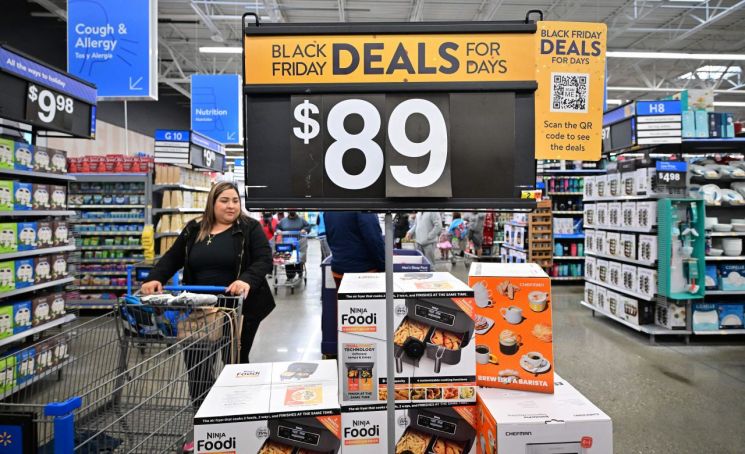
[Asia Economy Reporter Yujin Cho] "In previous years, this place was a battleground for parking spots due to the crowds of shoppers, but this year, finding a parking space has not been difficult at all."
On the 25th (local time), Marshall Cohen, senior industry advisor at market research firm NPD Group, reported this atmosphere from stores across the U.S. East Coast regions including New York, New Jersey, Maryland, and Virginia. He said, "All shoppers seem to be making only essential purchases," adding that the urgency of pushing through store doors or fighting over items has disappeared.
Despite Black Friday, the biggest shopping season in the U.S., foot traffic in malls was lighter than in previous years. This appears to be due to the rise of contactless shopping amid the COVID-19 pandemic and the worst inflation in 40 years hitting the U.S. economy, which has dampened consumer sentiment.
At the American Dream Mall, a mega shopping center in East Rutherford, New Jersey, there were hardly any scenes of customers lining up outside stores that day.
The rainy weather also worked against the shopping season. Jimena Silva (23), who works at a large Target store in Raleigh, North Carolina, said, "Only about 20 customers have passed through the self-checkout between 6 and 8 a.m. today." Miguel Martinez (35), who visited a Target store on Chicago's North Side around 9 a.m., said, "It feels like a weekday," reporting that the store was quieter than expected.
Similarly, major shopping districts in New York City, which experienced rain that morning, had a relatively calm atmosphere compared to previous years. At Macy's department store in New York, residents and tourists lined up from 5 a.m., but the turnout was reportedly not as large as expected.
Of course, there were areas where offline stores were crowded, but the overall mood was not as optimistic as initially expected that in-person shopping would fully revive after overcoming the COVID-19 crisis.
While the pandemic's impact has lessened, rising prices have weakened consumers' real purchasing power, and major companies held large-scale discount events throughout the fall, dispersing shoppers. These factors are cited as reasons for the relatively quiet Black Friday.
Recently, the National Retail Federation (NRF) estimated that a record 166.3 million people planned to shop from Thanksgiving (November 24 this year) through Cyber Monday (November 28), but many appear to have chosen online shopping rather than offline. However, the increase in online shopping sales is also expected to be limited due to inflation.
According to Adobe Analytics, Adobe's marketing data analysis solution, online shopping sales on Thanksgiving Day reached $5.29 billion, a 2.9% increase from the previous year. This exceeded Adobe Analytics' own forecast of a 2.5% increase. Salesforce estimated Thanksgiving online shopping sales at $7.5 billion, a 9% increase from the previous year. Online shopping sales on Black Friday are expected to increase by only 1% compared to the previous year.
© The Asia Business Daily(www.asiae.co.kr). All rights reserved.














![The Special Connection Between the Statue of Martyr Lee Jun in Jangchungdan Park and Mayor Oh Sehoon ③ [Current Affairs Show]](https://cwcontent.asiae.co.kr/asiaresize/319/2026012110001599450_1768957215.jpg)
