Seoul Apartment Sales Transactions from January to September Hit Record Low
Acquisition Tax Closely Related to Real Estate Transactions to Drop 15.9% Next Year
Sales Transaction Contraction Expands Nationwide with Similar Trends in Other Regions
[Asia Economy Reporter Hwang Seoyul] As the number of apartment sales transactions in Seoul hit an all-time low, acquisition tax, which accounts for a large portion of real estate sales transactions in next year's budget, also saw a significant decrease. Facing a nationwide cliff in sales transactions, emergency signals have been triggered for local governments' acquisition tax revenues next year.
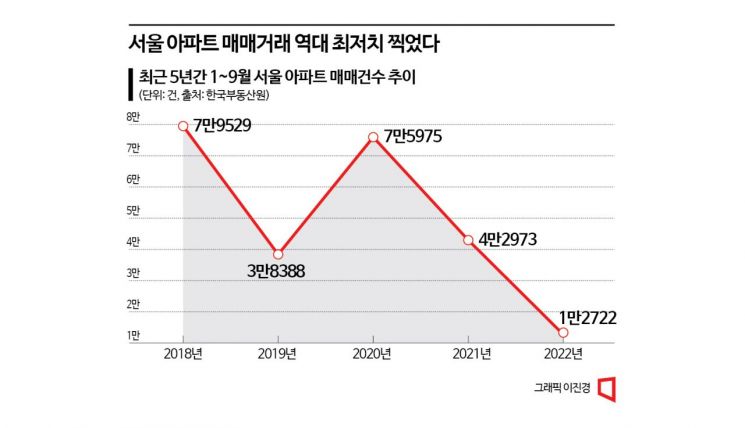
According to the Korea Real Estate Board on the 24th, the number of apartment sales transactions in Seoul from January to September this year was 12,722, marking the lowest since related statistics began in 2006. This is the first time the annual number of transactions during the same period has fallen below 20,000. Previously, the lowest transaction numbers were 27,898 in 2012 and 29,814 in 2010, both nearly below 30,000.
Looking at the monthly data also reveals the severity of the frozen transaction volume. From January to September this year, the monthly number of transactions did not exceed 3,000. On average, 56.54 transactions occurred per district per month. The most recent data for August and September showed 907 and 856 transactions respectively, both below 1,000. In 2012 and 2010, which had the next lowest transaction volumes this year, the number of months with fewer than 3,000 transactions was only four and five months respectively.
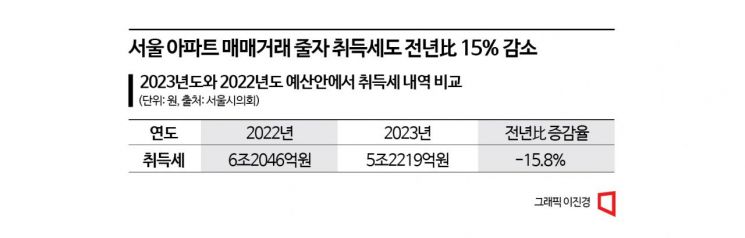
As the number of sales transactions froze, acquisition tax revenue in Seoul's 2023 revenue budget also decreased. According to the Seoul Metropolitan Council, the 2023 revenue budget for acquisition tax, closely related to real estate sales transactions, was estimated at 5.2219 trillion KRW, a decrease of 982.7 billion KRW (15.8%) compared to the previous year. According to the Korea Local Tax Research Institute's "September Real Estate Market Trends," real estate accounts for 81% of acquisition tax revenue, and the proportion of paid transactions by acquisition cause is high at 75%. A Seoul tax department official stated, "For acquisition tax, we applied a very conservative market forecast for next year considering real estate purchase sentiment indices, loan regulations, and interest rates."
The contraction in sales transactions is not only a problem in Seoul. Other regions also saw a decline of at least 30% in sales transactions from January to September this year compared to the same period last year. The region with the largest decrease was Incheon, with a decline rate of 95.51%, followed by Gyeonggi (-69.57%), Daejeon (-59.33%), Busan (-57.71%), and Daegu (-50.61%) excluding Seoul.
Therefore, the Korea Local Tax Research Institute predicted that the total acquisition tax revenue nationwide in 2023 will be between 22 trillion and 26 trillion KRW, which is more than 9 trillion KRW lower than the previous year (33.817 trillion KRW). According to the institute, acquisition tax revenue accounts for 25-30% of local government budgets nationwide, most of which comes from real estate transactions.
For example, in Daejeon's budget proposal for next year, acquisition tax decreased to 490 billion KRW, down 18.87% from the previous year (604 billion KRW). If acquisition tax accounted for 30% of local taxes last year, its share will drop to 24% next year. In Busan, acquisition tax for next year is 1.4447 trillion KRW, down 8.26% from 1.5749 trillion KRW the previous year, and its share of local taxes decreased from 32.5% to 28.6%.
Seoul and Gyeonggi, which have relatively high fiscal autonomy among local governments, are expected to suffer less damage from the decrease in acquisition tax compared to other regions. Fiscal autonomy is an indicator showing the proportion of resources that local governments can independently use among total revenues. However, there are voices that local governments with low fiscal autonomy may see an increase in local allocation tax revenues provided by the central government. Professor Hong Seonggeol of the Department of Public Administration at Kookmin University explained, "Even if acquisition tax decreases, places with high fiscal autonomy have other resources, so the impact won't be significant, but local governments lacking autonomous resources will be hit hard. In such cases, they have no choice but to compensate for tax revenues by increasing local allocation tax."
© The Asia Business Daily(www.asiae.co.kr). All rights reserved.
![Clutching a Stolen Dior Bag, Saying "I Hate Being Poor but Real"... The Grotesque Con of a "Human Knockoff" [Slate]](https://cwcontent.asiae.co.kr/asiaresize/183/2026021902243444107_1771435474.jpg)
















