Institute for Basic Science (IBS)
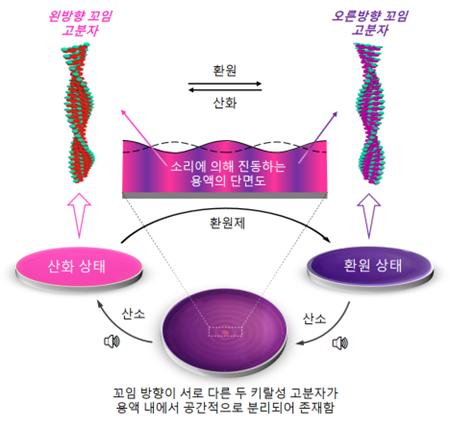
Waves generated by sound have crests and nodes. The crests are areas where oxygen is abundantly supplied in the air, causing oxidation reactions. Chiral polymer materials, which have different twisting directions depending on their redox state, exist separately in the solution in oxygen-rich oxidized regions and oxygen-deficient reduced regions. Using polymers that change color according to their redox state creates alternating concentric color patterns. This visually confirms the spatial formation and separation of the two substances.
Illustration and description by the Institute for Basic Science
[Asia Economy Reporter Kim Bong-su] The movie 'Kung Fu Hustle,' which gained great popularity in Korea, turns out to feature a female protagonist who mastered the sonic martial art of Shout of the Lion, using sound as a weapon. Is it possible to materialize and utilize the legendary 'sound'? A domestic research team has revealed for the first time in the world that chemical reactions can be controlled using sound.
The research team led by Kim Ki-moon, head of the Complex Self-Assembly Research Group at the Institute for Basic Science (IBS) and a professor in the Department of Chemistry at POSTECH, announced on the 16th that they succeeded in spatially separating molecules with different chirality in a solution using only sound.
The property of molecules having structures that are mirror images of each other is called enantiomerism or chirality. Chiral molecules, resembling twins, look the same when viewed in a mirror like left and right hands, but no matter how much they are rotated, they cannot be superimposed. Considering chirality in chemistry is very important because biomolecules use only molecules with specific chirality. Molecules with the opposite chirality are either unusable or often have harmful effects. However, since chiral molecules differ only in their three-dimensional structure and have similar physical and chemical properties, it was believed impossible to separate the two substances in a solution.
The research team came up with a new idea to separate chiral molecules in a solution using sound. When a Petri dish is placed on a speaker and sound below 100 Hz is played, concentric waves form inside the dish due to tiny vertical vibrations. The waves have nodes that do not move and antinodes (the highest and lowest points) that oscillate vertically. The nodes act as a kind of 'barrier.' Because the solution does not mix across the nodes, compartmentalization occurs.
Based on this characteristic, the team conducted experiments using molecules that show different chirality depending on oxidation-reduction reactions, using the nodes as boundaries. Perylene diimide (PDI) molecules form left-handed twisted polymers when combined with L-phenylalanine derivative (LPF) molecules. Conversely, when PDI molecules are reduced, they form right-handed twisted polymers. The two molecules with different chirality exhibit red and blue colors, respectively.
The team played sound in a Petri dish containing the reduced PDI/LPF solution. Oxidation reactions occurred at the antinodes, where contact with air is active, turning the solution red. As a result, concentric color patterns of oxidized red and original blue alternated in the Petri dish. This means that substances with different chirality exist in different regions within the same solution.
Director Kim said, "Sound was thought to have too little energy to affect chemical reactions, but our research team has shown that oxidation-reduction reactions and enzyme reactions can be controlled by sound." He added, "We expect this to be a revolutionary tool in various chemical reactions requiring separation and control of chiral substances, such as pharmaceutical manufacturing."
The research results were published on the 16th in the international chemistry journal Chem (IF 25.832).
© The Asia Business Daily(www.asiae.co.kr). All rights reserved.
![Clutching a Stolen Dior Bag, Saying "I Hate Being Poor but Real"... The Grotesque Con of a "Human Knockoff" [Slate]](https://cwcontent.asiae.co.kr/asiaresize/183/2026021902243444107_1771435474.jpg)















