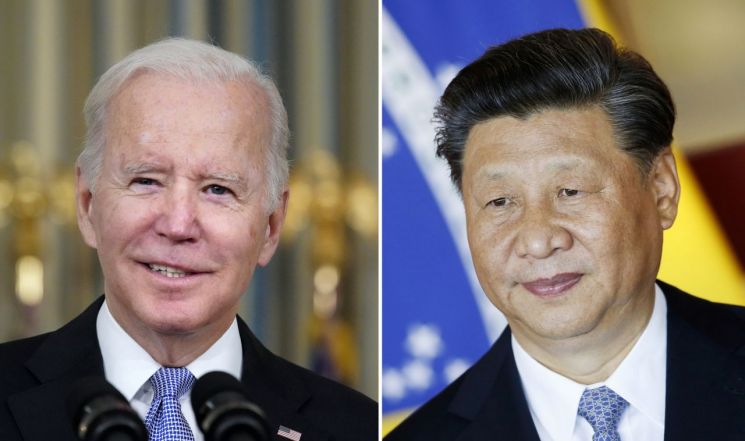
[Asia Economy New York=Special Correspondent Joselgina] U.S. President Joe Biden and Chinese President Xi Jinping have confirmed their first face-to-face summit as originally expected on the 14th at the G20 summit in Bali, Indonesia. Following House Speaker Nancy Pelosi's visit to Taiwan, political tensions between the two countries have escalated, cutting off major communication channels. There is hope that this meeting could restore some dialogue, including economic discussions.
The White House announced the summit schedule on the 10th (local time). Press Secretary Karine Jean-Pierre stated in a release, "The two leaders plan to discuss efforts to maintain and deepen communication channels between the two countries, responsibly manage competition, and cooperate on areas of mutual interest, including transnational issues affecting the international community."
This will be the first direct meeting between President Biden and President Xi. Since Biden took office in January last year, the two leaders have communicated five times via video calls and phone conversations.
The summit is expected to cover a wide range of topics, including trade and economic issues reflecting the ongoing hegemonic rivalry, the Taiwan issue, global affairs such as Ukraine, human rights, and climate change.
Especially since tensions peaked after House Speaker Pelosi's visit to Taiwan in early August, it is anticipated that messages aimed at easing these tensions will be exchanged. The timing of the summit also supports this view, as President Xi solidified his absolute power with a third term last month, and President Biden has eased early lame-duck concerns following the midterm elections. Earlier, President Biden repeatedly conveyed the message that he wants "competition, not conflict."
However, regarding Taiwan, since President Xi stated at the Party Congress that he would not rule out the use of force, conflict with the U.S., which opposes any change of the status quo by force, is inevitable. Direct exchanges are also expected concerning Russia's prolonged invasion of Ukraine. Additionally, as North Korea is understood to have completed preparations for its seventh nuclear test and only political decisions remain, issues related to the Korean Peninsula and North Korean nuclear matters are also expected to be on the agenda.
A White House National Security Council (NSC) official said during a phone briefing that day, "President Biden is expected to have candid discussions about China's activities threatening peace and stability in the Taiwan Strait, human rights violations, and concerns from the U.S. and its allies about China's harmful economic practices," adding that international and regional issues, including North Korea's recent provocations and Russia's war in Ukraine, will also be discussed. He further stated, "The two leaders will have deep and substantive talks aimed at better understanding each other's priorities and intentions."
No separate joint statement will be issued following this summit. Analysts suggest that rather than producing specific outcomes, the meeting will serve as a foundation for bilateral relations and allow the two leaders to directly communicate and identify certain 'red lines.'
President Biden also confirmed his intention to meet President Xi during the G20 summit at his first White House press conference after the midterm elections the previous day. He said that when meeting President Xi, he would discuss "various issues, including fair trade and matters related to China's relations with other countries in the region."
President Biden will attend the 27th Conference of the Parties to the United Nations Framework Convention on Climate Change (COP27) in Egypt on the 11th, then participate in the U.S.-ASEAN Summit and East Asia Summit in Cambodia on the 12th and 13th. Following that, he is scheduled to attend the G20 summit from the 13th to the 16th.
© The Asia Business Daily(www.asiae.co.kr). All rights reserved.
![Clutching a Stolen Dior Bag, Saying "I Hate Being Poor but Real"... The Grotesque Con of a "Human Knockoff" [Slate]](https://cwcontent.asiae.co.kr/asiaresize/183/2026021902243444107_1771435474.jpg)















