Old Soviet-era surface-to-air missile
Launched as surface-to-surface, suspected ballistic missile
Interception system confusion or stock depletion intent
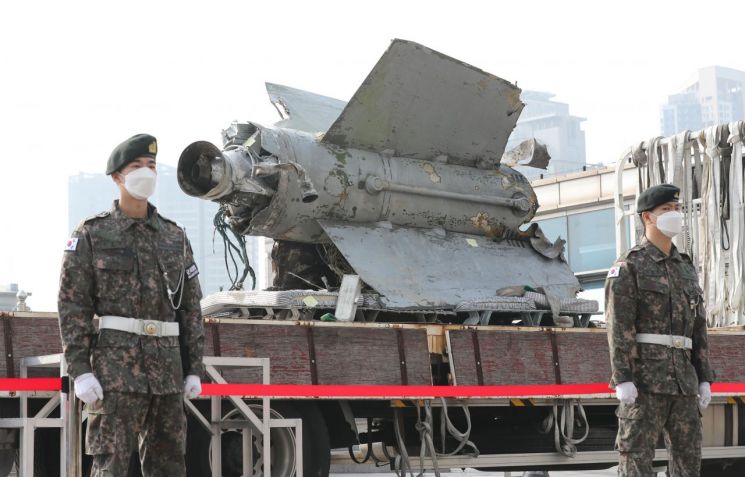 On the 9th, the Ministry of National Defense is revealing an object presumed to be debris from a North Korean missile. [Image source=Yonhap News]
[Asia Economy Reporter Jang Hee-jun] The missile North Korea fired across the Northern Limit Line (NLL) in the East Sea for the first time since the division of the peninsula has been identified as an SA-5 missile made by the former Soviet Union. It is an old missile that uses liquid fuel, and the body recovered from the sea bears Russian inscriptions, suggesting that North Korea is using weapons imported during the Soviet era.
Because the missile was launched in a manner different from its original purpose, it was mistakenly observed as a short-range ballistic missile (SRBM). Some analysts suggest that this was intended to confuse South Korea’s interception system. Military authorities have kept various possibilities open regarding North Korea’s intentions but strongly condemned it as a "deliberate provocation."
The Ministry of National Defense announced on the 9th that after recovering and analyzing the missile debris fired south of the East Sea NLL on the 2nd, it was confirmed to be an SA-5 missile. Earlier, after the missile fell into the sea near Sokcho, the navy was deployed to search the surrounding waters.
The debris recovered on the 6th was the rear fuselage of an SA-5 missile, measuring approximately 3 meters in length, 2 meters in width, and 0.8 meters in diameter. Four main wings were attached, and inside the fuselage, remnants of the liquid fuel tank, engine, and nozzle were found. Some of the acquired equipment clearly bore Russian inscriptions.
Also known as the "S-200" in Russian, the SA-5 missile was developed as a surface-to-air missile to shoot down aircraft but can also be used as a surface-to-surface missile. Developed by the Soviet Union in the 1960s, it measures 10.7 meters in length and has a warhead weight of 217 kg. It is known to be in use by at least 12 countries worldwide, including North Korea and Russia.
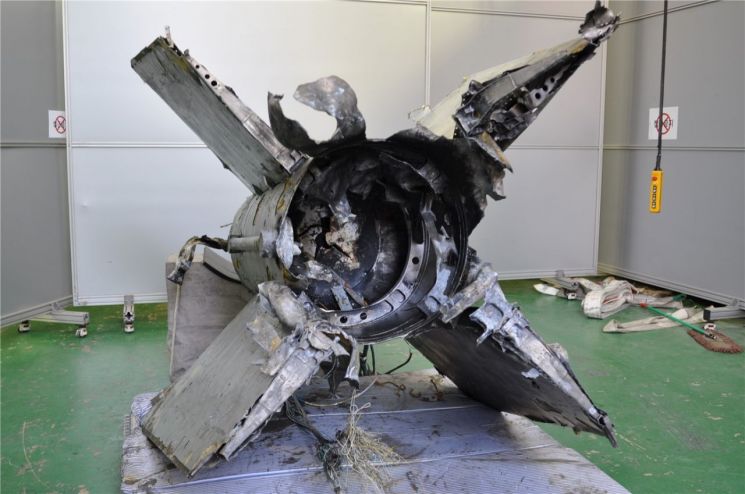
The debris revealed on this day bore serial numbers and specifications written in Russian. However, it is difficult to confirm whether North Korea directly imported it from Russia or acquired it from a third country and then modified it. A military official explained, "North Korea has operated various weapons developed by the former Soviet Union in the past. It is difficult to definitively say that the missile fired this time is Russian-made."
Initially, the military estimated the missile to be a short-range ballistic missile (SRBM). However, with the true identity of the SA-5 missile revealed, attention is focused on North Korea’s intention to launch a surface-to-air missile as a surface-to-surface missile. The military authorities maintain that this is a clear intentional provocation against South Korea, as the surface-to-air missile is designed to self-destruct if it passes its target but was fired southward.
Some analysts suggest that North Korea altered the usual method and purpose to confuse South Korea’s interception system.
There is also suspicion regarding the SA-5 missile being an old missile that uses liquid fuel. North Korea’s recently used ballistic missiles employ solid fuel. This has led to speculation that North Korea might be trying to exhaust old ammunition while developing new ballistic missiles or that missile stockpiles have become so depleted that they must use old missiles.
A military official emphasized, "North Korea’s SA-5 missile launch is clearly a planned and intentional provocation. Our military strongly condemns North Korea’s missile provocation, which escalates tensions on the Korean Peninsula and violates the September 19 Military Agreement."
He added, "The military will not tolerate any provocations by North Korea that threaten the lives and safety of our people and will respond firmly with the overwhelming capabilities of the ROK-US alliance."
© The Asia Business Daily(www.asiae.co.kr). All rights reserved.
![Clutching a Stolen Dior Bag, Saying "I Hate Being Poor but Real"... The Grotesque Con of a "Human Knockoff" [Slate]](https://cwcontent.asiae.co.kr/asiaresize/183/2026021902243444107_1771435474.jpg)
















