Institute for Basic Science Confirms Effectiveness in Animal Experiments
High Potential for Therapeutic and Antimicrobial Use
Reproducing Nobel Prize-Winning Chinese 'Gaeddongsuk' Research?
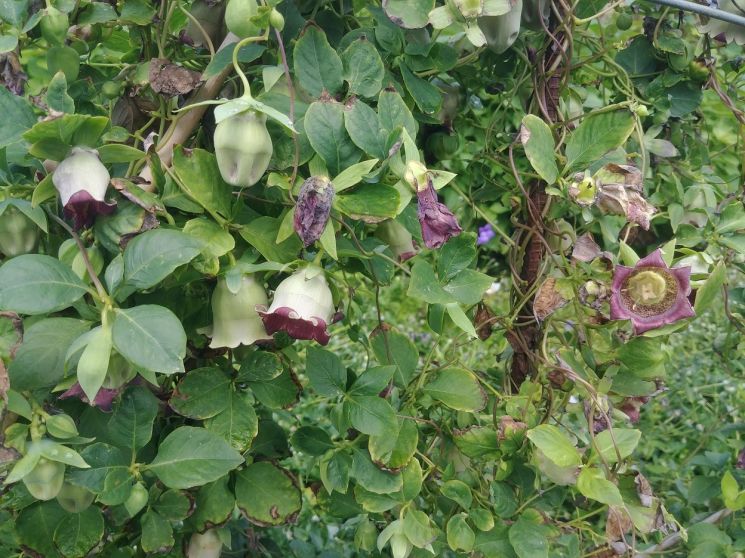
[Asia Economy Reporter Kim Bong-su] Antiviral components capable of inhibiting coronavirus infection have been discovered in Aster koraiensis Nakai (Koreasukkubjaengi), a native plant commonly found in Korea’s fields and mountains, and Codonopsis lanceolata Trautv (Deodeok).
The Institute for Basic Science (IBS) announced on the 9th that the research team led by Director Lee Chang-jun of the Life Science Research Cluster newly identified that ‘Astersaponin I’ and ‘Lancemaside A’ saponins contained in Aster koraiensis Nakai (commonly known as Koreasukkubjaengi) and Codonopsis lanceolata Trautv, respectively, inhibit coronavirus infection by blocking the cell membrane fusion pathway, which is the route for coronavirus entry into cells.
Aster koraiensis Nakai is a perennial plant belonging to the Asteraceae family and is endemic to the Korean Peninsula. Codonopsis lanceolata Trautv is a perennial climbing plant in the Campanulaceae family, growing throughout Korea’s mountains and fields, and is the second most widely cultivated wild vegetable in Korea after Platycodon grandiflorus (Doraji). Coronavirus particles enter human cells by fusing with endosomes or the cell surface plasma membrane. Both pathways require the essential ‘membrane fusion’ process between the coronavirus envelope and the human cell membrane. The research team revealed that Astersaponin I and Lancemaside A block this membrane fusion between coronavirus and human cells, thereby preventing all intracellular infection routes of the coronavirus.
The researchers created a coronavirus infection model using pseudoviruses expressing the coronavirus spike protein on their surface and human lung cells in a biosafety level 2 laboratory. They treated the model with Astersaponin I and Lancemaside A and confirmed the inhibitory effect on viral cell entry. Both saponins showed an IC50 (half maximal inhibitory concentration) of approximately 2 μM, effectively suppressing coronavirus cell entry pathways. The same results were confirmed in experiments using live infectious coronavirus, demonstrating similar inhibitory efficiency against not only the original coronavirus but also variants such as Omicron.
Astersaponin I and Lancemaside A have a central skeleton structure very similar to cholesterol, a major component of the cell membrane, with a long sugar chain attached on one side. When the cell membrane incorporates the central part of these saponins, which resemble cholesterol, into the membrane and the long sugar chain protrudes outside the membrane, this protruding part blocks membrane fusion with the coronavirus envelope.
Variants like Omicron have mutations in the spike protein that increase binding affinity to the cell receptor ACE2, facilitating cell infection. However, even if the spike protein binds strongly, if the subsequent membrane fusion process is blocked, the coronavirus cannot enter the cell. In other words, membrane fusion inhibitors can effectively prevent viral infection regardless of the virus’s binding affinity to the cell receptor.
The research results were published in the October online edition of the international journal Antiviral Research and the November online edition of Antimicrobial Agents and Chemotherapy.
Meanwhile, in May last year, the research team, together with Dr. Kim Seung-taek’s team at the Korea Pasteur Institute, identified the anti-coronavirus activity of Platycodin D, a saponin from Platycodon grandiflorus (Doraji).
Interestingly, Astersaponin I, Lancemaside A, and Platycodin D all belong to the class of ‘Triterpenoid saponins’ and share a similar chemical structure with a long sugar chain attached on one side.
Based on the finding that the sugar moiety attached to triterpenoid saponins is important for inhibiting coronavirus infection, the research team collaborated with Professor Han Soon-gyu’s chemistry team at KAIST to synthesize about ten different saponins with varying sugar chain lengths and types. As a result, they succeeded in synthesizing a new compound with twice the activity of Platycodin D, a naturally occurring triterpenoid saponin. This study was published in the October issue of the international journal Bioorganic Chemistry.
IBS Director Lee Chang-jun stated, “Triterpenoid saponins contained in Aster koraiensis Nakai, Codonopsis lanceolata Trautv, and Platycodon grandiflorus are major components of foods and herbal medicines easily accessible in daily life. When ingested, they can be exposed at high concentrations to epithelial cells of the upper respiratory tract, potentially effective for asymptomatic or early-stage patients.” He added, “Although this is still at the cell experiment stage, if good results are obtained in animal experiments, clinical trials may be possible.”
Professor Jang Dae-sik of Kyung Hee University commented, “In China, after Professor Tu Youyou of the China Academy of Traditional Chinese Medicine won the 2015 Nobel Prize in Physiology or Medicine for developing the malaria drug artemisinin from Artemisia annua, the government has provided full support for traditional medicine research. However, in Korea, support is rather shrinking, which is regrettable.” He added, “I hope this research announcement will contribute to revitalizing pharmaceutical development research using native or cultivated plants in Korea.”
Meanwhile, natural product-derived medicines have the advantage of being easily obtainable and having proven safety through long-term use. Historically, penicillin, aspirin, and the malaria drug artemisinin were all derived from natural substances. This membrane fusion inhibitor also broadly blocks infection by enveloped viruses like coronavirus, suggesting the potential for developing broad-spectrum antiviral therapeutics.
© The Asia Business Daily(www.asiae.co.kr). All rights reserved.
![Clutching a Stolen Dior Bag, Saying "I Hate Being Poor but Real"... The Grotesque Con of a "Human Knockoff" [Slate]](https://cwcontent.asiae.co.kr/asiaresize/183/2026021902243444107_1771435474.jpg)















