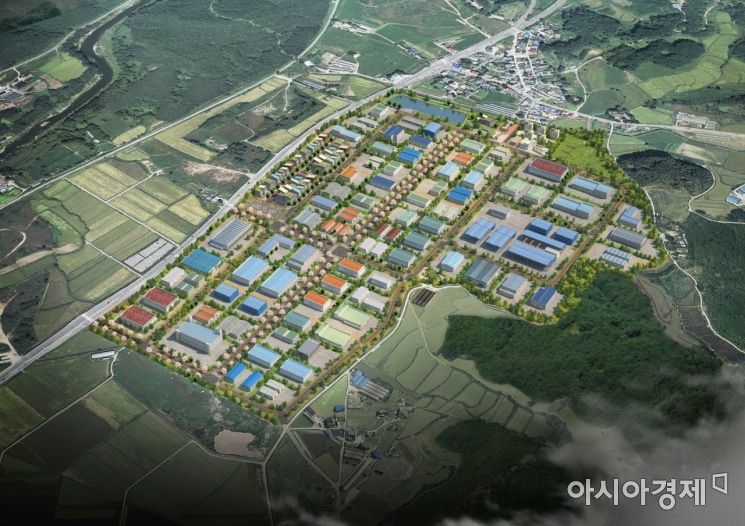
[Asia Economy Sejong=Reporter Dongwoo Lee] The government is expanding digitalization and decarbonization to reform industrial complexes. It will strengthen the working environment for young workers by building basic infrastructure such as roads, parking lots, parks, and cultural centers.
The Ministry of Trade, Industry and Energy unveiled the "Comprehensive Industrial Complex Innovation Measures" at the National Policy-Related Ministers' Meeting on the 3rd.
As of the end of last year, there are 1,257 industrial complexes nationwide, housing over 110,000 companies, accounting for 63% (1,104 trillion won) of Korea's manufacturing output, 66% (402.4 billion dollars) of exports, and 47% (2.27 million people) of employment. However, recently, industrial complexes have experienced the so-called "three olds (삼로)" phenomenon?aging industrial facilities, infrastructure, and workforce?while production and employment growth have slowed, creating a need for new growth engines.
In response, the government plans to promote 83 policy tasks across five major areas: digitalization, decarbonization, improvement of working and living conditions, safety enhancement, and innovation of location regulations in industrial complexes.
First, considering that 94% of companies in industrial complexes are small and medium-sized enterprises with fewer than 50 employees, the government will implement a program to assess the digital readiness of resident companies. It also plans to pursue carbon reduction strategies tailored to the characteristics of each industrial complex. Support will be provided for the spread of Environmental, Social, and Governance (ESG) management, business restructuring, and resource reuse promotion to help export-oriented small and medium-sized enterprises respond to global environmental regulations.
The government will develop carbon reduction technologies to lower carbon emissions in industrial complexes and promote eco-friendly energy fuels. To create industrial complexes where young people want to work, it will actively provide affordable startup spaces, support matching with manufacturing companies, offer youth job experience programs, and conduct specialized education.
It will also establish brand industrial complexes and future-oriented convergence spaces, expand and maintain basic infrastructure such as roads, parking lots, and parks, introduce flexible transportation means, and build complex cultural centers. Various policy tasks will be prepared to ensure a safe working environment by addressing safety accidents within industrial complexes.
The management system of industrial complexes will be comprehensively reviewed from a zero base. Private capital will be directly and indirectly utilized for industrial complex facility innovation, and industrial complex land will be used efficiently.
Jang Young-jin, First Vice Minister of the Ministry of Trade, Industry and Energy, said, "The industrial complex measures are essentially a growth strategy for our entire manufacturing sector and a core strategy for realizing the local era. The foundation of the policy is to create conditions that allow industrial complexes and resident companies to change themselves so that the unique advantages and inherent effects of industrial complexes can be maximized."
© The Asia Business Daily(www.asiae.co.kr). All rights reserved.
![Clutching a Stolen Dior Bag, Saying "I Hate Being Poor but Real"... The Grotesque Con of a "Human Knockoff" [Slate]](https://cwcontent.asiae.co.kr/asiaresize/183/2026021902243444107_1771435474.jpg)















