Group Shinhwa's Shin Hyesung Drunk, Smoking, Heading to Convenience Store
MZ Generation's Convenience Store Power Abuse Everyday... Concerns Over Crime Victimization
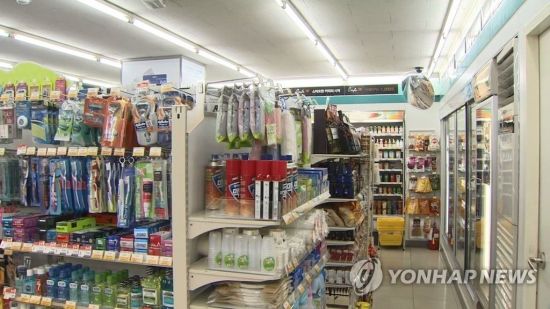 Many convenience store part-time workers are still subjected to abusive language and power harassment. The photo is not related to the specific content of the article. Photo by Yonhap News
[Asia Economy Reporter Han Seung-gon] "Actually, such incidents are so common that I hardly get angry anymore."
On the 13th, footage was released showing Shin Hye-sung (43, Jeong Pil-gyo), a member of the group Shinhwa, who was arrested on suspicion of refusing a breathalyzer test, stopping by a convenience store just before getting behind the wheel in a heavily intoxicated state.
According to the closed-circuit television (CCTV) footage released by KBS and others on that day, Shin entered a convenience store in Sujeong-gu, Seongnam City, on the morning of the 11th with a cigarette in his mouth. Staggering due to intoxication, he purchased a lighter and snacks with cash. When the clerk handed him the change, Shin bowed his head in thanks.
As this scene was revealed through media reports, convenience store part-timers expressed their frustration. This is interpreted as anger stemming from experiencing abusive behavior such as being spoken to informally or verbally abused while working part-time at convenience stores.
Kim, a man in his 30s who has experience working part-time at convenience stores, said, "There are many people who not only use abusive language but also throw money on the counter," adding, "Seeing (Shin Hye-sung smoking a cigarette in the convenience store) reminds me of the past and stresses me out."
Choi, another office worker in his 30s with part-time convenience store experience, also expressed frustration, saying, "Once, I saw someone vomiting in the convenience store and acting as if it was normal, which stressed me out."
◆ 'Disrespecting Personality,' 'Taking Out Anger'... When Will Abusive Behavior Toward Convenience Store Part-Timers End?
The anger of MZ generation part-timers working at convenience stores is also evident in statistics. Eight out of ten MZ generation part-timers reported having experienced so-called 'gapjil' (abusive behavior) from customers. The most common type was informal speech, but many also experienced disrespect and venting of anger.
According to a survey released on the 12th by 'Alba Heaven,' a job portal specializing in part-time jobs, 79.2% of 1,652 MZ generation respondents who have part-time experience or are currently working said they had experienced abusive behavior from customers.
By type, 'informal speech' was the highest at 56.7%. Next was the 'reckless' type, who ignore store manuals and demand unreasonable requests at 48.3%, followed by the 'twenty questions' type, who do not clearly state their demands and make the part-timer ask repeatedly, at 39.8%.
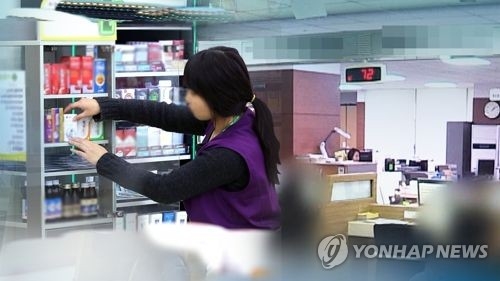 Convenience store part-timers viewed the use of informal language and disrespectful behavior as abuse of power. This is unrelated to the specific content of the article in the photo. Photo by Yonhap News
The types of abusive behavior that hurt part-timers the most showed slightly different patterns. While informal speech was still the highest at 22.5%, 'disrespecting personality' and 'venting anger' accounted for 13.6% and 12.5%, respectively.
MZ generation part-timers were called by various titles on the job. The most common was "Excuse me" or "Hey there," at 76.8%. This was followed by "Boss" at 46.9%, "Agassi" (Miss) at 43.6%, "Unni" (older sister) at 34.2%, "Ya, Eoi" (Hey, you) at 24.9%, and "Auntie" at 20.2%. Among these, "Ya, Eoi" was the most disliked title at 67.1%. Next were "Ajumma" (Ma'am) at 9%, "Agassi" at 6.2%, "Ajusshi" (Mister) at 5.2%, and "Jagiya" (Honey) at 3.5%.
The way MZ generation part-timers respond to abusive behavior is not much different from older generations. The most common response was the 'parrot type,' who only repeats the manual, at 41.5%. Next was the 'apology type,' who apologizes to the customer, at 34.6%, followed by the 'endurance type,' who just tolerates it, at 24.9%. Overall, they responded passively to abusive behavior.
In addition, crimes occurring in convenience stores continue unabated. According to the National Police Agency, the number of convenience store crimes increased annually: 13,548 cases in 2018, 14,355 in 2019, and 14,697 in 2020. Among these, violent crimes such as injury, assault, and threats accounted for 2,368 cases in 2020. A survey conducted by the Alba Union targeting convenience store part-timers found that 67.9% of respondents had been exposed to violent situations. Considering the overall situation faced by convenience store part-timers, there is a risk of both abusive behavior and criminal victimization.
Experts analyzed that ultimately, awareness improvement is necessary. Oh Yoon-sung, a professor in the Department of Police Administration at Soonchunhyang University, said, "There is still an atmosphere that 'the customer is king,'" pointing out, "'Because I sell you goods, you eat and live' is a form of abusive behavior." He added, "Anger over requests to wear masks is in a similar context. In fact, it is a mutually complementary relationship, but it also shows a kind of superiority complex, and mutual respect is necessary."
© The Asia Business Daily(www.asiae.co.kr). All rights reserved.
![Clutching a Stolen Dior Bag, Saying "I Hate Being Poor but Real"... The Grotesque Con of a "Human Knockoff" [Slate]](https://cwcontent.asiae.co.kr/asiaresize/183/2026021902243444107_1771435474.jpg)















