8 out of 10 Small Business Owners "Have Experienced Review Damage"
Seoul, Gyeonggi, and Other Local Governments Launch 'Public Delivery Apps' for Win-Win
Experts Say "Delivery Apps Must Lead Changes in Review Methods"
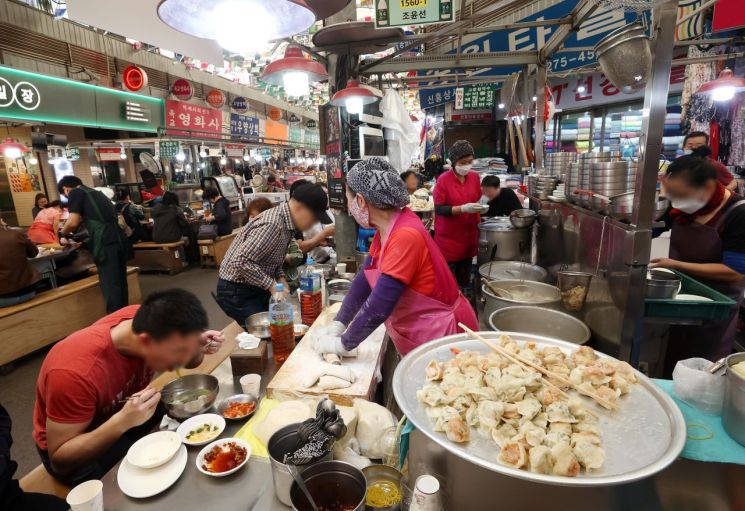 The photo shows Gwangjang Market in Jongno-gu, Seoul, taken on April 28, and is not related to the specific content of the article.
 [Image source=Yonhap News]
[Asia Economy Reporter Park Hyun-joo] Some self-employed business owners are experiencing difficulties due to unreasonable demands from certain consumers. However, they lament that they have no choice but to reluctantly accept these unreasonable requests from consumers. This is because about 70% of their total sales come from delivery apps, and if they do not comply with consumer demands, they may suffer so-called "star rating terrorism" or "review terrorism," which can negatively impact their sales.
Recently, a self-employed business owner A, who runs a gopchang (grilled intestines) restaurant, shared a story on an online community about how he responded to an absurd delivery request by canceling the order. According to his explanation, the customer wrote in the delivery request section, "The child is sleeping, do not press the doorbell under any circumstances, knock and send a photo. Refund if the child wakes up." After canceling the customer's order, A firmly told the customer, "Please do not order again."
In addition, on the online community "Apeunikka Sajangida" (Because It Hurts, I'm a Boss), where self-employed business owners gather, many stories can be found about their struggles with ridiculous delivery requests. On the 29th, a story was posted about a customer who ordered malatang (spicy Chinese hot pot) and demanded more than the standard amount, saying, "It's cheaper at the supermarket." B, a self-employed business owner selling Chinese food such as malatang, shared a photo of a receipt with a request to "add more dried tofu and vegetables" and the comment "It's cheaper at the Chinese supermarket." B lamented, "There was a customer who asked for a lot of bean sprouts in malaxiangguo (spicy stir-fried dish). That customer left a 2-star rating, complaining why I didn't give them bean sprouts when a large bag costs less than 2,000 won at the mart."
If consumers post false reviews or give low star ratings that harm business operations, they can be punished for obstruction of business. However, self-employed business owners say it is difficult to refuse unreasonable demands because consumer star ratings and reviews greatly affect sales. According to a survey conducted by the Korea Consumer Federation in December last year targeting 500 men and women aged 20 or older with online shopping experience, 97.2% of respondents said they check reviews before purchasing.
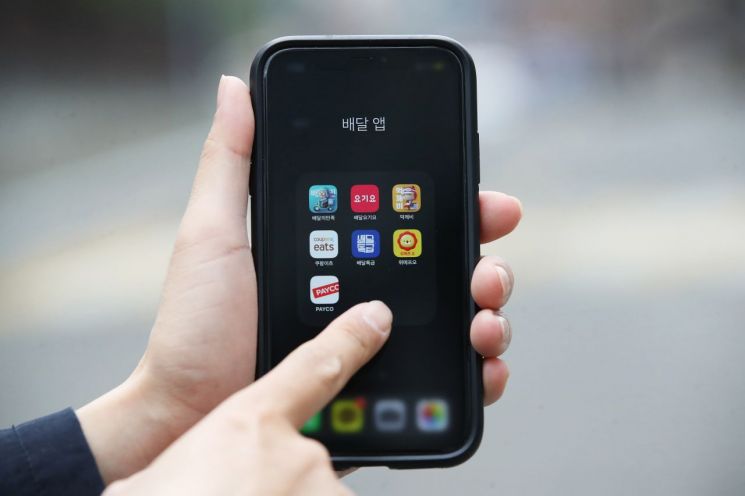 Some local governments have launched public delivery apps to promote coexistence between consumers and small business owners. The photo is unrelated to the specific content of the article. [Image source=Yonhap News]
Eight out of ten small business owners reported experiencing damage related to consumer reviews. According to the "Delivery App Usage Survey" announced on the 21st by Koo Ja-geun, a member of the National Assembly's Industry, Trade, Energy, Small and Medium Enterprises Committee from the People Power Party, 78% of small business owners responded that they had experienced damage due to delivery app reviews. The reasons for damage included ▲shifting consumer faults onto the restaurant (79.0%) ▲unjustified negative evaluations (71.7%) ▲unreasonable service demands backed by reviews (59.7%), among others.
In response, some local governments have launched public delivery apps. Seoul's "Zero Delivery Union" and Yeosu's "Meokkebi" have lowered delivery brokerage fees and reduced platform entry barriers for small business owners. In particular, Gyeonggi Province's "Baedal Teukgeup" changed its review function to a phrase selection type (responding by selecting applicable evaluation phrases presented in the app) to preemptively block indiscriminate malicious reviews and protect self-employed business owners. However, the market share and awareness of public delivery apps remain low, and they have not replaced existing delivery apps. In the "Delivery App Usage Survey," 97.1% of businesses not using public delivery apps cited low awareness and other reasons for having no intention to use them in the future.
Experts urge delivery platforms to take the lead in changing review methods and establishing protection measures for self-employed business owners. Professor Eun-hee Lee of Inha University's Department of Consumer Studies said, "It is necessary to seek changes by referring to various review methods used by domestic and international companies, such as phrase selection and mutual evaluation (where self-employed business owners and users evaluate each other)." She added, "Also, awareness should be raised through campaigns and other methods to prevent some customers from abusing consumer rights."
© The Asia Business Daily(www.asiae.co.kr). All rights reserved.
![Clutching a Stolen Dior Bag, Saying "I Hate Being Poor but Real"... The Grotesque Con of a "Human Knockoff" [Slate]](https://cwcontent.asiae.co.kr/asiaresize/183/2026021902243444107_1771435474.jpg)
















